On 30 July, InnoLight rang the bell in Hong Kong, raising 53.4 billion HK dollars, about 6.8 billion US dollars, with greenshoe. The issue price was 980 HK dollars. Its A-share fell 9.15 per cent that day and the Hong Kong debut closed down 2.04 per cent, breaking issue on day one.
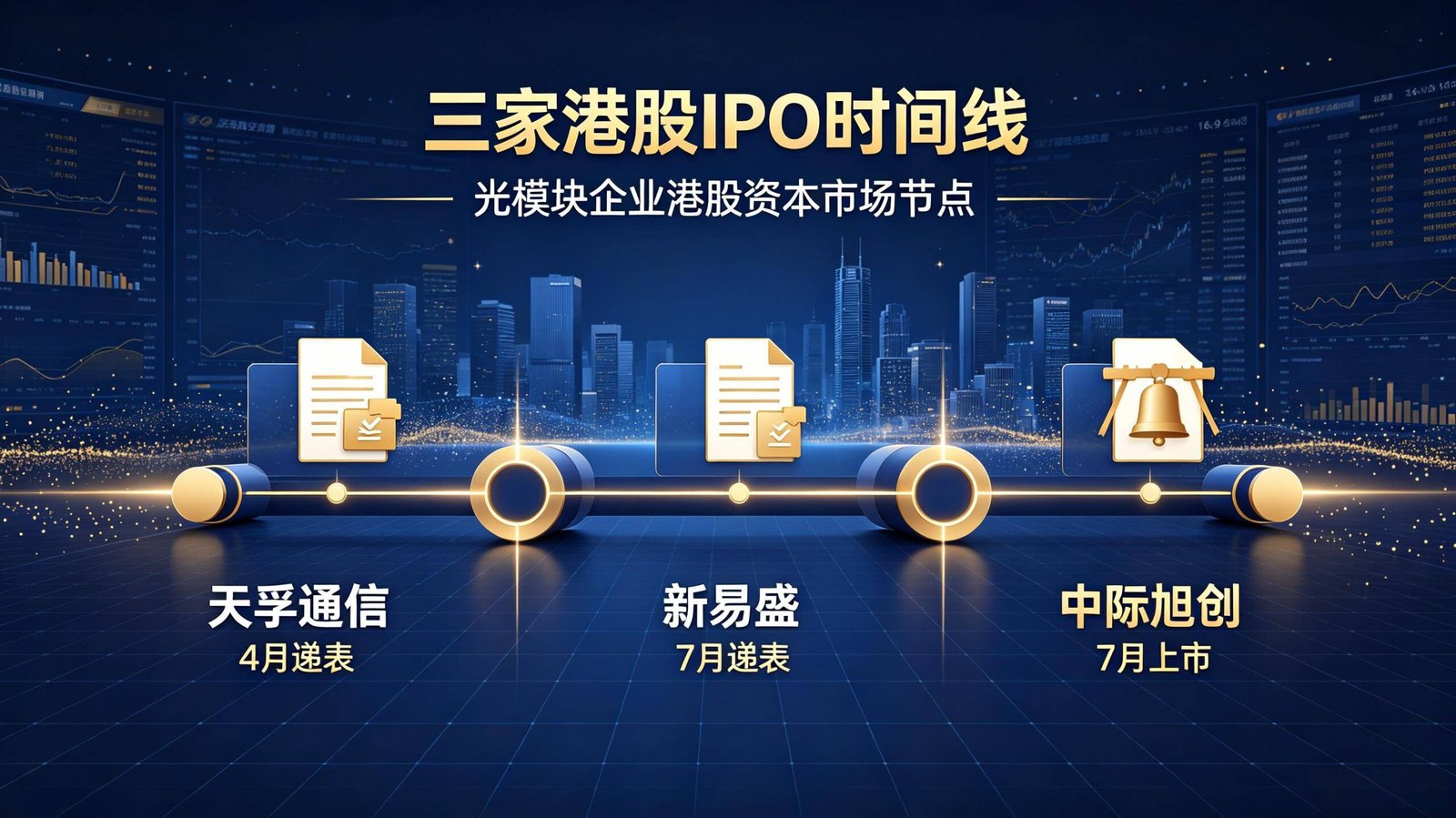
Yet the queue only grows. Eoptol flagged an H-share in June, secretly filed in July, and is rumoured to seek 4 to 5 billion US dollars. TFC filed in April with a 1.2 to 2.0 billion estimate. The three, nicknamed Yizhongtian, total about 14 billion US dollars combined. Beyond them, Cambridge, YOFC, Luxshare and others have listed, while Yuanjie, DSBJ and HGTECH are filing. Half of China’s optical-communications roster is now in the window.
The use of proceeds is telling: 35 per cent to research, 30 per cent to capacity, 15 per cent to upstream mergers, 10 per cent to supply chain, 10 per cent to working capital. None goes to repaying debt or wealth management.
The cash story explains the rush. In 2025 operating cash flow looked strong, InnoLight at 10.9 billion yuan, up 244 per cent, Eoptol at 7.7 billion, up 1,101 per cent. But in the first quarter of 2026, operating cash flow across the group was only 2.8 billion against 10.5 billion in net profit, cash at just 27 per cent of profit. Inventories hit 39.9 billion yuan, up 64 per cent, prepayments tripled, and InnoLight’s cash fell from 12.2 billion to 6.9 billion yuan in two months.
The gap between release cadence and commercial cadence is the core problem. An 800G sample appeared in 2020 but mass use came in 2023 and stays mainstream through 2027. The 1.6T enters scale delivery only in 2025-26, with few stable suppliers. Chipmakers set the standards, module makers adapt.
Upstream rules are hard. Without large prepayments there is no production slot. Indium phosphide shortage tops 70 per cent, 200G EML above 60 per cent. Even top upstream firm Shijia Photons posted a 45 per cent profit rise in the first half yet negative operating cash flow, the whole chain fronts money.
The three pots of capital buy the same thing. About 19.1 billion HK dollars of research targets 1.6T optimisation, 3.2T prep and next-gen packaging, buying time. Some 8.2 billion goes to upstream deals, where localisation of fast optical chips is below 5 per cent and five Western firms hold 95 per cent. The rest buys position, roughly 50 million units of new annual capacity with an overseas base in Thailand, because customers are in North America, where four hyperscalers will spend 670 billion US dollars in 2026.
Thirty-three cornerstone investors took 3.45 billion US dollars, almost half the global offer, including Temasek, Hillhouse, BlackRock, ADIA, Tencent and Alibaba. That is real money placed before listing. The break is the market pricing the uncertainty of turning fuel into definition power, not a broken thesis. In the first half of 2026, Hong Kong IPOs passed 176.5 billion HK dollars, with hard tech near 129.3 billion, an industry wave, not a one-off.
Will optical modules return to the 40x tech-stock multiple? They will not disappear, but they may stop being tech stocks. The money still earns, yet the valuation lens must change. Buying back pricing power is harder than losing it, and chipmakers still set the rules.
Editor’s note: This is a translated adaptation of a Chinese-language report from Sohu Tech (sohu.com). Figures, dates and direct quotations are reproduced as published.