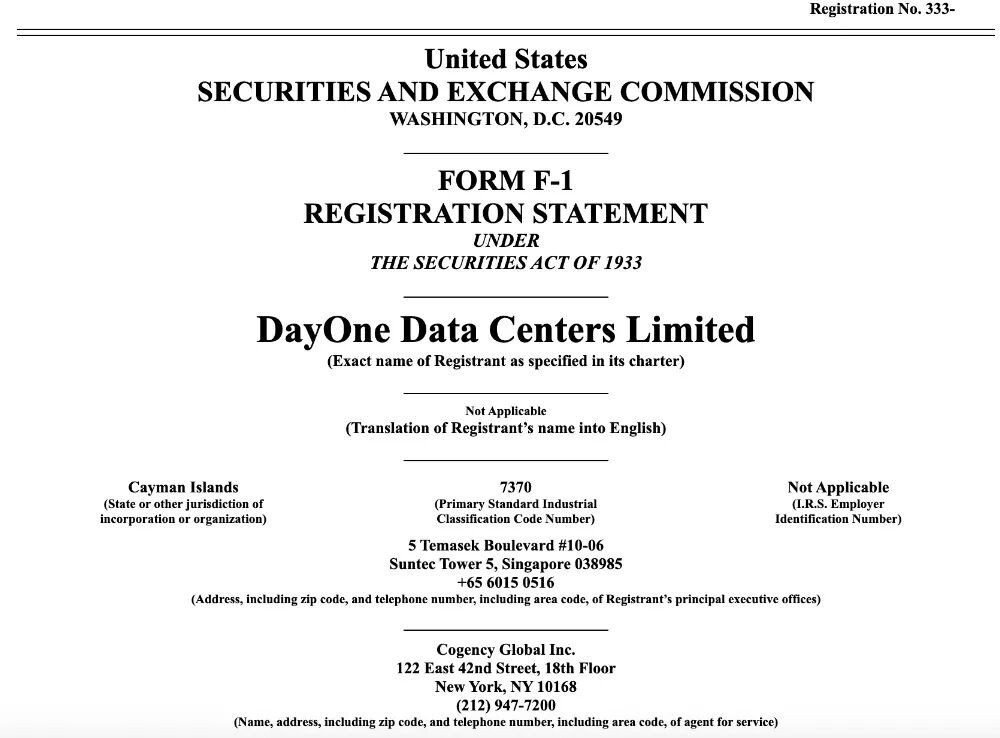
DayOne Data Centers filed its Form F-1 registration statement with the US Securities and Exchange Commission in recent days, aiming for a Nasdaq listing inside 2026. The Singapore-based developer is targeting a raise of up to USD 5 billion, or roughly RMB 33.4 billion, at a potential valuation of about USD 20 billion, or RMB 133.6 billion, according to Reuters and other outlets.
Buried in the filing is the number that matters more than either: one unnamed customer produced close to 70 per cent of DayOne’s revenue in 2025 and again in the first half of 2026. The Information identified that customer as ByteDance.
A landlord business with one tenant
DayOne was incorporated in 2022 as the international arm of Chinese data centre operator GDS Holdings, and was spun out as an independent group on 1 January 2025. It builds and operates hyperscale campuses, selling space, power and cooling to cloud and AI tenants on 10 to 15 year take-or-pay contracts. Customers deploy their own IT equipment. DayOne runs the facility and carries the service level agreement.
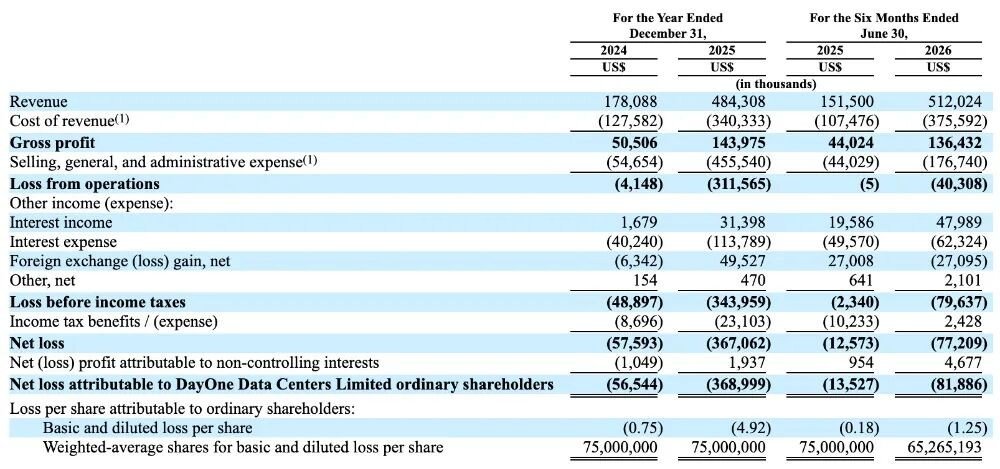
Revenue went from USD 178.0 million in 2024 to USD 484.3 million in 2025, growth of about 172 per cent. The first half of 2026 alone produced USD 512.0 million, up roughly 238 per cent year on year and already above the whole of 2025. Gross margin was 29.7 per cent in 2025 and 26.6 per cent in the first half of 2026, or 55.2 and 55.7 per cent on an adjusted basis.
It is still loss-making. Net loss reached about USD 367 million in 2025 and USD 77.2 million in the first half of 2026. DayOne attributes the widening to share-based payments and settlement costs from terminating customer support arrangements with GDS.
RMB 41 billion of equity in four years
The company has raised about USD 6.4 billion, or RMB 41.4 billion at current rates, in equity since 2022. Series A and B brought in USD 1.9 billion in 2024. Series C added USD 1.3 billion in 2025 and USD 3.2 billion in 2026.
Debt has been just as busy. On 5 November 2026 DayOne closed a HKD 1.86 billion bank loan, about USD 237 million, to refinance and expand a Hong Kong project. It raised MYR 15 billion of debt in June 2025 and another MYR 15 billion in October 2026, plus a mezzanine facility of up to EUR 1 billion in December 2025.
Dilution tells the story of a captive unit becoming a standalone company. GDS held about 52.7 per cent after the A round. It now holds about 19.4 per cent. Coatue and entities linked to Hillhouse hold about 19.5 per cent each and are joint largest shareholders.
The Singapore-Johor-Batam corridor
DayOne’s differentiator is what it calls the SIJORI cross-border model, stitching Singapore’s connectivity and low latency to Johor’s cheaper land and power and Batam’s room to expand into a single regional platform. On booked capacity it claims about 33 per cent of the Singapore, Johor and Batam market.
As of September 2026 the company had about 962 megawatts in service, about 1,328 megawatts under construction, about 2.3 gigawatts booked by customers and about 4.6 gigawatts of total resources across 10 markets, including Singapore, Malaysia, Indonesia, Thailand, Hong Kong, Japan, Finland and Spain. Modular prefabrication compresses delivery to between 8.5 and 12 months, which DayOne says is 20 to 30 per cent cheaper than the average of AirTrunk, Equinix and Digital Realty.
The ByteDance relationship dates to 2020, when GDS won the account. It deepened as TikTok Shop expanded across Southeast Asia, where user spending more than quadrupled in 2022. By September 2026 ByteDance had committed to 838 megawatts across DayOne sites in Malaysia, Thailand and Finland for video delivery and e-commerce processing. In contracts signed for 2027 onward, ByteDance falls to less than 50 per cent of total commitments.
Oracle is the second client at about 15 per cent of first-half 2026 revenue. The top two together account for close to 85 per cent.
Why the timing is uncomfortable
DayOne is listing into a rout in the neocloud sector. Shares in CoreWeave and Nebius fell about 20 to 25 per cent in a single week. Australia’s Firmus abruptly withdrew its IPO. Britain’s Nscale ran into delays and customer contract risk. DayOne is closer to a traditional hyperscale landlord than to a GPU cloud, but the concentration profile is the same shape, and so is the capital intensity.
The filing also discloses an unusual side project. In March 2026 DayOne, Cortical Labs of Melbourne and the National University of Singapore’s medical school announced a biological data centre prototype using human stem cell derived neurons as compute. The system went live on 16 July 2026, drawing roughly 850 to 1,000 watts per rack.
Two questions now sit in front of investors: whether a single tenant can be converted into a diversified base before 2027 contracts roll over, and whether 15 year take-or-pay paper survives contact with a customer that is itself under political pressure in Washington.
Editor’s note: This is an adapted translation of the original 36Kr report. It has been trimmed and restructured for readability for an international business audience. The full original (in Chinese) is at https://36kr.com/p/4062388598461318.