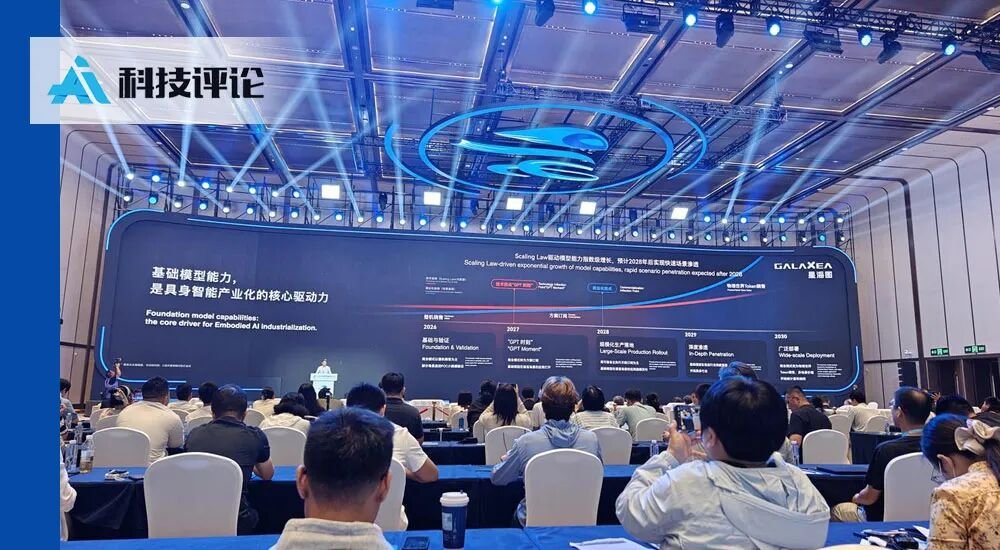
At WRC 2026, Galaxea co-founder Gao Jiyang argued that the ultimate business model for embodied AI is selling “physical-world tokens”, the way OpenAI bills developers per text token today. In his telling, robot hardware eventually becomes a negative-margin vehicle whose only job is to put more endpoints into the real world to consume model tokens.
Galaxea positions itself as an “embodied brain” company. Its base model uses a single autoregressive architecture that unifies zero-shot generalisation, universal grasping and long-horizon tasks. Through distributed fleet reinforcement learning, it lifts pre-trained centimetre-level control to millimetre or sub-millimetre precision and pushes task success to 99.9 per cent.
Gao offered a sharp commercial translation of a research word: “Generalisation is essentially training cost.” A robot that needs endless retraining has low generalisation and high cost. Galaxea currently needs about ten hours to post-train a new long-horizon task and wants to compress that to one hour within a year.
The economics ladder upward: sell hardware at 40 to 60 per cent gross margin now, move to solution subscriptions near 20 per cent, then to token sales where the box may run at a loss. Galaxea’s “1 plus 3 plus N” strategy spans e-commerce, manufacturing, logistics and services, with wheel-arm, biped and open-developer product lines.
Editor’s note: This is an adapted translation of the original Leiphone report. It has been trimmed and restructured for readability for an international business audience.