The 200-company warning
Zhu Xiaohu, managing partner of GSR Ventures, used a two-hour talk at Peking University’s innovation school to warn that China now has more than 200 robot companies, many able to dance or throw punches, but few running a real business, and that most may not survive ten years.
The line lands because it follows an earlier one. Months ago Zhu trended for saying he was exiting humanoid-robot startups in bulk, after asking their founders who would actually pay six figures for a robot to do the jobs they demoed. A founder fired back that questioning a newborn by what it cannot yet do is beneath someone of Zhu’s standing, but at Peking University Zhu’s tone was firmer and his logic, to many investors, more complete.
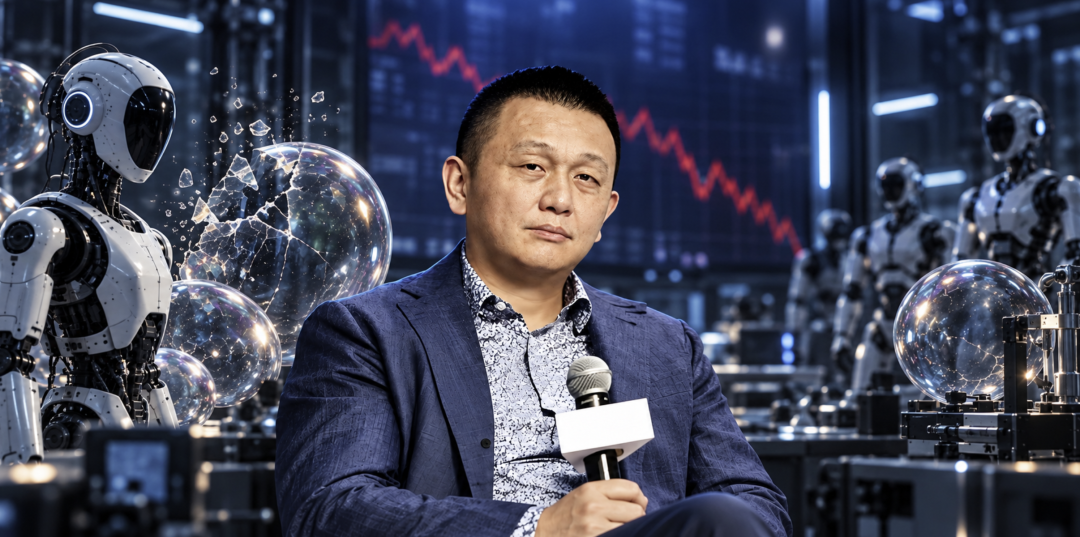
His core point is that robotics is moving from can it be built to will anyone keep paying. A demo proves nothing about unit cost, failure rate, upkeep or payback. He urges startups toward tasks with clear boundaries and measurable demand, such as underwater cleaning, warehouse sorting and flexible arms, and warns that a customer shown a good prototype can become a competitor once the technology diffuses.
Three different businesses, not one market
Zhu’s sharper insight is that lumping industrial, humanoid and service robots into one huge market number clouds judgement. The three are at very different stages.
Industrial automation is mature. The International Federation of Robotics put global industrial-robot installations at about 542,000 in 2024, with China at roughly 295,000, or 54 per cent of the world, and China’s installed base above 2 million units with local makers holding a 57 per cent share. That is a business with real customers, lines and delivery records.

Humanoids and embodied systems are still being validated. Reuters, citing the federation, reported about 7,000 humanoid units sold globally in 2025 for industrial and professional-service use, a fraction of the 542,000 industrial installs, with many bought by research bodies for AI training and car-factory pilots still in the single to low double digits.
Specialised and service robots, from underwater cleaning to warehouse sorting and patrol, draw less attention but usually find a paying party sooner.
Where the money actually is
GSR itself has backed embodied-intelligence and robot names including Xinghai Tu, Songyan Dynamics, Flexiv, Xijue and Nimble Robotics, and it exited Xinghai Tu’s angel round within a year. Zhu has said he favours industrial robots and robots that actually work, and GSR has funded Shihang Intelligent, which began with underwater hull cleaning and extended to customs inspection, offshore solar cleaning and aquaculture, the same logic of solving one paid problem then copying it outward.
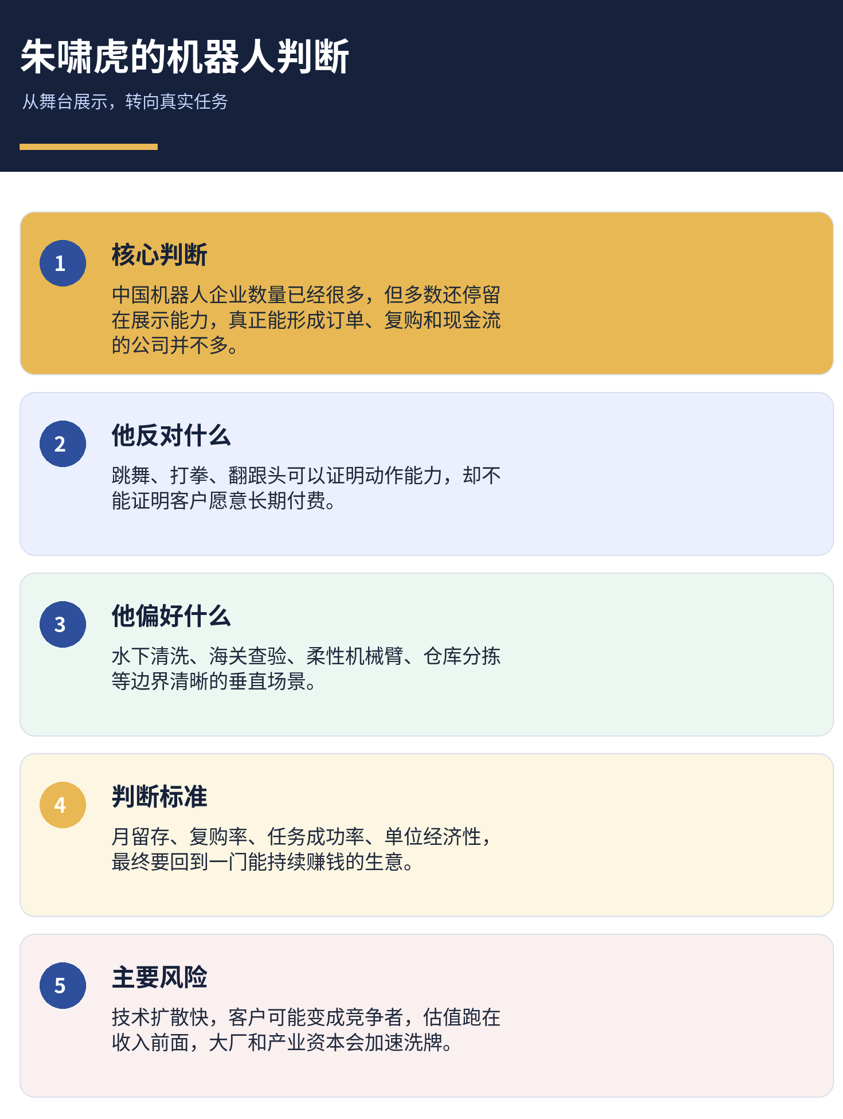
Public financials temper the hype. Inovance’s breadth means it is not a pure humanoid play. Estun turned profitable in 2025 but margins are thin. Siasun still loses money on large revenue, and UBTECH’s full-size embodied revenue grows fast while remaining in the red. The China Electronics Society now lists task success rate, efficiency gain, safety and economic feasibility as the metrics that matter, signalling a shift from prototype shows to real-post appraisal.
What it means for incumbents
The policy push reinforces the trend. The Ministry of Industry and Information Technology is steering deployments toward typical manufacturing and livelihood scenarios, and a 2026 real-world training programme stresses genuine settings, real-machine data and batch roll-out. The line of the sector is sharpening from does it look human to can it do the work steadily.
For European manufacturers and investors, Zhu’s framework is a useful filter. It separates a profitable, decades-old industrial-automation market from a humanoid wave that is still hunting for its first durable customer, and it reminds incumbents that the Chinese cost pressure showing up in industrial robots is real while the humanoid premium is not yet earned. The hard questions are not on any stage: how many hours a day the unit runs, who fixes it, what efficiency it adds, and whether the customer reorders in three years. Robotics is unquestionably a future industry, and Chinese suppliers took more than 97 per cent of global humanoid shipments in the first half of 2026, but scale in shipments is not the same as scale in paid, repeating work.
Editor’s note: This is an adapted translation of the original OFweek report. It has been trimmed and restructured for readability for an international business audience. The full original (in Chinese) is at https://robot.ofweek.com/2026-09/ART-8321202-12003-30704413.html.