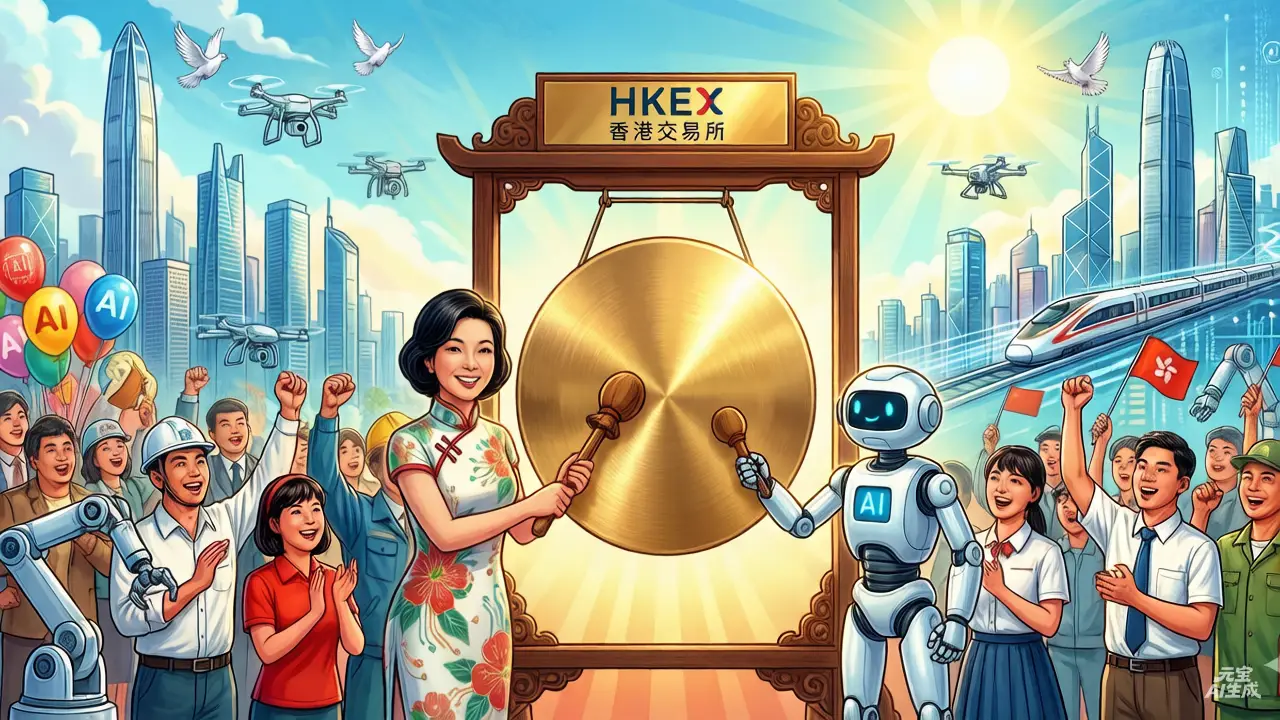
Is Hong Kong Dying? Or is it Rebirthing in Silicon?
Why the “Pearl of the Orient” is becoming the “Brain of the Robot Belt”
Reports of the city’s demise are exaggerated. For a glimpse of the AI future, watch the 13-minute train.
TO THE casual observer, Hong Kong’s recent narrative has been one of slow, sclerotic decline. The BBC, with characteristic British understatement, recently described the city as a mere “transit airport”—a glorified layover where mainland Chinese firms refuel with foreign capital before jetting off to global markets. The unspoken implication is clear: the Pearl of the Orient has become a hollow shell.
Yet, to stand on the floor of the Hong Kong Exchanges and Clearing (HKEX) is to witness a very different reality. The listings of MiniMax, Zhipu AI, and Biren Technology are not random acts of capital flight. They are the exhaust fumes of a high-performance engine. If the sceptics see a transit lounge, the smart money sees the “Robot Belt”—and the “Hong Kong-Shenzhen” nexus is its beating heart.
The 58% Factor
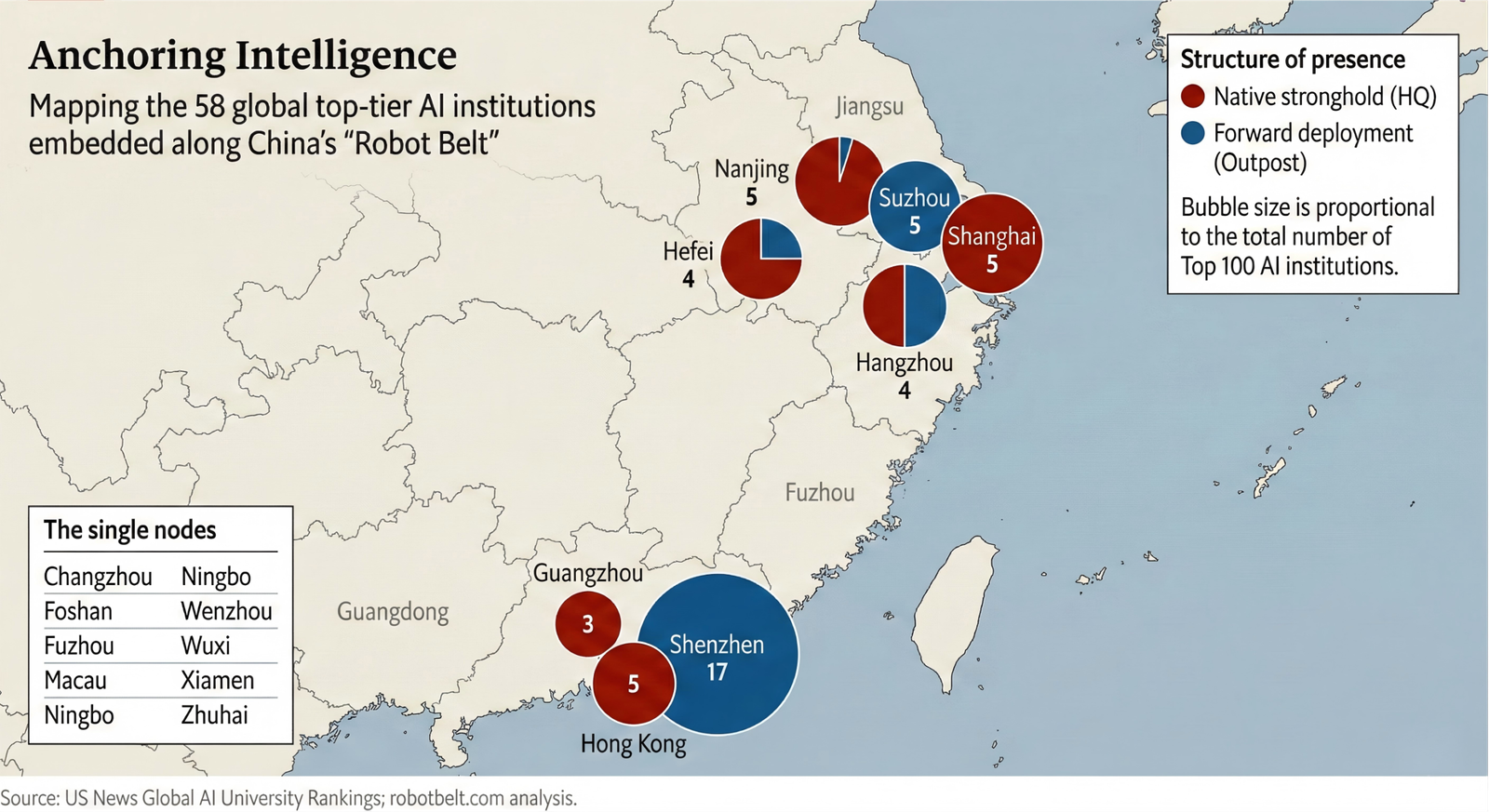
To understand why, one must look beyond the Hang Seng Index and at a map of global intellect. New data reveals a statistic that should give Western policymakers pause: 58%.
This is the share of the world’s Top 100 universities in AI research that are now physically anchored along China’s southeastern industrial corridor. But the real story lies in the density. Zoom in on the geography, and you find a “super-core” that defies historical precedent.
Separated by a mere 13-minute high-speed rail journey—shorter than the average commute in London or New York—lies Shenzhen. While politically distinct, Hong Kong and Shenzhen have effectively fused into a single metropolitan organism. Within this tight urban cluster, the concentration of brainpower is cliff-like in its dominance.
Shenzhen alone hosts 17 of the world’s Top 100 AI universities, effectively acting as a global “enclave” for academic resources. It is the southern landing strip for China’s academic giants—Tsinghua, Peking, and Harbin Institute of Technology all have graduate schools there—but also for Western royalty like Georgia Tech and UC Berkeley (via the TBSI partnership).
Add Hong Kong’s own 5 top-tier institutions to Shenzhen’s 17, and the math becomes staggering. This twin-city metropolis now accounts for more than one-fifth of the world’s elite AI and robotics research capacity. Nowhere else on earth does such density exist. Even Silicon Valley, for all its storied garages and sand Hill Road venture capital, cannot hold a candle to this sheer concentration of R&D infrastructure.
The Incubation Engine
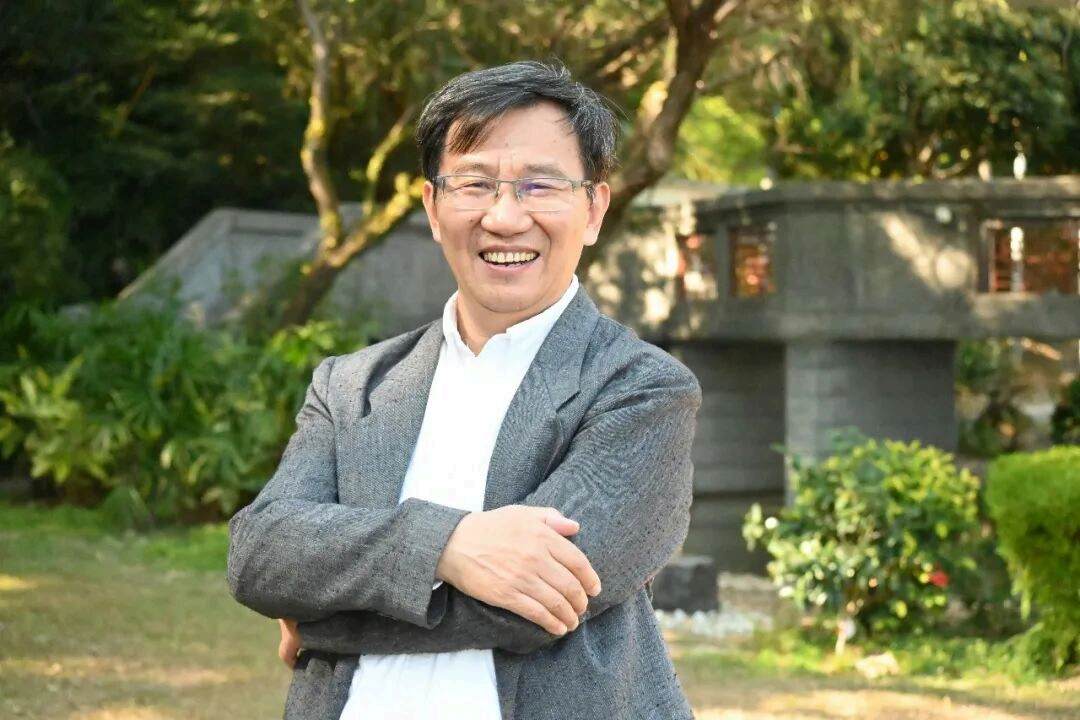
Professor Li Zexiang, the “Father of DJI” and architect of the XbotPark ecosystem.
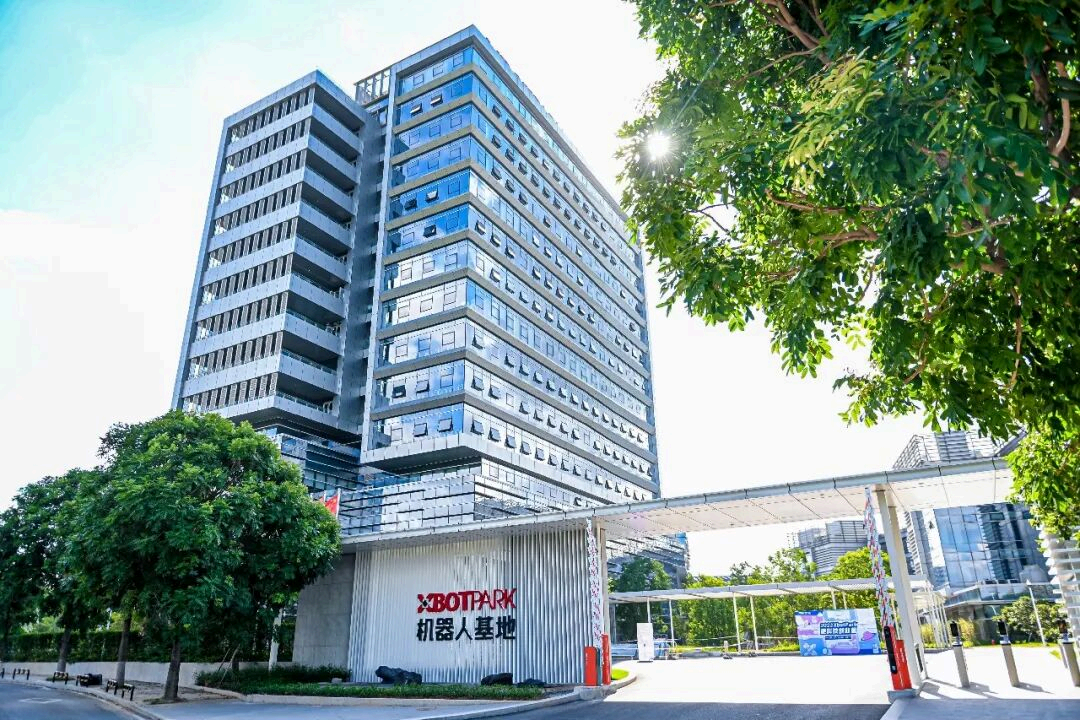
This academic hegemony has consequences. It was, after all, in a dorm room at the Hong Kong University of Science and Technology (HKUST)—one of those local five—that Frank Wang founded DJI. That was no fluke; it was the prototype for a pipeline now being industrialised by Professor Li Zexiang. Known as the “father of DJI,” Mr Li has established XbotPark, an incubator dedicated solely to robotics and AI.
At least six billion-dollar unicorns have already emerged from this endeavour, proving that this metropolitan cluster can turn code into hardware as deftly as it turns loans into bonds.
From Lab to Listing
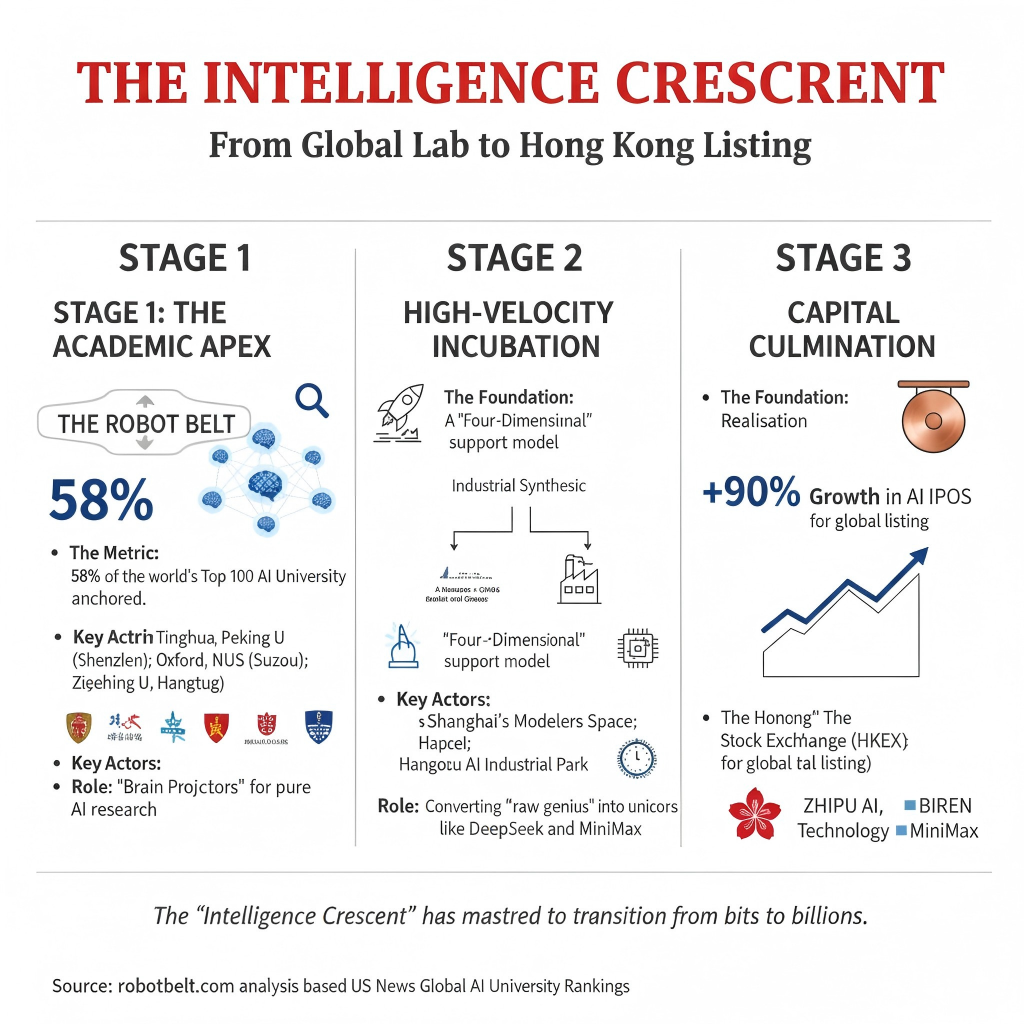
What is emerging is a master-class lifecycle that moves from the blackboard to the bourse at breakneck speed, as illustrated above:
- It begins at the “Academic Apex,” where that 22-university super-core provides the sovereign algorithms.
- It flows into “High-Velocity Incubation” hubs which offer a four-dimensional diet of mentorship, GPU clusters, proprietary data, and industrial orders.
- By the time these firms arrive in Central to ring the gong at the HKEX, they have been de-risked by the most intensive research network on the planet. They are not refueling; they are launching.
International observers scrutinising the surge of AI unicorns flocking to Hong Kong often miss the forest for the trees. They see a financial anomaly; the data shows an industrial inevitability. The “Robot Belt” has evolved into a self-sustaining Silicon Spine.
For global investors, the lesson is stark. The narrative of Hong Kong as a dying city is a lagging indicator. The leading indicator is the 13-minute train ride that connects the world’s densest concentration of AI intelligence. If you wish to buy into the automated future of the world, you had best stay in Hong Kong. The transit airport, it turns out, is the most efficient engine in the East.
Data Brief: A tale of two bays
Why the “Silicon Spine” is stiffer than the Valley
The most striking divergence between the San Francisco Bay Area and the Hong Kong-Shenzhen Metropolis is not market cap, but the density of “minds per square mile.”
| Metric | The Bay Area (SF & Silicon Valley) | The HK-SZ Super-Metropolis | The Economist’s Take |
|---|---|---|---|
| Top 100 AI Universities | ~4 (Stanford, Berkeley, UCSC, SJSU) | 22 (17 in Shenzhen + 5 in Hong Kong) | The Cliff: While the Valley relies on two giants, the HK-SZ nexus operates as a “World University City.” |
| The “Output” | Disembodied Brains (Chatbots, SaaS, LLMs) | The Full Stack (Brain + Body) | The Integration: HK-SZ integrates the Brain (Algorithms) directly into the Body (Robotics/EVs). |
| Connectivity | 60+ mins (Car/Caltrain) | 13 mins (High-Speed Rail) | The Friction: In HK-SZ, the “border” is faster to cross than a rush-hour drive from Palo Alto to SF. |