Huawei’s rotating chairman has written his own company’s history in an American magazine, and the most revealing number in it is a consulting invoice. Between 1997 and 2006 the company paid IBM nearly USD 600 million in fees.
The article
TIME published a first person piece by Eric Xu under the heading “Inside Huawei’s innovation journey: seeing it, living it, leading it”. It runs as paid partner content, and it tells the company’s story through one engineer’s career rather than through products or market share.
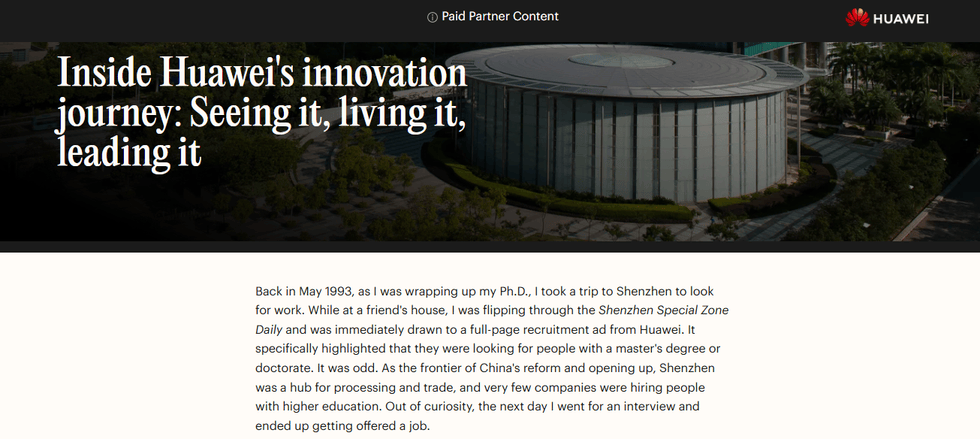
Xu joined in 1993, finishing a doctorate and answering a full page recruitment advertisement in the Shenzhen Special Zone Daily. What struck him was that a company in a city built on processing trade was advertising for master’s and doctoral graduates. Of 600 employees, more than 200 were R and D engineers and five had joined as PhDs that same year, when China produced roughly 2,000 doctorates annually.
The numbers that carry the argument
Western switches sold for about RMB 3,000 per line. Huawei’s fiber-connected remote switching module, designed for counties where a full exchange per village made no economic sense, sold for about RMB 1,000 per line at a margin above 20 per cent. Between 1993 and 2002 headcount went to 22,000, including more than 10,000 R and D engineers, and revenue approached USD 4 billion.
The R and D organisation went from 10,000 engineers then to 110,000 today. Ren Zhengfei commissioned the Integrated Product Development system after touring American technology companies in 1997, and IBM was hired to design and install it from 1999. Xu took over delivery in 2002, and describes the point of the exercise as replacing heroics with a system that could ship predictably.
Why this piece exists now
A Chinese company under American export controls has bought space in an American magazine to argue that it learned its management methods from American companies and paid them for the privilege. The story is factual, the framing is careful, and the audience is Washington as much as it is investors.
It is also an argument about where capability comes from. Huawei’s account of itself is that the moat is a process, bought for USD 600 million and refined for two decades, not a single product or a subsidy. Companies that buy tools but not process tend to find out about the difference at the second product generation.
The distributed base station, the article notes, came from a field visit in the Netherlands where Richard Yu saw that European site acquisition costs made conventional base stations unbuildable. The insight was local. The system that turned it into a product line was imported, and paid for.
Editor’s note: This is an adapted translation of the original Sohu Tech report. It has been trimmed and restructured for readability for an international business audience. The full original (in Chinese) is at https://www.sohu.com/a/1101207822_115479.