Twelve months is a short window to multiply a valuation by 4.3. Path Robotics did it in a category that most robotics investors had written off as too dirty, too manual and too dependent on human judgement.
The Columbus, Ohio company closed a USD 300 million Series E at a post-money valuation of USD 2.45 billion, about RMB 16.4 billion. Georgian, a growth fund focused on artificial intelligence, led the round. D.E. Shaw’s venture arm and NAVER Ventures joined as new investors. Georgian partner Emily Walsh took a board seat.
From USD 570 million to USD 2.45 billion
Forge’s funding records show Path closed a USD 67.11 million D-2 round in November 2025 at a post-money valuation of USD 570 million. Cumulative funding now exceeds USD 610 million, and annual recurring revenue is up 17-fold over eighteen months.
On the 2026 robotics funding tables, USD 300 million is not the largest cheque written. What makes it conspicuous is where it landed: a welding company, in the year American shipyards ran their worst welder shortage on record.

A garage, two brothers, and a father who welded
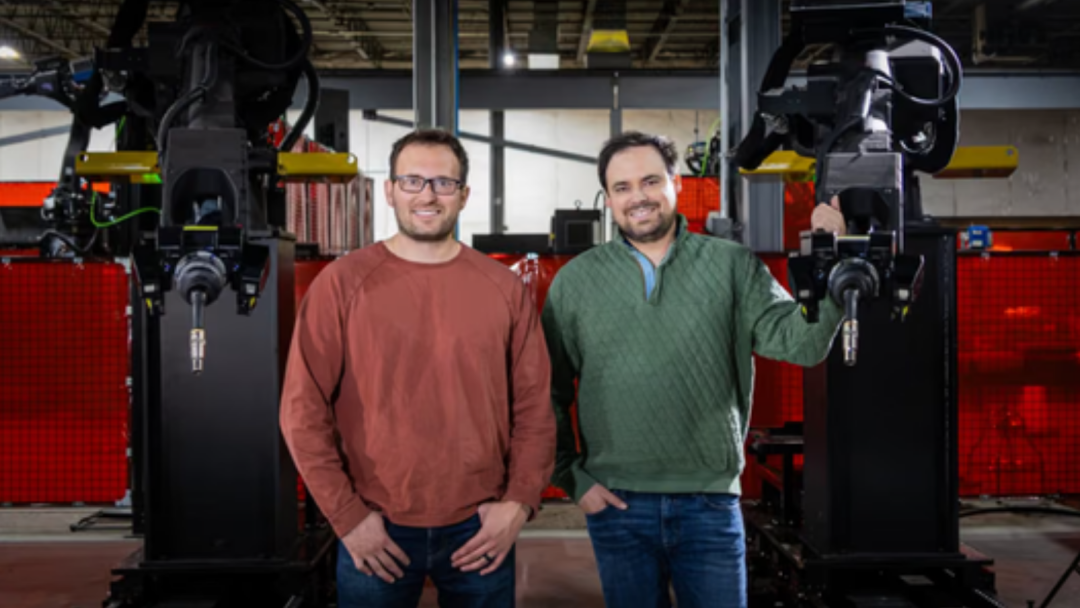
Andy and Alex Lonsberry are brothers. They learned welding working with their father and spent their weekends assembling off-road vehicles in his shop. Both went on to mechanical engineering doctorates at Case Western Reserve University, Alex completing his master’s work on the sensing side of the same problem.
The technical bet is a rejection of the fixture. Conventional robotic welding assumes the part arrives where the fixture says it will, to a tolerance the upstream process has to guarantee. In shipbuilding and heavy fabrication, that assumption fails routinely. The parts are large, the runs are short, and the gap between two plates varies from joint to joint.
Path’s systems scan the workpiece, locate the joint, generate the path and weld it. The value is not the arm. It is the sensing and the decision layer that lets an arm work on a part nobody measured precisely.
The labour shortage is the business model
American shipbuilding is the clearest case. The industry’s order book has recovered on naval and Jones Act demand, while the welder workforce has aged out faster than apprenticeship pipelines replace it. Yards cannot expand capacity by hiring, because there is nobody to hire.
That is the reason a welding company could raise at a software multiple. The buyer is not purchasing productivity. The buyer is purchasing the ability to accept an order it would otherwise have to decline.
The same logic explains the investor list. D.E. Shaw’s venture arm is a quantitative shop pricing a labour arbitrage with a measurable payback. NAVER Ventures brings an Asian strategic view, and Korea’s shipbuilders face the identical welder shortage with a far more concentrated industrial base.
What the round buys is deployment capacity: more cells in more yards, and the service organisation to keep them running. Industrial robotics fails on service, not on specification.
What the multiple is really pricing
Seventeen-fold ARR growth over eighteen months, on a base that was still small, is the kind of curve that invites a correction if it flattens for two quarters. Heavy fabrication is cyclical, and shipbuilding order books are political as much as commercial.
The deeper risk is the one every sensing-led robotics company faces: once the part tolerances are controlled upstream, the premium for adaptive welding falls. Path is betting that in shipbuilding and large-structure fabrication, tolerances will never be controlled upstream, because the economics of building a hull do not allow it.
For Chinese robot builders watching from the outside, the lesson is not about welding. It is that the highest multiples in 2026 went to companies that solved a specific, unglamorous, labour-constrained process, not to companies that demonstrated general capability.
Editor’s note: This is an adapted translation of the original OFweek report. It has been trimmed and restructured for readability for an international business audience. The full original (in Chinese) is at https://robot.ofweek.com/2026-11/ART-8321202-12005-30711491.html.