The embodied-intelligence sector has no shortage of robots that can deliver one flawless demo. What it lacks is robots that repeat a task ten thousand times in a real setting and still perform reliably.
PaXini says it has just closed a RMB 1 billion strategic round, lifting cumulative funding to nearly RMB 4 billion. The roster spans industrial capital, financial institutions, regional artificial-intelligence funds and market players. The lead investors include a global consumer-electronics and semiconductor leader, widely read as Samsung, alongside BOC International, the Kunpeng fund and Hexin Fangce; CDH Investments’ BaiFu unit, the Chengdu Jiaozi AI fund, Jingming Capital and Jinrong Guosheng also joined, with returning backer Zhilai Capital adding more.
At the same time PaXini has moved its headquarters to Beijing and completed a joint-stock restructuring. Three moves at once point to one judgement: the company has grown from a technology shop into an industrial system that can deliver ‘predictable robotic capability’ at scale.
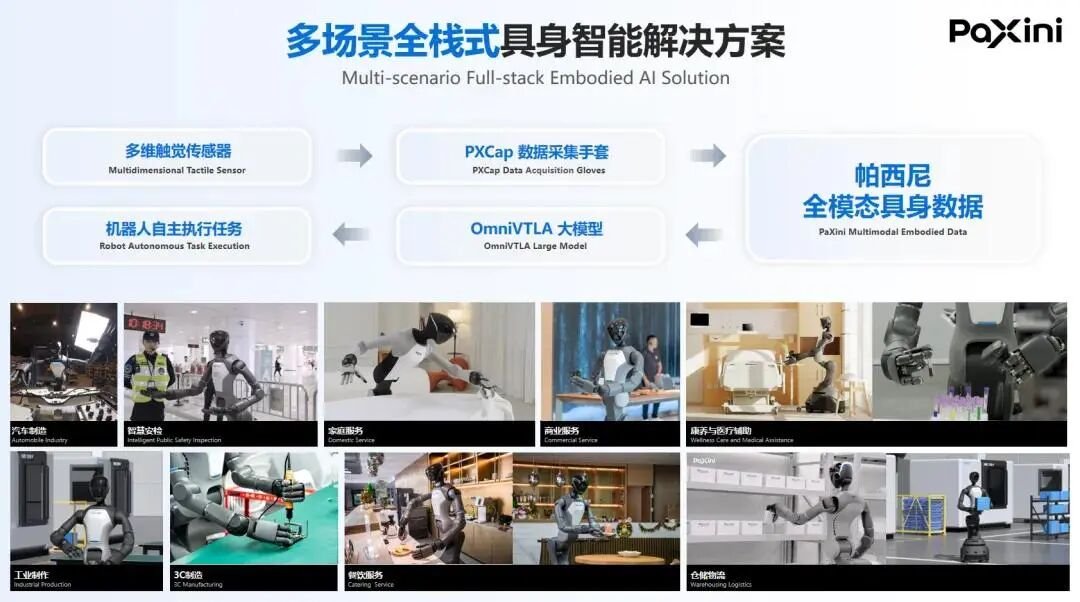
PaXini’s business already spans the whole embodied-intelligence chain. It builds tactile sensing, full-modal data collection, dexterous hands and robot bodies in parallel, closing the loop from perception to execution. That full stack is exactly what capital is betting nearly RMB 4 billion on: a system that takes robots from ‘can do it’ to ‘does it reliably’.
Embodied intelligence enters the ‘failure-pricing’ phase
For years the industry’s most shareable asset was the demo video. Whether a robot can grab an egg, fold laundry or slot a part decided how fast a company drew attention. But inside factories, warehouses and service sites the customer’s question changes: how many times can an action run before it fails? Does it still work on a different batch of material? How long does recovery take after a fault?
A demo answers whether a robot can do something. Commercialisation answers whether it can keep doing it. The gap lives in physical contact. A robot can see a cup’s position and shape yet cannot tell from one glance whether the wall is deforming or the liquid’s centre of mass is shifting; it can plan an assembly path yet may not know the misload the moment parts meet; it can recognise an object yet fumble it as friction changes. These are not rare edge cases. They are the everyday physics of the real world.
In software, one error means recompute. In a real robot, one error means damaged material, downtime, safety risk and a human stepping in. Once a mistake reaches the physical world, its cost compounds. That is why touch’s commercial value is feeding those contact changes back to the controller before failure happens.
Capital is buying stability, not specs
A robot that hits 99 per cent success on one task is not yet a product if that result holds only on one material, at one temperature, with one debugged setup. Industry needs performance across machines, batches and times of day to converge, compressing result variance into a manageable band. Call it a robot’s ‘variance convergence’.
Accuracy decides whether a robot reaches the right result; repeatability decides whether it repeats under identical conditions; long-run stability decides whether that ability survives material wear, temperature shifts and repeated handling. Together they decide not a lab spec sheet but whether a customer can forecast output, staff a line and model a payback period.
Take PaXini’s PX-6AX GEN3 fingertip product: the firm says it outputs up to 717 tactile channels at up to 1,000 Hz, with IP68 protection and over 10 million measurement cycles. Those figures matter only if they cut task variance, reduce human takeovers and lengthen stable uptime. Capital is not buying ‘717 channels’. It is buying the chance those signals make robotic outcomes more predictable.
The real value of ‘full stack’ is blame
Every embodied-intelligence startup loves the word full stack. To an investor, a long product line is not a moat by itself and can even scatter the organisation and inflate R&D. The version that pays is the ability to explain a failure. A failed grasp may come from sensor drift, finger stiffness, misaligned touch and joint data, a slow controller or a model that misread contact state.
PaXini runs tactile sensors, full-modal data, dexterous hands and robot bodies together. The part worth watching is not how many products it has but whether it can trace one failure down the whole chain: sensors record contact, the data system syncs touch, vision, joint state and motion, and the actuator tests the control policy. After a fault the firm can say whether the problem sat in material, structure, calibration, comms, model or control, and fix it precisely.
To capital that capability is the firm’s learning speed, not one product generation. With each failure does it keep reusable information? With each new scene does it cut the next deployment’s cost? With each added unit does the whole system get steadier? Over time those factors, not a single parameter, are more likely to separate the winners.
Editor’s note: This is an adapted translation of the original OFweek Robotics report. It has been trimmed and restructured for readability for an international business audience. The full original (in Chinese) is at https://robot.ofweek.com/2026-08/ART-898890-8120-30698082.html.