While most humanoid robots are still stuck in the demo-and-competition phase, Shenzhen’s embodied-intelligence machines have already moved into real production and service settings: logistics, transport, elderly care and domestic work. A dual-arm humanoid built by local firm WoNeng Juti (I Can Do) recently entered a commercial pilot on the parcel-sorting line at the Guangzhou Post export hub in Jianggao. China’s Foreign Ministry spokesperson Mao Ning promoted Shenzhen’s embodied-intelligence results on overseas social media, praising the city’s progress.
Humanoids deep inside physical production
On the Guangzhou sorting floor, the robot swings its arms to handle parcel feeding, waybill recognition and the sorting of damaged or anomalous items, all repetitive high-intensity work. Relying on its own multimodal perception and autonomous-decision technology, WoNeng Juti’s machine slots into the existing line without major retrofitting. At peak it feeds 1,200 parcels an hour and holds a stable rate of about 800 an hour, easing labour pressure and giving the industry a repeatable template for putting humanoids on real shop floors.
Public records show that since 2025 Mao Ning has highlighted Shenzhen robots four times, spanning transport and logistics, industrial operations, home services and physical sorting, signalling to the world how mature the city’s embodied-intelligence deployment has become.
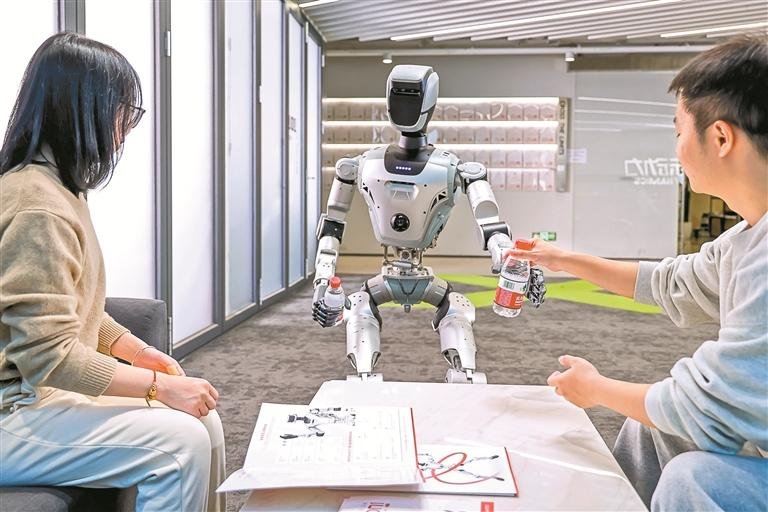
In July 2025, two Shenzhen robot videos went viral abroad. Shenzhen Rail Transit and Vanke built the world’s first metro-freight robot, using AI dispatch and panoramic lidar to ride the subway off-peak and deliver goods, a low-carbon model that drew international attention. UBTECH showed a self-swapping humanoid that docks in three minutes via a world-first hot-swap battery system, enabling round-the-clock work and solving the endurance problem. This July, a video of LimX Dynamics’ Oli doing housework spread across the Chinese internet; the firm’s self-developed three-layer “humanoid brain” links cognition, memory, planning, task dispatch and motion control so the robot flows through various household chores.
A growing tier of innovators
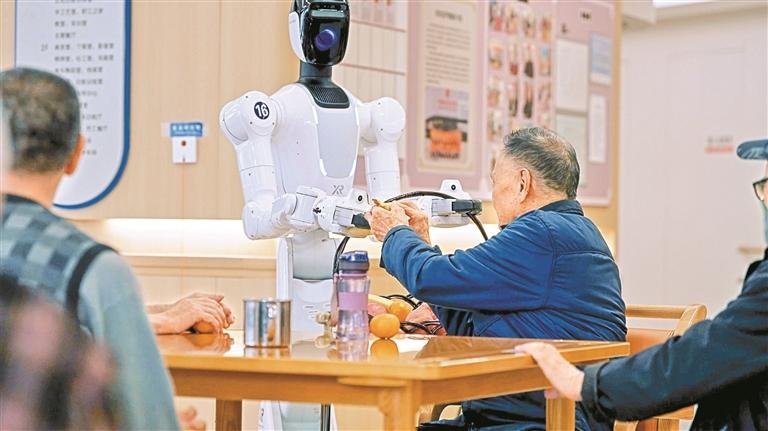
Zizheng (Autonomous) Robotics, an early mover in general embodied large models, launched WALL-B, what it calls the world’s first “world unified model”, fusing vision, touch, language and physical reasoning. After landing in Shenzhen the firm quickly iterated a home-service plan and, with a domestic-service platform, put its “0755” humanoid into a Shenzhen elderly-care home for a pilot. Zizheng has now closed four funding rounds, with a post-money valuation above 20 billion yuan, and its “robots into the home” project was the only embodied-intelligence case included in an Asia-Pacific digital-enablement casebook.
Local innovators now form a clear tier: LimX Dynamics, UBTECH, WoNeng Juti and Zizheng, among others, span industrial sorting, rail transit, home and domestic work, elderly care and smart operations, closing a healthy loop of “innovation, scenario validation, technology upgrade”.
A plan with teeth
Behind the boom is a clear top-level plan. Shenzhen’s 2025 to 2027 action plan for embodied-intelligence robotics targets, by 2027, more than 50 application scenarios at the 1-billion-yuan scale, related industry output above 100 billion yuan, and over 1,200 embodied-robotics cluster firms, building a leading industrial cluster at home and abroad.
Around that plan the city is combining technology breakthroughs, platform building and ecosystem cultivation: backing core parts, AI chips, bionic dexterous hands and base models; supporting Futian Lab and Guangming Lab; building an embodied-intelligence test ground and a provincial innovation centre; and forming an industry alliance with a global parts trading platform so Shenzhen robots reach the world.
Editor’s note: This is an adapted translation of the original Shenzhen News report. It has been trimmed and restructured for readability for an international business audience.