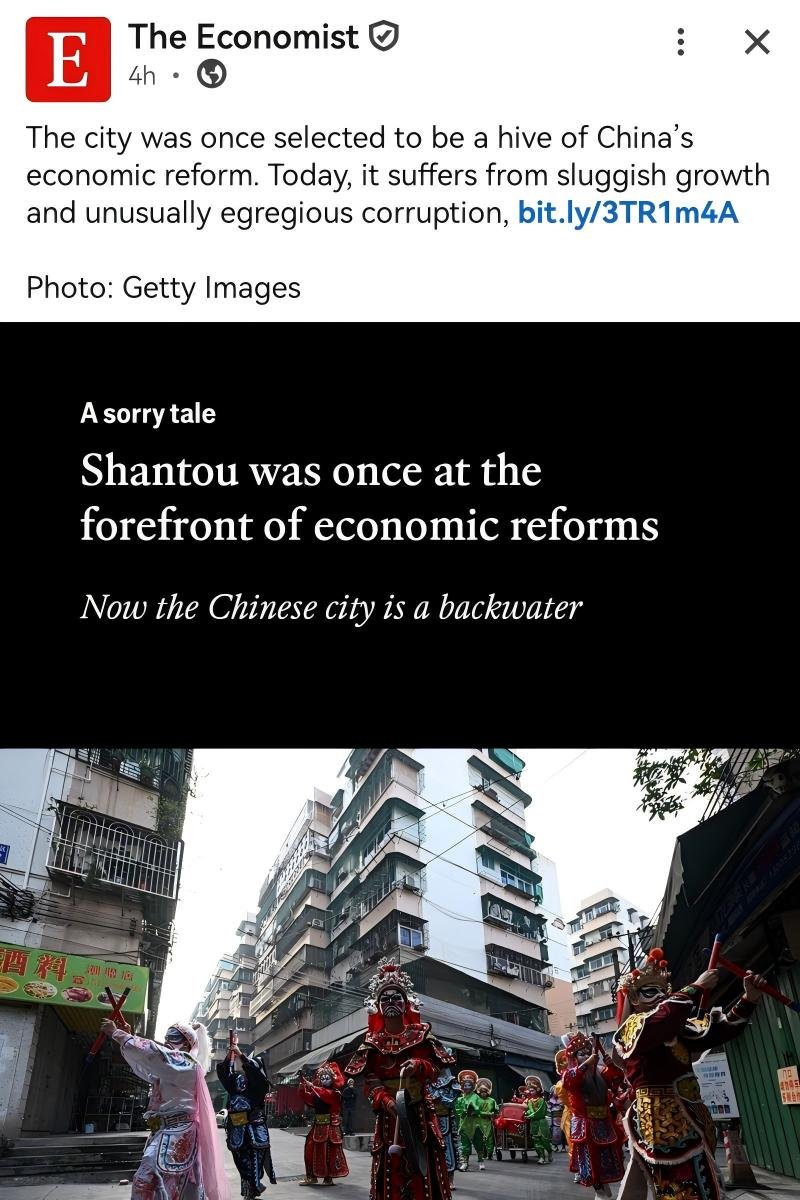
The Economist sent a reporter to Shantou to cover a hit film. What came back was an autopsy.
They are wrong about the patient.
The piece (”Bottom of the class”, July 23) declares Shantou the special economic zone that failed, the odd one out among four. GDP per person of 54,000 yuan. Growth of 0.1% last year. Property investment down 38.8%. Toys down 8.6%, garments down 18.3%.
All true. Every number checks out. And the frame built around them is false from the first paragraph.
Start with the control group.
The control group is fake
The article’s premise is simple: three SEZs flourished, one floundered. History disagrees.
Zhuhai spent decades as a backwater. In the 1990s it was borrowing from neighbouring Zhongshan just to pay its civil servants. It only revived when Shenzhen and Dongguan capital spilled west across the Pearl River Delta. Xiamen faced a Taiwan it could not reach. Before direct cross strait links opened in 2008, a Taiwanese businessman’s flight to Xiamen routed through Hong Kong. Macau was too small to power anything.
Do the arithmetic. Of the four zones, exactly one had a functioning capital tap: Shenzhen, glued to Hong Kong. The experiment did not produce three successes and one failure. It produced one success and three cities waiting for a neighbour.
Shantou is not the odd one out. Shenzhen is.
That is the first flaw. The second is what the article refuses to name.
The cause the article will not name
Jensen Huang, explaining China’s tech rise to Lex Fridman this year, put it in one sentence: “China is not one giant economic country. It’s got many provinces and cities with mayors all competing with each other.”
That distributed competition is the engine of China’s tech leap. Thirty years ago in Chaoshan, the same engine ran in reverse.
Chaoshan is one economic region. One dialect, one merchant network, one diaspora. In 1991 it was carved into three competing administrations: Shantou, Chaozhou and Jieyang. Three mayors now bidding against one another for the same factories, port traffic and diaspora money. Scale and hinterland fragmented overnight. The original zone covered 1.6 square kilometres.
The Economist mentions all of this. Then it blames the dialect.
Hold that thought. First look at the evidence. Look at the dates.
The 25 year old crime scene
The article’s evidence for present day corruption peaks in the year 2000, when graft busters sent by the central government died in a hotel fire. A quarter century ago.
That was a different country: Guangdong’s grassroots cadres climbed up from village party branches, and politics in parts of western Guangdong turned genuinely mafia like, with deputies accused of hiring hitmen against their own bosses. Today’s township cadres are university graduates, heavily engineering and science, recruited through examination. The corps has been replaced wholesale.
Citing a 2000 arson to grade a 2026 city is like citing Tammany Hall in a review of Bloomberg’s New York.
The corruption charge is an anachronism. The culture charge is worse.
The culture alibi
The article’s deepest claim is cultural: insularity, dialect and mistrust of outsiders.
But remittance towns across Guangdong shared the same qiaopi (侨批, “remittance letters”) fed rhythm: money arrived from overseas and life stayed unhurried. Southern Xiangshan, the soil Zhuhai was carved from, had it too, and Zhuhai was still rescued the moment real capital arrived.
Run the dialect test across all four zones. Xiamen speaks Hokkien. Zhuhai speaks Cantonese. Shantou speaks Teochew. None of the three is intelligible to a Mandarin speaker. And Shenzhen, the single success, runs the most fragmented dialect map of all: Teochew migrants, Hakka, Cantonese and Hunanese in one city. If dialect explained failure, the scoreboard would look very different.
Culture is the constant in this story. Geography and capital flows are the variables.
And on the dialect itself, the article does more than get the economics wrong. It betrays its own newsroom.
The dialect double standard
Western media mourns every dying dialect. Mandarin only schooling gets called cultural erasure. Yet here The Economist argues Shantou stayed poor because its dialect is “unintelligible to Mandarin speakers”.
Read that again. That is the Speak Mandarin Campaign’s logic, word for word. Singapore’s establishment has blamed dialects for economic backwardness for fifty years. The Economist has mocked Singapore’s nanny state for just as long.
When a dialect dies, it is a tragedy. When one survives and packs cinemas, it is an economic defect.
Pick a lane.
The misreading of culture is lazy. The misreading of capital is structural.
The capital the article could not see
For a century Teochew money moved through qiaopi linking Swatow (Shantou’s old treaty port name) to Bangkok, Singapore and Hong Kong. That network’s descendants include Li Ka-shing, Pony Ma and the founding family of Bangkok Bank.
Teochew capital is mobile. It flows wherever returns are. Low FDI into Shantou measures options, not poverty. Grading a Teochew city on FDI is like measuring a smartphone user by counting landlines.
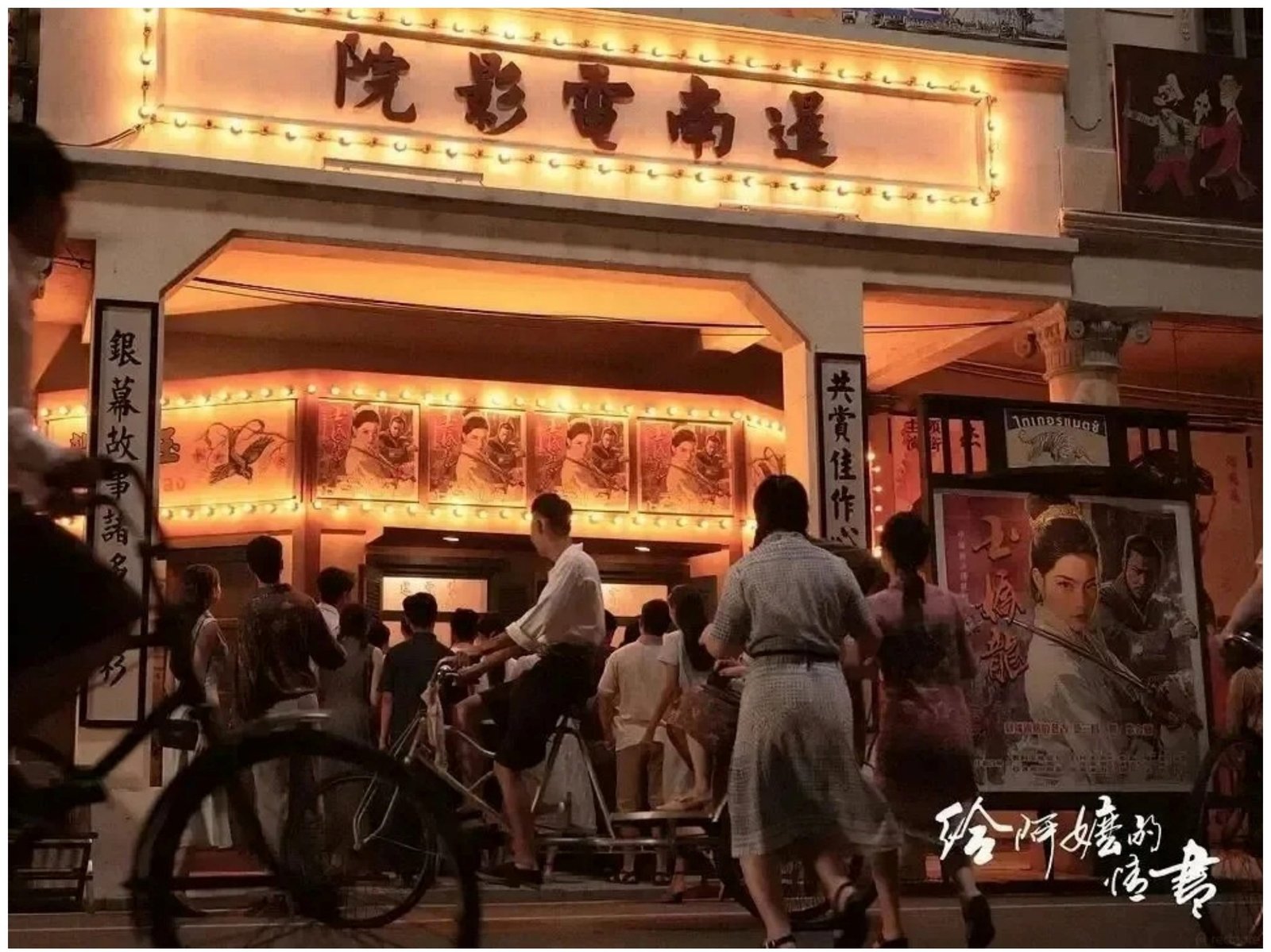
You can walk through the proof. The reporter did.
Even the buildings are mislabelled
The article praises the restoration of “crumbling colonial-era buildings”. Shantou was a treaty port and it was never a colony.
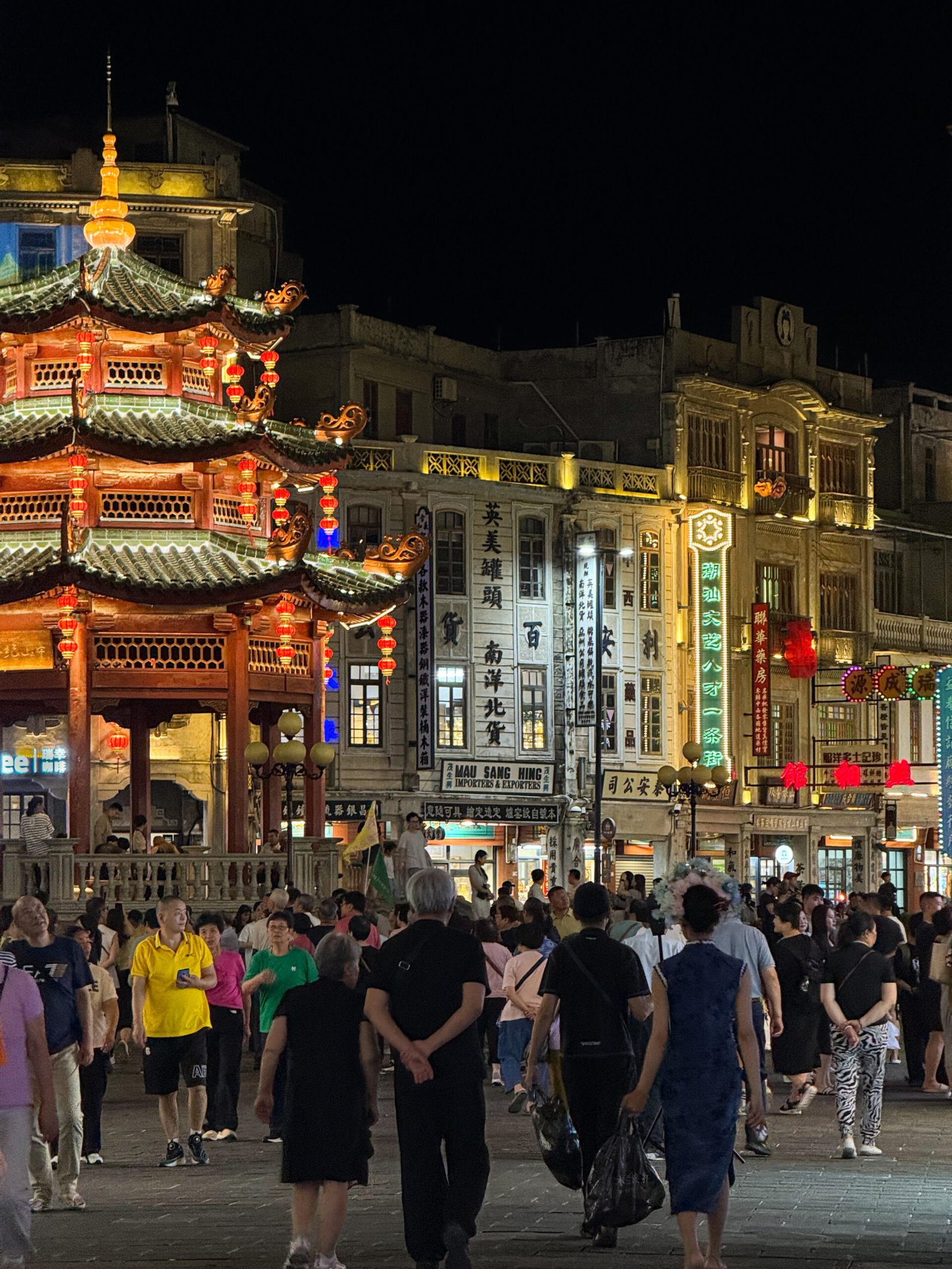
Those are qilou (骑楼, arcaded shophouses), built with returned overseas Chinese money in a style shared from Guangdong to Thailand, which was never colonised either. The diaspora the article could not see literally built the very street it praises.

The credit went to the West, which brings us back to the corpse.
The corpse that sells out cinemas
Here is what the reporter actually saw. Overnight visitors rose 12.8% in 2025 and tourism revenue grew 23.9%, powered by “Dear You” (给阿嬷的情书), a hit film shot in Shantou and spoken in the very Teochew dialect the article blames for its decline. The old town now buzzes at night.
The assignment was a phenomenon. The filing needed a failure. So one was manufactured.
Shantou has real problems. So does every third tier Chinese city in a property downturn. But a city whose dialect just filled cinemas is not a backwater. It is a brand.
The charges, in order: a control group that never existed, evidence twenty five years old, a culture alibi that collapses across the border in Zhuhai, a dialect argument borrowed from the Singapore playbook this magazine loves to mock, capital graded on the wrong meter, and buildings credited to a colonial past that never happened here.
That is not reporting on a failed city. It is a template in search of one. The autopsy says more about the pathologist than the patient.
Published simultaneously on The Robot Belt and Substack.