Shanghai Weijian Technology closed a fifth funding round in November, above RMB 100 million, with Caitong Capital as the sole investor named. The company says the money will go into manufacturing capacity, overseas market entry and continued work on embodied AI.
Founded in June 2020, Weijian is one of a small number of construction robot makers that can point to machines working on commercial sites rather than pilots. Its founder, Liang Yanxue, took an undergraduate and master’s degree at Shanghai Jiao Tong University and a doctorate at Tokyo Institute of Technology, then spent about ten years at FANUC on robot kinematics, dynamics and offline programming. He returned to China to localise lithium battery equipment at CATL, and later ran research at Bright Dream Robotics, the construction automation arm of Country Garden.
Why construction resisted automation
Liang’s explanation is about people, not physics. Industrial robots are deployed into a workforce that is organised, educated and able to state a requirement. Construction is the opposite. Craft knowledge is passed on by demonstration, there is almost no digital baseline, and much of the workforce cannot read a parameter sheet.
The economics cut the other way. Labour on a construction site costs two to three times what an industrial plant pays, and automation is close to zero. That combination, high input cost and no installed base, is what made the category worth entering.
Weijian spent its first years building what Liang calls disembodied intelligence: no real-time perception, no natural language, just high-precision motion control and a digitised process. The argument was that the value sits in the action itself. Telling a machine that a wall is 3.523 metres long earns nothing. Plastering it to tolerance is what a client pays for.
The product line and the numbers
The wall system is the core. The PMC-3000 and PMC-6000 plastering robots cover 300 to 350 square metres a day, with a best recorded day of 708 square metres. Vertical flatness is held to 2 millimetres over 2 metres against a Chinese code requirement of 4 millimetres, and the machine applies 30 kilograms of pressure against the wall to prevent hollow patches. The PNP-3000 and PNP-6000 handle spraying, and the MIB-5000 handles modelling.
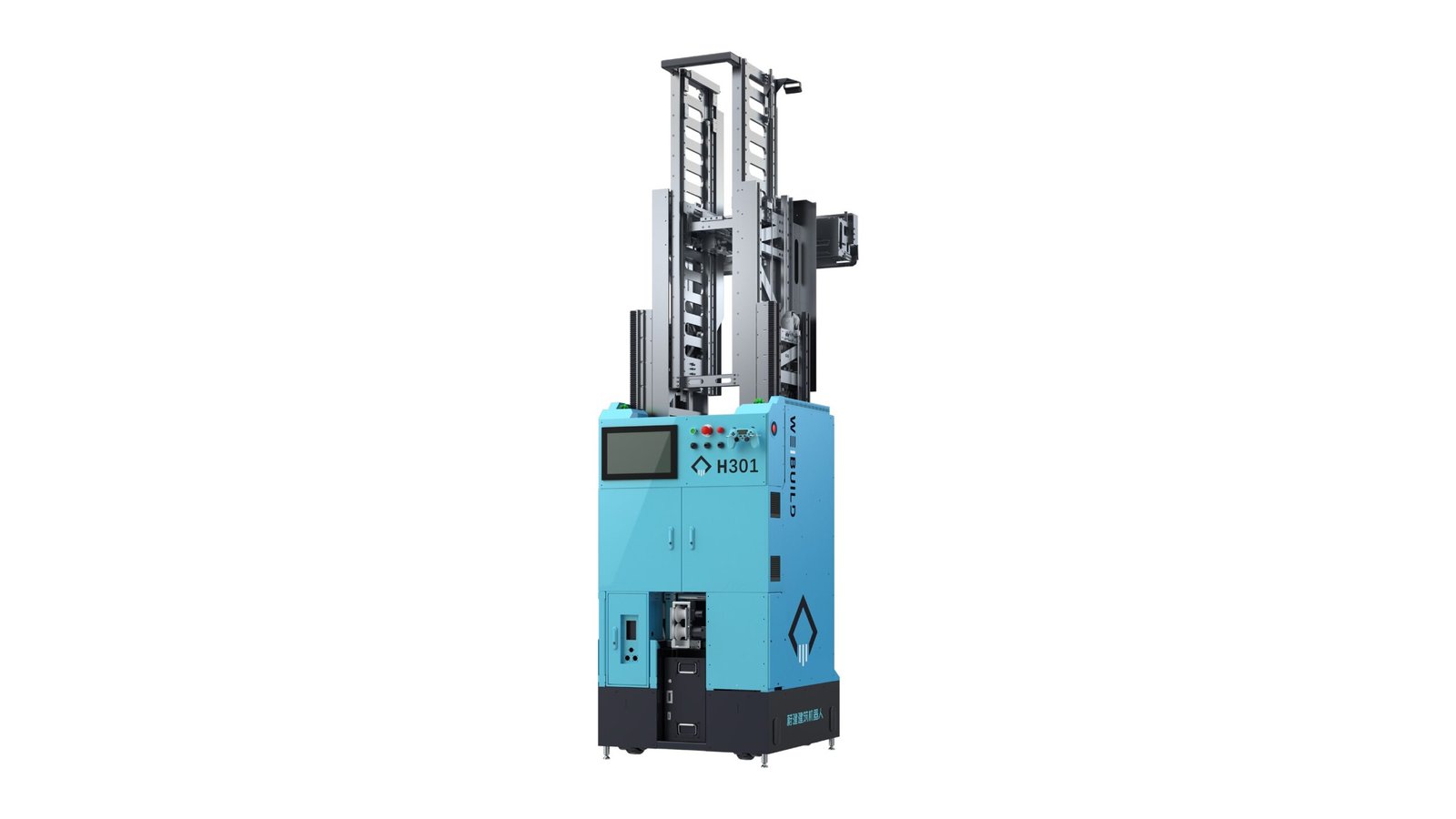
The rebar side is a separate business. The RMC-40 flexible rebar processing centre cuts, rolls, bends and sorts without manual handling, needs two people for loading and can process 20,000 tonnes a year. The company puts labour savings at 90 per cent and material waste reduction at 80 per cent.
Overseas work is where the margins are being tested. A 6-metre spraying robot worked the NS Square project in Singapore, handling a complex ceiling with perception, decision and spraying running unattended, at roughly ten times manual output. Singapore’s Housing and Development Board has bought through a centralised tender. Takenaka in Japan and ALEC, ACC and Sobha in the Gulf have started using the machines, and Weijian expects product orders to pass RMB 100 million in 2026, more than double 2025.
The shift to embodied AI is a usability argument
From this year the company has been adding perception and language interfaces, which in the current vocabulary means becoming an embodied AI company. Liang is careful about why. It is not a technology trend. It is that crews could not operate the machines well enough to lift utilisation.
The company built an in-house stack it calls Tiangong, split into a motion and process-parameter layer and a perception and semantic layer. In its first year it brought experienced site foremen into the company so that a team of engineers could record what they did and convert the mechanics into parameterised commands. The gap between a good plasterer and a mediocre one is a set of small force and timing decisions that nobody had written down.
Domestically the reference customer is a joint venture with China State Construction Engineering’s eighth bureau, which the company describes as the only robotics joint venture the group has approved. It also works with the third and first bureaus, Shanghai Construction Group and Zhejiang Construction. Those relationships matter more than a demo video: a general contractor that has accepted a machine on one project will specify it on the next.
The next competitive question, in Liang’s framing, is not whether a robot beats a mason on quality. Five years of projects have settled that. It is whether the machine holds that quality in the hands of an ordinary worker, because that is what decides utilisation, and utilisation is what decides whether the category has a business.
Editor’s note: This is an adapted translation of the original 36Kr report. It has been trimmed and restructured for readability for an international business audience. The full original (in Chinese) is at https://36kr.com/p/4070571639067782.