On 22 October, the 2026 World Physical AI Conference and Unitree’s partner ecosystem event opened in Hangzhou. Wang Xingxing, Unitree’s founder, used his keynote to make an argument that cuts against most of the industry’s current enthusiasm.
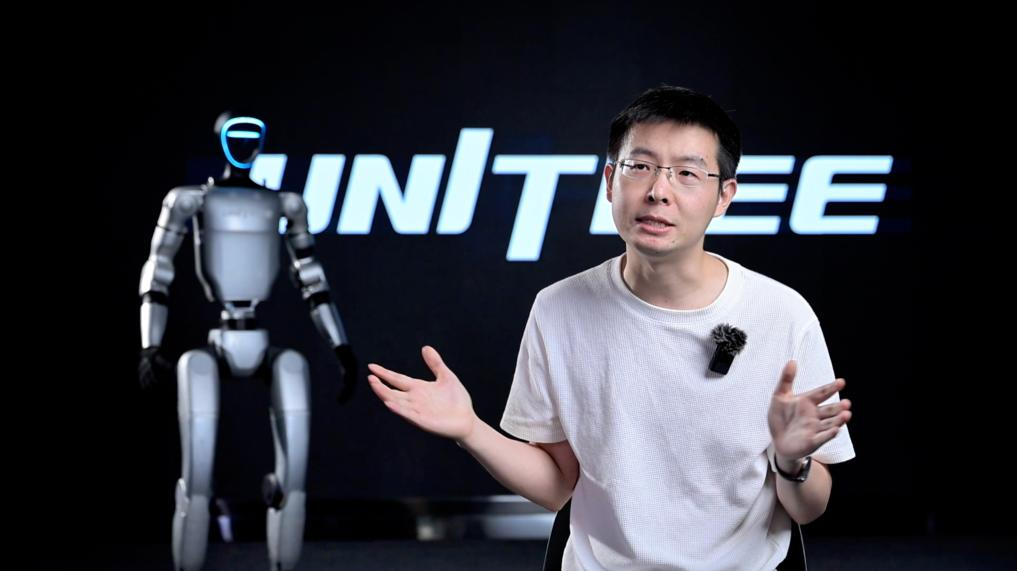
His first point was that the models are further along than the discourse assumes. Inside leading model companies, he said, models have essentially achieved self-evolution. They write their own programmes and collect their own data with only modest human guidance. From technical breakthrough to genuine mass adoption, he estimates five to ten years.
His second point was less comfortable. The core obstacle to a ChatGPT moment in embodied AI is not whether the model is smart enough. It is alignment between what the model puts in and gets out, and the actual robot on the other side of that interface.
The king of the cloud, an infant in the physical world
The gap is easy to demonstrate. Models in virtual environments grasp, fold clothes and reason through complex sequences with near-perfect reliability. Put the same policy inside a metal shell and the system collapses when floor friction shifts slightly or a sensor lags by a few tens of milliseconds.
That is what Wang means by alignment. Large-model reasoning happens in a digital space where input and output are effectively error-free. A robot’s perception, decision-making and motor execution form a chain in which error accumulates at every link.
The analogy he reached for is a brilliant mind in an uncooperative body. The intention can be perfect while the hand shakes and the water ends up on the floor, and in that case the task failed regardless of the reasoning. The industry talks about general-purpose humanoids while the physical alignment problem remains unsolved, which produces machines that are clever and not useful.
The repricing that follows
If alignment is the binding constraint, the capital markets have to reprice two things.
The first is primary valuations. Until recently, any team with a vision-language-action concept and a striking demo could raise at a nosebleed valuation, because investors were reading leaderboard positions. Once the interface problem is named, the questions get harder and more useful: what is your alignment error in a real setting, and can your data loop resolve physical latency? Purely algorithmic companies that cannot answer will see valuations cut.
The second is listed equities, and it explains why money has been fighting over Tesla’s supply chain and core components. Whoever builds the model, whether Unitree, Tesla or Figure, needs hardware underneath it that holds tolerance. High-precision reducers, fast six-axis force sensors and lightweight joint modules stop being commodity metal. They are the physical defence against accumulated error.
No matter how smoothly the model runs in the cloud, a gear with backlash at the final joint undoes it. That is why suppliers able to solve error accumulation in hardware and manufacturing process, names such as Sanhua, Tuopu and Leaderdrive, are being treated as assets that can carry through a cycle. Capital is moving from buying narrative to buying precision.
From slideware to engineering
The encouraging part of Wang’s position is that he does see the breach coming. Physical AI, in his framing, is showing the first signs of being broken through. The less encouraging part is what has to happen first. The industry has to stop competing on benchmark scores and start competing on yield on the line and end-to-end latency.
Alignment sounds like a dry engineering word. It is the only door into general-purpose robotics, and it is a narrow one.
Editor’s note: This is an adapted translation of the original OFweek report. It has been trimmed and restructured for readability for an international business audience. The full original (in Chinese) is at https://robot.ofweek.com/2026-10/ART-8321205-8470-30708406.html.