48V spent a decade as the transitional technology nobody wanted to defend: a belt starter-generator and a small battery bolted to a combustion engine, worth 8 to 12 per cent in fuel savings. It is now being pulled back into the centre of the car for a completely different reason.
The low-voltage rail is running out of power. Advanced driver assistance, cockpit displays, central compute and active chassis systems have pushed 12V towards its limit. A 48V rail carries the same power at a quarter of the current, with lower losses and thinner harnesses, and that is what makes it interesting again.
The installed base never went away
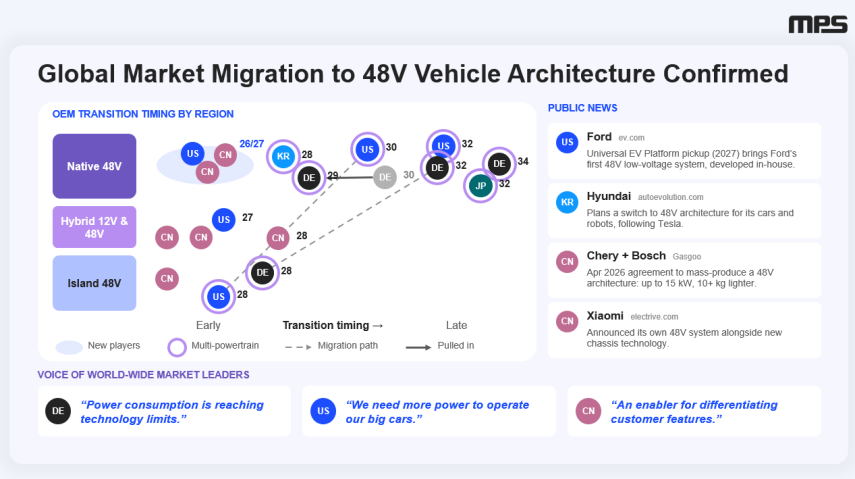
Industry data puts more than 17.4 million vehicles with a 48V system on the road in 2025, about 29.6 per cent of global hybrid sales. The base is large. The growth story was what failed, because 48V saved fuel and the fuel bill was being absorbed by plug-in hybrids and battery electric cars.
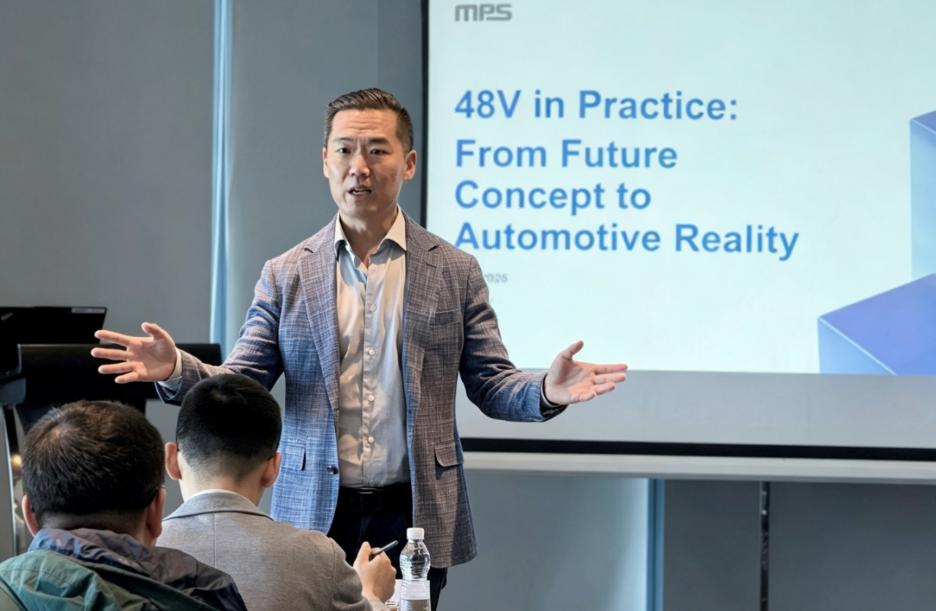
What changed is the load side. Allen Chen, vice president of the automotive product line at Monolithic Power Systems, argues three trends are pushing demand: the spread of zonal control architectures, the need to optimise harness and power paths, and the steady increase in high-power loads.
The zonal point is the structural one. A traditional car spreads function across dozens of electronic control units. A zonal architecture groups functions by physical location into three to five zone controllers. Fewer boxes, more current through each of them.
Why this is harder than raising the voltage
Chen is direct that the engineering difficulty is not the number. It is making the whole chain work at once.
Transient spikes come first. A 48V system sits well below the 60V safety extra-low voltage threshold, but real operating conditions produce voltage excursions that a 12V architecture rarely sees, and a protection circuit is the last defence when a spike crosses a device’s rating.
Then thermal and fault isolation in a multi-voltage domain. Cockpit electronics and ADAS are consolidating into central compute boxes, which concentrates heat in a smaller volume and widens the blast radius of a single failure. Availability and safety have to be designed at architecture level, not component level.
Then parasitic effects. Thinner, shorter harnesses are the selling point, but they introduce stray inductance and capacitance, and a connector unplugged under load can produce a voltage step that destroys a device. Those failures usually surface only in full-vehicle integration.
Finally the rulebook. ISO 25769, which covers 12V, 24V and 48V vehicle electrical systems, is scheduled for publication in December 2027. Until then, 48V low-voltage systems are being designed ahead of their standard.
From a serial supply chain to a joint design
The old division of labour was serial: the carmaker wrote the requirement, the tier one chose the parts, the chip company supplied part numbers. That model breaks when a power path, a zone boundary and a protection strategy all interact.
Chen’s version of the new process runs in the opposite direction. Define functions, load behaviour and failure expectations at vehicle level. Then define zone partitioning, power paths and diagnostic responsibility at hardware level. Then map those requirements onto devices that convert, protect and monitor. The loop repeats.
MPS is participating in the ISO 25769 working groups alongside carmakers, tier ones and semiconductor companies from Europe, Japan, Korea, China and the United States, which is a reasonable proxy for how much of this will be settled by committee rather than by product launch.
The company’s 48V portfolio covers front-end power conditioning, ideal diodes, protection and distribution, buck conversion and point-of-load supply. The flagship part is the MPQ5884-AEC1, an automotive-grade integrated 48V electronic fuse in a 5mm by 6mm QFN-30 package, aimed at replacing discrete protection networks.
Chen expects Chinese carmakers to reach volume first. His other point is less comfortable for the industry: the threshold is not the voltage, it is whether anyone is willing to take responsibility for the entire chain. In a serial supply chain, nobody is.
Editor’s note: This is an adapted translation of the original Gasgoo report. It has been trimmed and restructured for readability for an international business audience. The full original (in Chinese) is at https://auto.gasgoo.com/news/202611/13I70477874C103.shtml.