There is a wall inside most factories, and it has been there for decades. On one side, the production line: industrial robots, programmable stations, cycle times measured in seconds. On the other, the warehouse and the internal flow of parts, which often still runs on people, forklifts and partial automation.
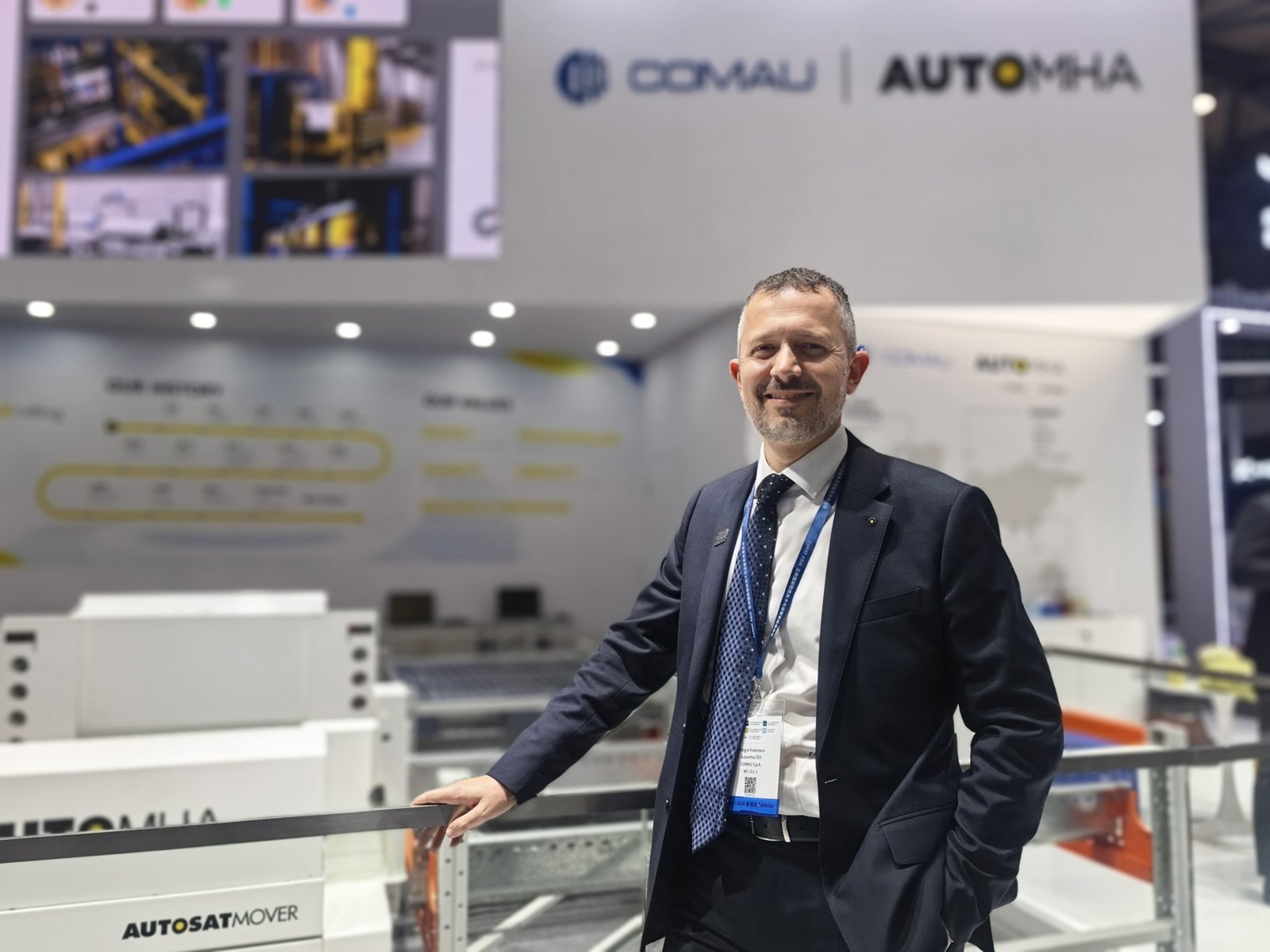
Francesco Allegra, chief executive of Automha and chief operating officer at Comau, says the split holds even in automotive, the most automated manufacturing sector in the world. The two Italian companies used CeMAT Asia 2026 to show what closing it looks like.
What was actually on the stand
The display was deliberately not a wall of shuttle carts. Automha showed Autosat Mover, a parent-and-child shuttle system in which a mover carries smaller supercap units to perform high-density storage and retrieval, together with AWMS, its warehouse management software. AWMS tracks jobs, equipment status and scheduling, and a Nova AI module adds predictive maintenance and operational decision support.
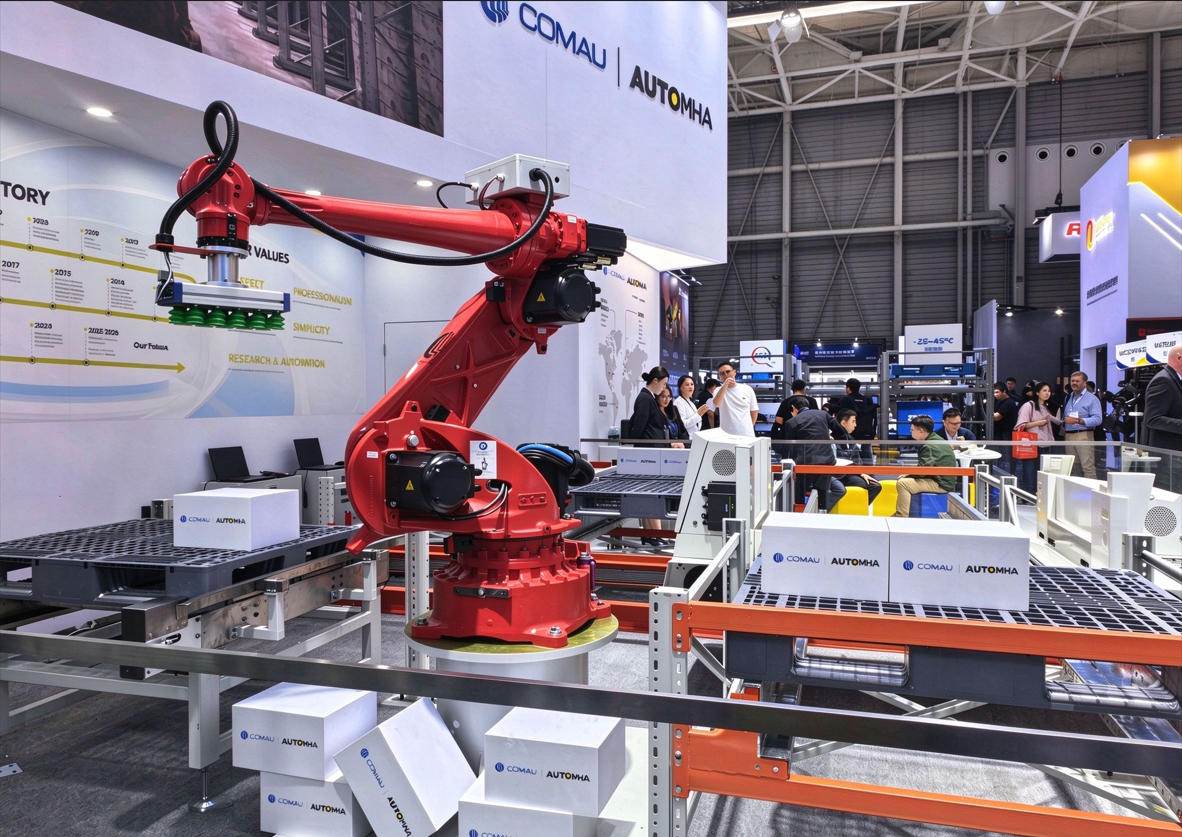
Comau showed the NJ-40 industrial robot for palletising, packaging and handling at the edge of the line, and the MATE exoskeleton range for the tasks that still need a human: unloading trucks, manual sorting, repetitive lifting. The combination is meant to cover storage, movement, handling and human-machine cooperation as one chain rather than four products.
Why buy instead of build
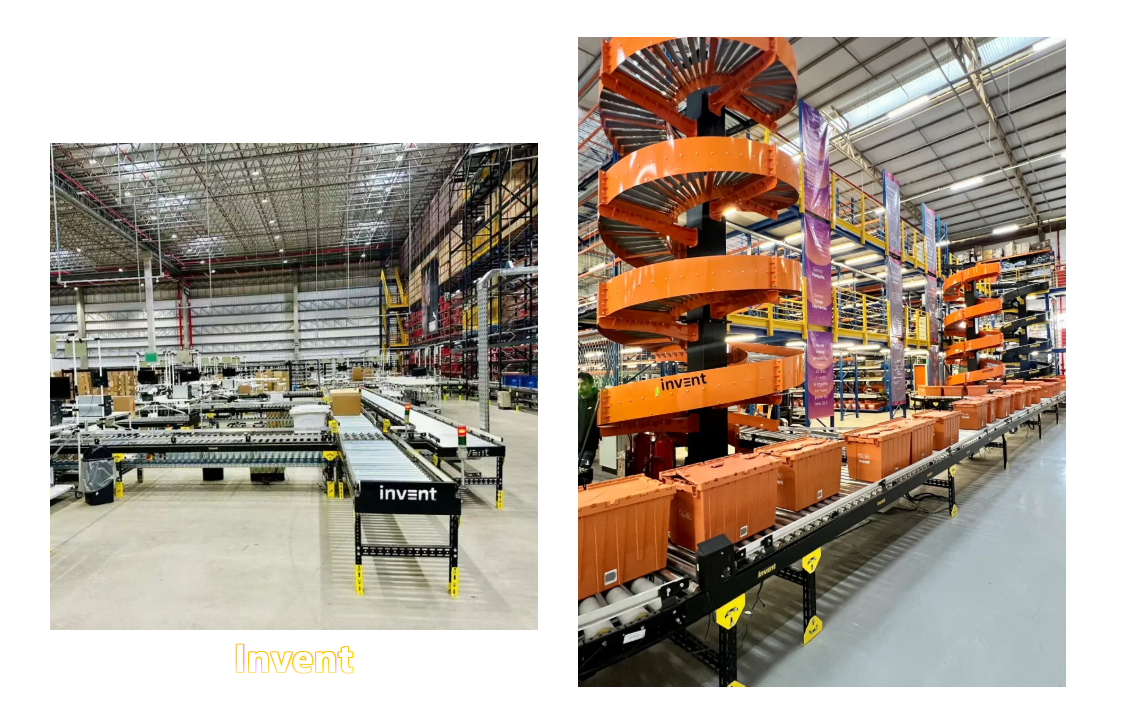
Comau’s route into this business has been acquisition, not internal development. Automha brought automated pallet storage, high-density racking and shuttle systems, plus a customer base in food and beverage, cold chain, third-party logistics and textiles. Invent added bin handling, sorting and software, alongside fast access to the Brazilian market.
Allegra’s explanation is about time. Automated warehousing is not a business you enter by adding robots to a catalogue. It requires rack design, analysis of what is being stored, system scheduling, on-site engineering and years of maintenance. Those capabilities, and the customer relationships that come with them, take a long time to build from zero.
Comau’s contribution is the other side of the wall: robot platforms, manufacturing engineering, and a global production and service network. The stated ambition is a single industrial platform spanning internal logistics and factory automation, sold as one turnkey scope.
The recycling problem, industry by industry
The obvious question is whether expertise transfers. A cold-chain warehouse is designed around storage density and reliable operation at temperature. An automotive plant is designed around takt time: every part must arrive at a station in sequence, and a late delivery stops the line.
That difference is exactly why the gap has persisted. Automotive has pushed robot density to the highest level of any sector, yet its internal logistics automation has lagged, because the requirement is not storage efficiency but synchronisation with production. Allegra treats that lag as the market.
For Automha, the automotive route runs through Comau’s knowledge of OEM standards, process discipline and plant engineering. For Comau, Automha supplies the intralogistics capability its manufacturing automation business did not have. Both sides describe the fit as complementary rather than overlapping, which is the standard language of an acquisition, but the product lines genuinely do not collide.
China as both market and test bench
Comau is explicit that China matters for two reasons. It has the largest automotive and component supply chain in the world, and it is adding battery and new energy capacity faster than anywhere else. It is also, in Allegra’s words, strategically important, fiercely competitive and highly innovative, which means local execution speed decides who wins.
Automha is not starting from zero there. Its systems are already installed across several Chinese industrial segments. The plan is to use Comau’s Chinese network to localise manufacturing, engineering and service, and to shorten the distance to customers who want customisation quickly.
The second Chinese driver is outbound. Chinese manufacturers building plants abroad face warehouse planning, materials flow and plant supply as well as equipment purchase, and they want the same standard replicated across countries with local adjustment. A group holding shuttle hardware, warehouse software, sorting technology and robot platforms can sell that as one package.
Industry forecasts put intralogistics automation growth at roughly 13 per cent a year for the next three to five years. The competitive question is no longer who supplies the most machines. It is who connects machines, software and process into something a plant manager can run.
Editor’s note: This is an adapted translation of the original Gasgoo report. It has been trimmed and restructured for readability for an international business audience. The full original (in Chinese) is at https://auto.gasgoo.com/news/202611/13I70477671C103.shtml.