From demo hall to live railway
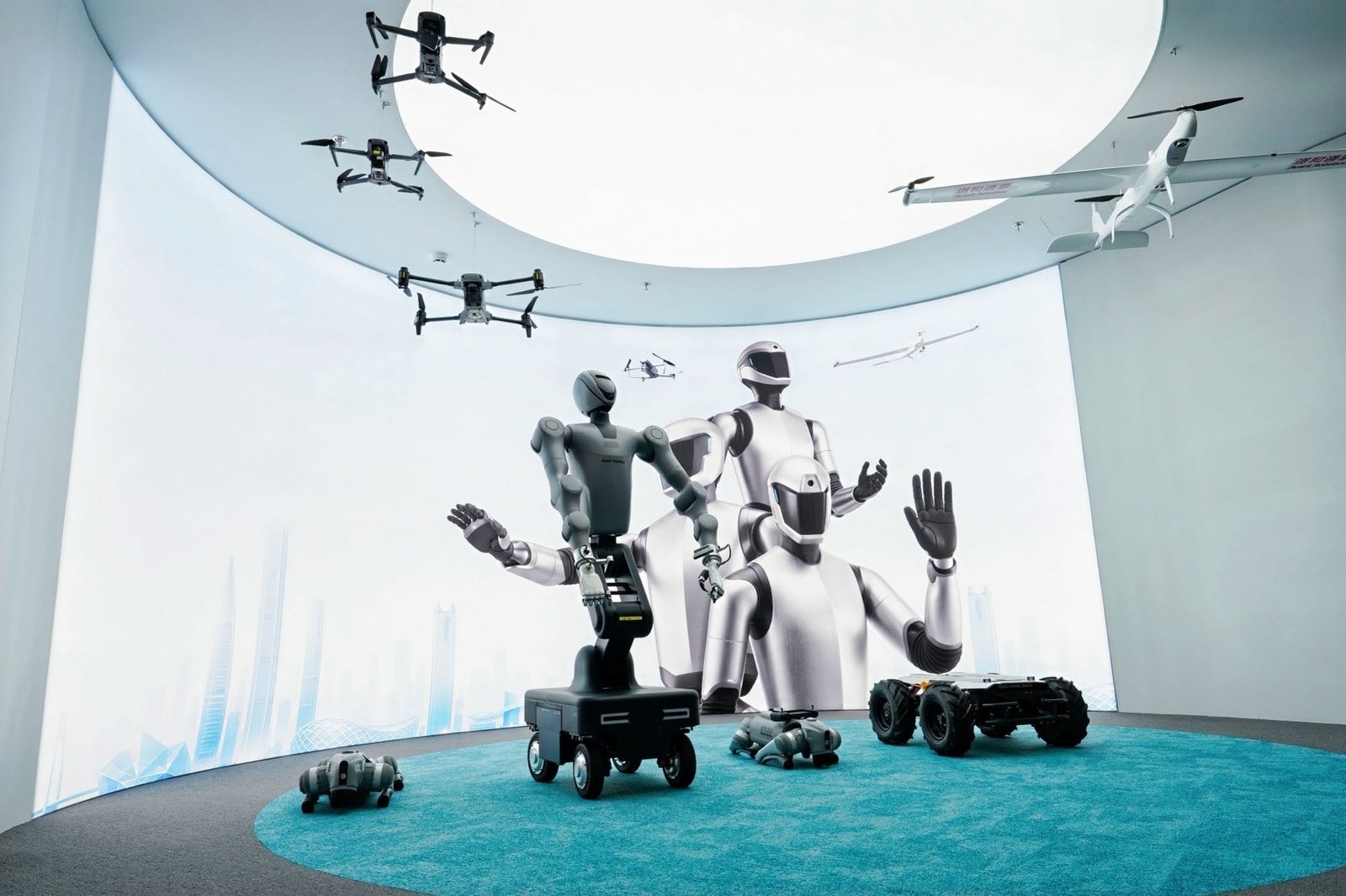
At an open day in Shenzhen’s Nanshan district on July 24, Autel (道通科技) ran two scenes at once: a drone nest opened, a vehicle ran self-checks and took off to patrol a railway line, while an operator on the 15th floor controlled a robot two floors up to grasp spheres and irregular objects. Another robot set off from across the room, found a door on its own, planned a route and opened it with its arm.
The railway loop on show runs over 7 km; a drone finishes one patrol in about 20 minutes, against roughly two hours on foot. Humanoid robots running and dancing at exhibitions is no longer novel. Once they enter railways, oilfields, power facilities and industrial parks, customers ask sharper questions: can the robot actually spot a real anomaly, work inside complex spaces, and coordinate with drones and unmanned vehicles?
Not just “see and walk” — it has to learn to act
Autel chose smart inspection as the wedge for putting embodied AI to work, trying to move robots from “showing moves” to “doing the job.” The door-opening demo drew the most attention: the robot can locate a door from about 10 meters, open it under varying angles and lighting, with a success rate around 90%. That matters because inspection robots that hit a closed equipment room stop at the threshold — door-opening is the first step to going inside.
The “see the site” capability rests on a “fast-slow brain” architecture. The fast brain continuously processes live drone and robot feeds, quickly flagging people, vehicles and equipment; only on a suspected anomaly does it call the heavier “slow brain” to judge whether someone intruded, parked illegally or a device faulted. Autel says this lifted inspection-event detection accuracy above 90% while cutting the compute cost of running large models continuously. The figures are the company’s own test results and still need validation across more live projects.
From car diagnostics to robot inspection
Autel was founded in 2004 and listed on Shanghai’s STAR Market in 2020, built on automotive intelligent diagnostics, TPMS and ADAS calibration, later extending into smart charging and AI robots. In 2025 it posted revenue of RMB 4.83 billion with R&D spend of RMB 874 million. The logic carries over: car diagnostics must connect different brands and models, read data, find faults and advise repairs; industrial inspection must likewise handle diverse equipment, collect site data, judge anomalies and propose fixes.
Rather than send a “universal robot” into homes, Autel flies it along railways, into oilfields and industrial parks — solving a batch of needs that are clear, repetitive and safety-critical. Its formula: an Agent platform plus an inspection “brain” plus an embodied body plus air-ground coordination, with an industry knowledge base, simulation testing and data feedback raising adaptation speed. Building a dedicated inspection Agent for one client now takes about a day; the goal is hours.
Translated and adapted from Shenzhen News (sznews.com) (https://www.sznews.com/news/content/2026-07/27/content_32133561.htm).