Embodied intelligence has no shortage of technical routes. It has a shortage of commercial ones, and investors have started paying for the difference.
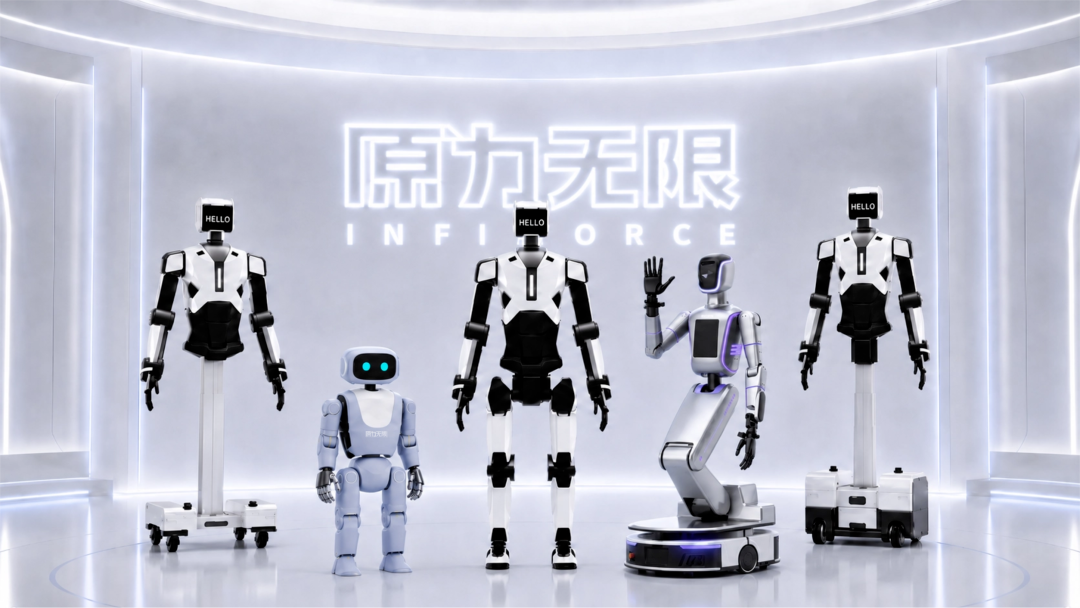
Zhejiang Venture Capital Group has completed an investment of close to RMB 100 million in INFIFORCE, a Hangzhou embodied AI company founded in 2023. The round lands about two months after the company closed near RMB 1 billion across an A round and an A-plus round in August.
Two rounds in ten weeks, and the reason why
A three-year-old company taking large cheques twice in ten weeks usually invites a question about burn. The answer here sits in the founding team, which reads like a composite of the three industries that have to converge for a robot brain to work.
Founder and chief executive Bai Huiyuan spent more than 15 years at Alibaba and rose to vice president, having run businesses from zero to scale in the RMB 10 billion to RMB 100 billion range. Chief technology officer Wang Yizhou holds a PhD from UC Berkeley and was a founding core member of Baidu’s IDL autonomous driving team and a core member of Nvidia’s DriveAV unit. Chief scientist Chen Jiayu is an assistant professor at Hong Kong University.
Commerce, autonomous driving and academic learning theory. The company is explicitly betting that a robot brain needs all three, and that the market has been overpaying for the first two alone.
The technical bet: causality, not correlation
INFIFORCE describes the current state of the industry as a split with a missing half: bodies that are formed and intelligence that is absent, a cerebellum that works and a cerebrum that does not. Robots can run, jump and execute scripted motion, then fail the moment a real environment presents something unscripted.
Its chosen route is a causal world model. Conventional data-driven models are good at finding correlations across large samples. A causal model tries to establish the relationship between action, state and outcome, so that the robot can reason about what happens if the action changes rather than only predicting what follows the current one.
Three building blocks support that. First, egocentric data captured from a human first-person perspective, recording vision, motion, spatial relationships and environmental feedback together, on the argument that third-person demonstration data teaches a robot how to perform a motion but not what to do when it is standing in that position in that room.
Second, two parallel technical lines: a causal world model for prediction and exception recovery, and a continuously learning vision-language-action model for task understanding and motion generation. Third, a self-built training stack the company calls DataGrid, covering collection, processing, training, deployment and feedback.
What it actually ships
The company says it does not compete on hardware specifications but keeps multiple body forms as validation and deployment vehicles: the AstroDroid AD-01 full-size wheeled humanoid, the UltraDroid general-purpose humanoid, the small biped Xiao Yuanzi and the FORCE series of task-specific machines.
The AD-01 has completed an end-to-end order, location, pick, pack and handover cycle inside an instant-delivery warehouse in Hangzhou, and has appeared at the Yunqi conference and the World Internet Conference. The technology and products have reached roughly 100 real scenarios across nearly 30 Chinese cities.
The question the next round will ask
Continuous large rounds fund research and also lock in a high burn rate. What they cannot do is prove that a general brain is worth more to a customer than a narrow one that already works.
The warehouse pilot is the right kind of evidence, because a fulfilment centre has hard metrics: picks per hour, error rate, uptime and the cost of a human supervisor standing nearby. If the brain improves those numbers across a second and third customer without a bespoke integration each time, it is a product. If every deployment needs a team on site for a month, it is consultancy with a neural network attached.
Chinese embodied AI has spent two years proving that bodies can be built. The next two years will be spent proving that intelligence can be sold more than once.
Editor’s note: This is an adapted translation of the original Gasgoo report. It has been trimmed and restructured for readability for an international business audience. The full original (in Chinese) is at https://www.gasgoo.com/apps/e060bad9eca91db7f01403fc7120041f/robot/news/70475996-seeds.