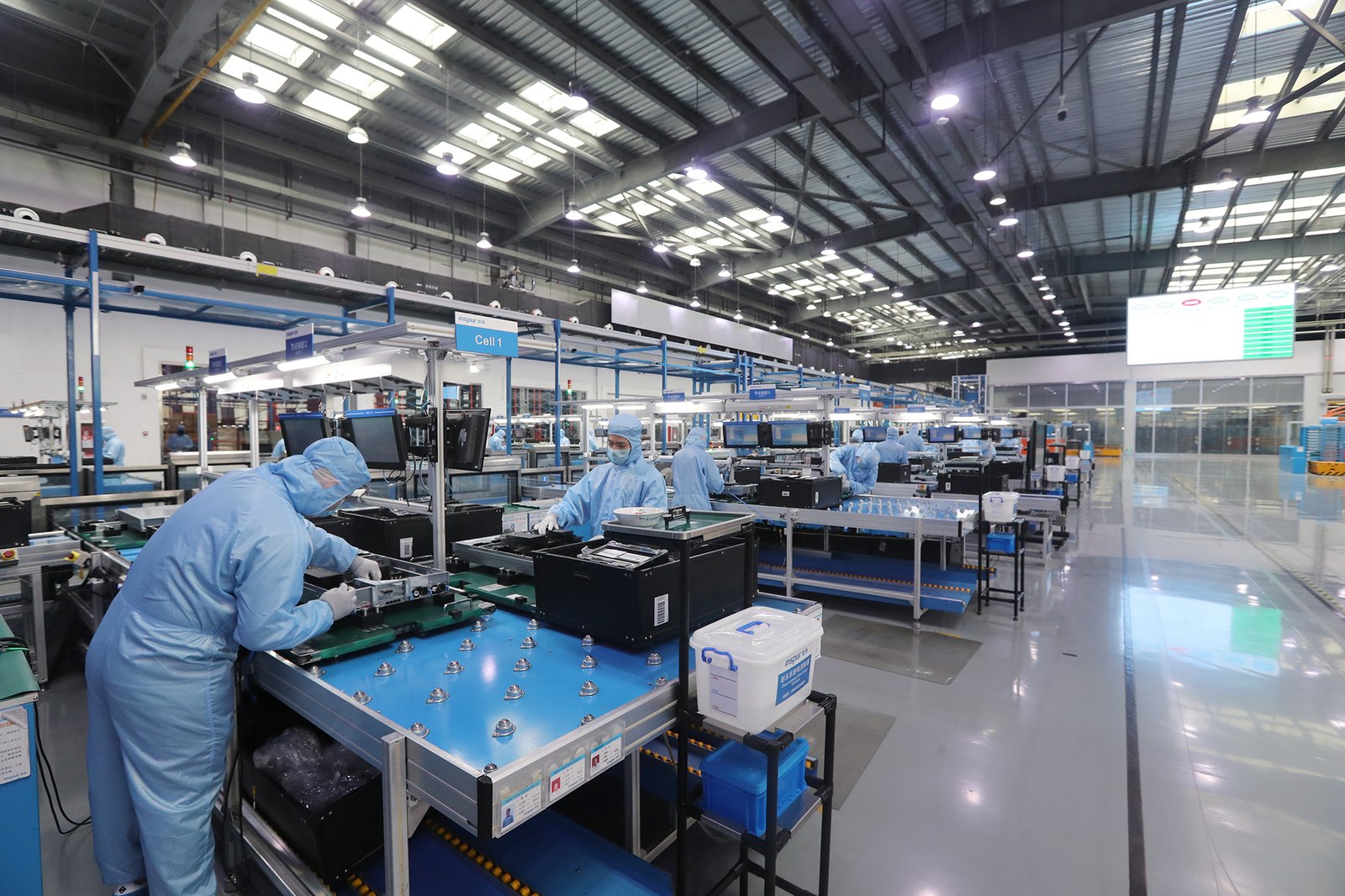
As manufacturing competition shifts from single-device contests to full-chain coordination, Shenzhen’s Bangqi (磅旗科技) has set its core strategy as “building whole-factory intelligent system capability.” On its self-developed industrial vertical AI model, Bangqi uses an LDS production-coordination system and an ADS multi-brand scheduling system as the base, while also making its own AGV/AMR and embodied-intelligence robots — a software-hardware bundle pushing factories from local automation toward global autonomous decision-making.
Bangqi’s chairwoman, Wu Xiaoqian, says the goal is to let factories worldwide run “AI-unmanned.” Its clients include CATL, EVE Energy, Gotion, Sunwoda, Guangzhou Pharmaceutical, SF Express and DHL — nearly a hundred leading firms, over 2,000 deployed projects, across China, North America, Europe and Southeast Asia.
“One body, two wings”
Bangqi frames its three technology fronts — AGV/AMR, embodied intelligence and industrial AI agents — as a closed loop of “hub-execution-coordination.” The industrial AI agent is the factory’s “digital brain” (global perception, autonomous decision, continuous optimisation). One “wing” is embodied intelligence, connecting brain and physical world so the robot becomes an “intelligent limb” that senses and self-adjusts. The other “wing” is AGV/AMR — the “legs” that solve multi-brand mixed scheduling and end-to-end logistics, while feeding field data back to embodied-AI R&D.
The AGV/AMR layer looks mature, but Bangqi’s edge is unified scheduling across brands and types. In a top battery plant, a dozen brands and hundreds of AGVs run different navigation (laser SLAM, magnetic, QR) on incompatible maps; Bangqi’s ADS is a “general execution nerve center” solving trajectories, tasks and battery in real time on one dynamic map. Embodied robots — launched globally at the 2025 Industry Fair — carry dual 7-DOF arms and high-precision dexterous hands, move at 1.5 m/s, run 8+ hours, and already work in auto-parts lines.
From single-point automation to plant-wide autonomy
The industrial AI agent’s hard parts: unifying data semantics across incompatible systems, binding AI’s probabilistic “hallucinations” to the absolute certainty industry demands, and adapting to dynamic scenes with explainable, attributable decisions. In one battery gigafactory, Bangqi’s full-chain agent lifted plant automation from 30% to over 90%, raised output ~10%, cut hardware spend 30% and labour cost 50%. For a top Chinese EV maker it delivered an end-to-end unmanned, traceable flow lifting efficiency and material turnover 20%+. Wu sees four trends ahead: ubiquitous industrial AI agents, scaled embodied robots, standardised open digital bases, and green/smart fusion with RaaS lowering the bar for SMEs.
Translated and adapted from OFweek Robotics (https://robot.ofweek.com/2026-07/ART-898890-8120-30694084.html).