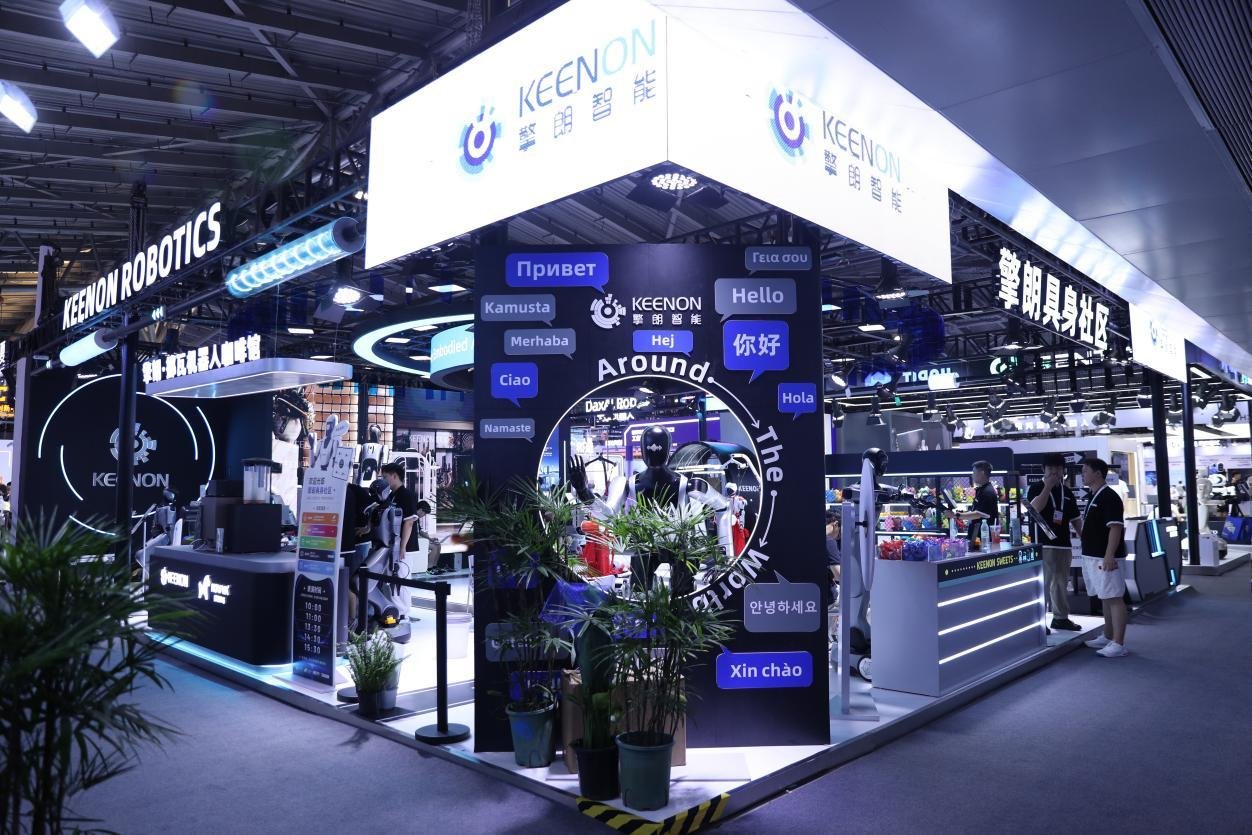
At WAIC 2026 in Shanghai, Shenzhen-based service robot leader Keenon (擎朗智能) unveiled something more ambitious than a product demo: an “embodied community” spanning four real-world service scenarios, all running on humanoid robots with zero human teleoperation.
What ‘Zero Teleoperation’ Actually Means
The industry default for robot showcases is still remote piloting — a human operator behind the curtain, making the robot look autonomous. Keenon’s WAIC exhibit deliberately removed that crutch. Every robot on its booth ran autonomously, powered by a proprietary VLA (Vision-Language-Action) architecture that fuses world-model reasoning with end-to-end task execution.
The technical stack has four layers:
- Perception-decision-action unification. Visual understanding, language instructions and motion generation live in a single end-to-end model, eliminating information loss across traditional modular pipelines.
- World-model physics prediction. Before executing a movement, the robot simulates the physical outcome internally — predicting how an object will respond to force, how fabric will deform during folding. This enables proactive rather than trial-and-error action.
- KEENON ProS: role-specific vertical models. On top of the generalist VLA, Keenon trained specialised models for barista work, retail picking, laundry handling and hotel logistics — each with multimodal environmental awareness and fine force control.
- Real-scenario data flywheel. The models are trained on data from Keenon’s global fleet of 100,000+ robots operating daily in hotels, malls, restaurants and hospitals. Every real-world deployment feeds back into model improvement.
Four Scenarios, All Real
Keenon’s WAIC booth was not a concept showcase built for the exhibition. Each scenario was derived from actual commercial partnerships:
Robot café (with Nowwa Coffee). The XMAN-R1 humanoid operates as a “guest barista,” using KEENON ProS to autonomously handle cup collection, coffee extraction and handoff to a latte-art printer. The robot handles multi-modal environment perception and fine force control in a space designed for humans, not machines.
Hotel laundry room (simulating Ramada Plaza operations). Two humanoid robots operate under unified scheduling, autonomously completing the full wash-and-fold workflow. The multi-task planning capability handles flexible object recognition and processing, adapting to equipment state changes in real time — a closed-loop operation directly transferable to commercial laundries.
Dessert shop. A humanoid uses visual recognition to identify and precisely pick M&M’s by target colour from an unstructured retail environment. A spinning wheel interaction lets audience members choose colours, forcing the robot to generalise across randomised targets — testing operational flexibility under live conditions.
Retail store. A humanoid autonomously maps shelf layouts, locates target items, executes precision grasping and delivers goods to customers — validating object recognition, spatial localisation and dexterous manipulation in genuine commercial environments.
The Bigger Picture
On the same floor, Keenon’s T10 delivery robot and C40 cleaning robot operated alongside the humanoids, forming a “general-purpose + specialist” coordination loop. Specialist robots handle efficiency tasks (delivery, cleaning at scale); humanoids handle complex interactive tasks (operations requiring dexterity, customer-facing roles). Between them, they cover the full spectrum of service-sector automation needs.
According to IDC’s 2025 report, Keenon has held the #1 global market share position in service robot shipments for consecutive years. Behind that number lies 16 years of commercial deployment experience and a fleet exceeding 100,000 units operating daily in real hospitality, retail and healthcare environments worldwide.
What Keenon demonstrated at WAIC is not that humanoid robots can perform choreographed demos. It’s that a Shenzhen company with deep operational roots in physical service industries is now embedding foundation-model intelligence into robots that have already proven their reliability at scale. The “embodied community” framing is deliberate: these aren’t lab prototypes waiting for a use case. They’re production-grade hardware being upgraded with production-grade AI, deployed into production-grade environments where the ROI math already works.
Read the original report (LeiPhone / 雷锋网)
*Translated and adapted from LeiPhone (leiphone.com).*