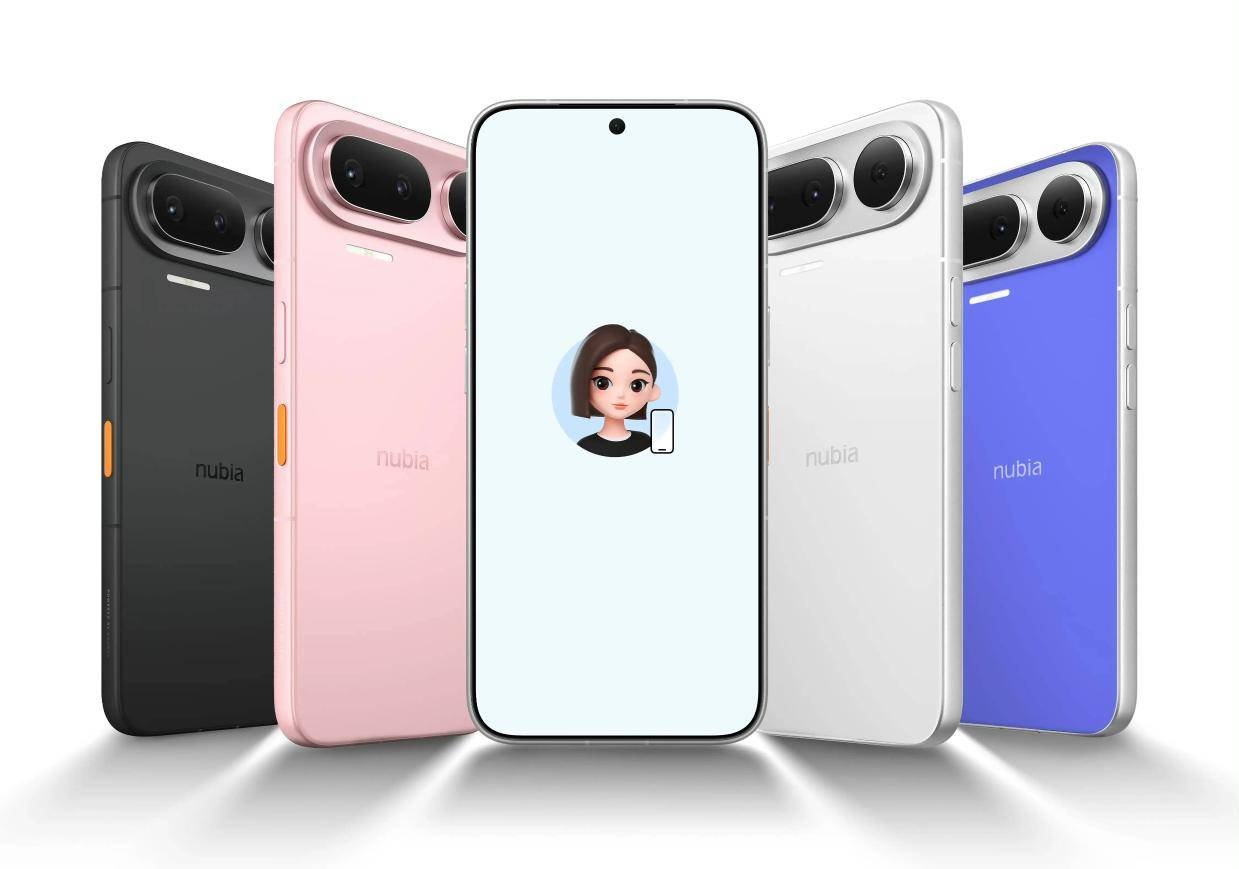
In July 2026, the Nubia NaviX Ultra drew a crowd at the World Artificial Intelligence Conference in Shanghai. The phone has a plainer name: the Doubao Phone 2. Eight months earlier, the first Doubao Phone sold 30,000 units at 3,499 yuan and briefly resold for nearly 8,000 on the second-hand market, until the frenzy lasted less than 48 hours, when WeChat, Alipay and other super-apps shut down its core function.
Now it is back. Officially it comes in black, pink, white and blue, with a dedicated orange physical AI button on the right side to wake the assistant. Reportedly, the second generation has moved from GUI simulation clicks to MCP, the Model Context Protocol, and A2A, agent-to-agent protocols. One commentator describes the shift as moving from “breaking in through the window” to “knocking on the door.” Alongside it, Honor’s Robot Phone and StepFun’s STEPX Neo appeared at the same show, and the AI-phone race got crowded. The real questions: what actually changed between generations, why ByteDance insists on building a phone, and which of Apple, Huawei, Honor and ByteDance will win?
From breaking in to knocking
Ni Fei, president of Nubia, argued that today’s AI phones just layer AI onto a phone; users still jump between apps to get anything done. The next phase, he says, moves from “feature stacking” to “native agents,” the phone understands intent and gets things done. That is the Doubao Phone 2’s pitch: it listens, acts, remembers and stays safe.
The first generation, the Nubia M153, could already do cross-app tasks by voice, downloading apps, checking logistics across shopping platforms, auto-claiming coupons, opening a car’s frunk remotely. Its core was a GUI Agent that read the screen and simulated clicks without the app’s cooperation. That is exactly what got it blocked: WeChat and Alipay, citing security, flagged accounts.
This time “safety” is a headline feature. The second generation switches to MCP and A2A: instead of peeking at the screen, the AI talks to apps through standard-open interfaces. The protocol call redraws the power line between agent and app, turning “breaking in” into “knocking.” The commentator also notes that even without the app blockade, the GUI route was unsustainable on cost and reliability, compounding failure rates on long tasks, token costs, and ever-shifting app UIs. Protocol calls collapse multi-step GUI actions into one API request and change the cost curve. GUI is not dead, just demoted to long-tail edge cases.
ByteDance’s real ambition
ByteDance may not care about selling phones. Reportedly the Doubao 2 has about 200,000 units earmarked, 100,000 in the first batch, up from 30,000, but still a rounding error: China shipped roughly 66 million smartphones in the second quarter of 2026, so 200,000 is about 0.3 per cent. One analyst calls it less a consumer launch than targeted placement to a niche.
But the 200,000 are not meaningless. They mark AI phones moving from “technical validation” to “market education,” proving users will pay for agent capability, and building bargaining chips for later ecosystem fights. The deeper reading: ByteDance is not building a phone, it is building an agent-centric terminal operating system. What it buys with real money is not handset volume but system-level permission. Late last year, media reported ByteDance was in AI-phone talks with vivo, Lenovo and Transsion, all declined to comment.
Why must ByteDance do this? Its real anxiety is the ceiling on Douyin’s traffic growth; the phone is the only physical vehicle to break it. Douyin’s model depends on users opening the app; an AI-agent phone offers a different model where the agent, not the app, schedules services and becomes the new traffic gate. “Whoever holds the gate holds the next generation of ad display, transaction commissions and data distribution,” the analyst argues. System-level permission turns users from “open Douyin” into “pass through Doubao in every scenario,” ByteDance’s leap from a content-distribution company to an infrastructure company.
Who wins the AI phone?
The competitive map clarified at WAIC. On 15 July, the cyberspace regulator published its first on-device AI filing list, Apple, Huawei, OPPO, vivo, Xiaomi, Samsung and Nubia. Two days later, three “agent phones” appeared: Honor Robot Phone, Nubia NaviX Ultra and StepFun STEPX Neo, three products, three paths. Honor goes in-house on-device with a retractable titanium gimbal and its YOYO model. Nubia is the internet-giant-plus-OEM joint product, deeply integrating the Doubao model. StepFun builds hardware itself with its Step AOS and Amoo agent.
Analysts agree the vertically integrated route of Apple and Huawei is more resilient, they own the system layer and core traffic gateway, building a deep moat. ByteDance’s “model plus second-tier OEM” alliance is essentially an attempt to bypass the super-app blockade by “borrowing a boat.” But in the short term it cannot shake the majors: when core transactions and accounts are involved, internet giants will not easily cede permission, and an agent without top ecosystem support becomes a sideshow.
The analyst’s core judgment lands on the “protocol war.” “The real deciding variable is not hardware share, but who defines the standard protocol between agent and app, a TCP/IP-versus-OSI fight.” Apple can set rules inside iOS; the Android camp needs a public standard. ByteDance’s real opening is not how many phones it sells, but whether its Obric UI and Doubao agent framework become the de facto Agent protocol for the Android world. The awkward part: ByteDance is both the protocol author and an internet service provider, Douyin, so other giants naturally distrust a standard it leads. In 2026, the AI-phone contest looks like hardware on the surface, but underneath it is a fight for who controls the protocol.
Source (Chinese original): Sohu IT
Translated and adapted from Sohu IT (it.sohu.com).