For years the debate over LiDAR was simple: believers called it essential safety redundancy, sceptics led by Tesla called it an expensive, bulky transitional product. In 2025 the sceptics lost the first round. LiDAR is now mass-producing onto cars, and humanoids, delivery bots and factory automation have become new customers.
The new fight is not about whether LiDAR survives. It is about who controls the chip inside it.
One architecture, two markets
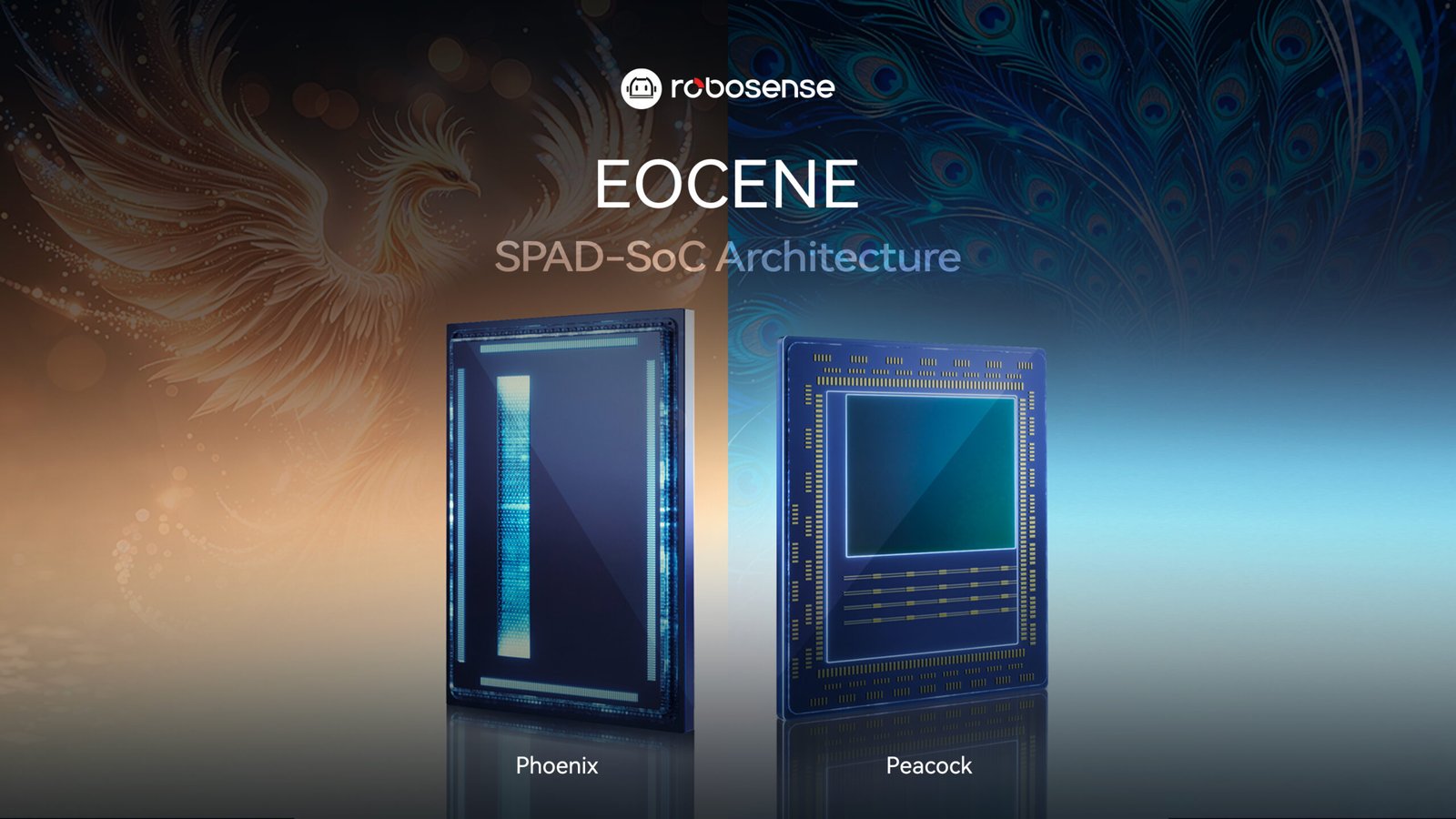
Chip-scale architectures, built on SPAD-SoC designs, can serve both vehicles and robots from a single underlying platform. RoboSense’s Eocene SPAD-SoC architecture, released in April, spans a narrow-array ‘Phoenix’ chip for high-line automotive use and a large-array ‘Peacock’ chip for robotics and blind-spot radar; both enter mass production this year. Its previous large-array chip already powers more than 300,000 units.
Hesai, meanwhile, unveiled its Picasso SPAD-SoC, a 6D full-colour LiDAR chip that fuses depth and colour at the silicon level to produce coloured point clouds. Its ETX series reaches 4,320 lines and is due for mass production in the second half of the year.
From price war to performance war
The shift is rewriting the competitive map. Historically firms competed on integrated manufacturing and cost; now the moat is chip design. Hesai’s own signal-processing chips have shipped 2.3 billion units, and its 2025 revenue reached 3.028 billion yuan, up 45.8 per cent, with a net profit of 436 million yuan, its first full-year profit.
RGBD single-chip approaches promise to merge camera and LiDAR into one low-cost sensor, but resolution still lags far behind automotive cameras, and pure-camera routes from Tesla and Xpeng keep the pressure on. The consensus forming among investors is that the long-term race favours those who own the silicon, not just the box.
When optical giants like Ofilm enter with contract-manufacturing economics, the industry may replay the camera supply chain: clear division between chip designers and assemblers, lower system cost, and a bigger total market. LiDAR no longer has to explain why it exists. It now has to decide where it sits in the chain.
Translated and adapted from Leiphone (leiphone.com).