The auto industry’s structural strengths, a deep supplier base, a manufacturing culture and tolerance for long-cycle capital, are now being aimed at humanoid robots, and the strategies split into two clear camps.
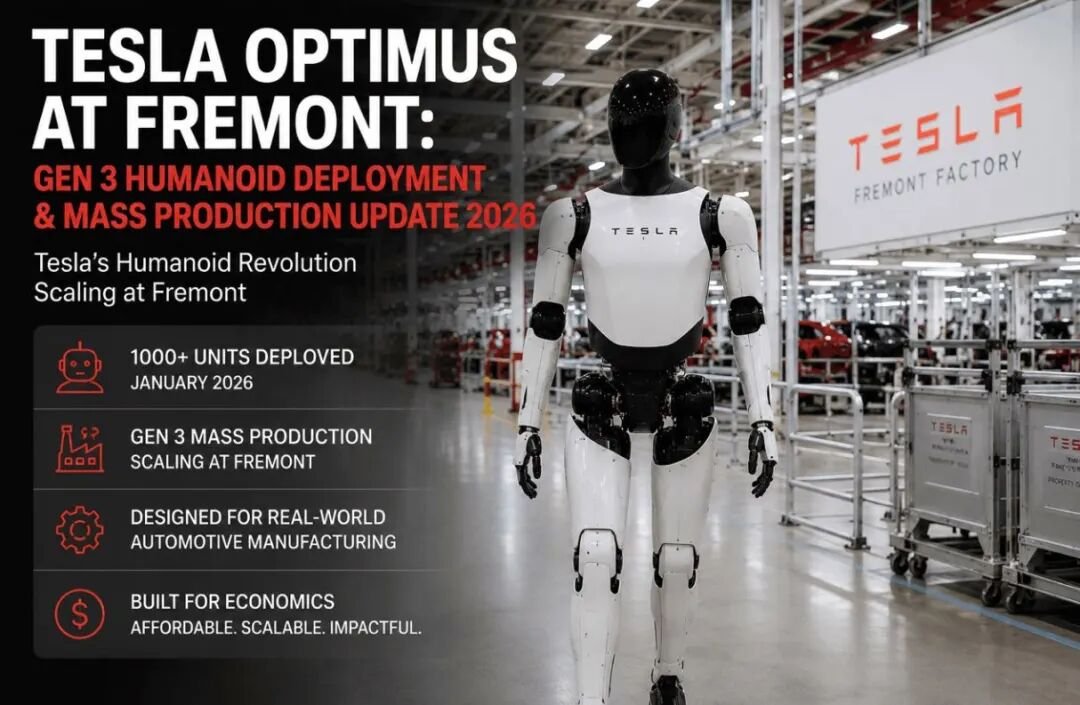
Tesla’s product play
Tesla targets a 20,000 to 30,000 dollar Optimus, roughly the price of a Model Y, by reusing its motor, battery-management and sensor supply chain and driving cost down through scale. The deeper move is the data flywheel: with more than a thousand Optimus units inside its own factories by 2026, each robot becomes a node that generates training data through failure and recovery. It is the same logic Elon Musk used at FSD, now applied to the body. Workers on the line, though, report an adjustment period as robot behaviour is not yet fully predictable at crossing points.
Hyundai and BMW, the tool camp
Hyundai’s route runs through Boston Dynamics, whose all-electric Atlas shows best-in-class dynamics, paired with Google DeepMind for reasoning and an aggressive ‘robot as a service’ subscription model that leases advanced robot labour. BMW is more circumspect: it validates Figure 02 and the wheeled Hexagon Aeon in controlled pilots, locking robots to three task types, monotonous, ergonomically risky and high-voltage work, a design choice that eases passage under Europe’s AI Act and union frameworks.
What both camps share
Tesla builds a standalone product and platform; Hyundai and BMW treat the robot as a manufacturing tool. Both chase the dark factory where humanoid robots reuse human tools and stations. But three contradictions loom: the labour transition as technology matures, the dexterity ceiling on flexible materials where touch still beats code, and a total cost of ownership where software iterates in weeks while expensive hardware ages over years, dampening real procurement appetite.
Read the original report (OFweek Robotics)
Translated and adapted from OFweek Robotics (robot.ofweek.com).