At most five companies in China are genuinely making money on ego data this year. The person making that call is Yuan Rizheng, an entrepreneur in embodied data. His name may be unfamiliar, but people in the field know the company: EgoScale.
The obvious assumption is that the name rides on a trend, given that the concept was popularised by Nvidia’s EgoScale paper. Yuan says he registered the egoscale.com domain four months before that project was published. As one of the earliest entrants in ego data, he spent more than a year building a collection system and getting an automated processing pipeline working.
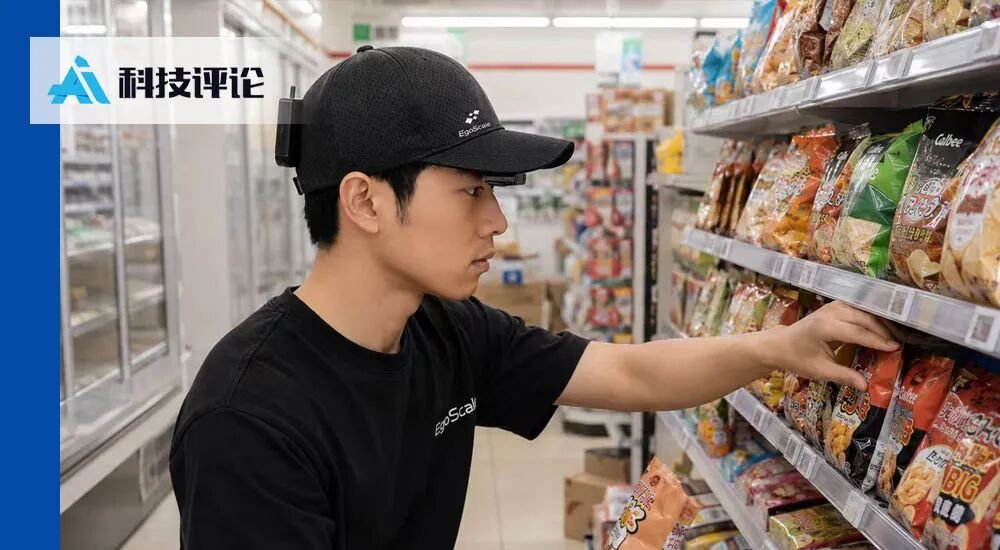
By his account EgoScale now sits firmly in the top three in China by ego data delivery volume, which is the basis for his opening claim. He also notes that some of the real volume producers in the data business operate below the waterline.
So how does a company nobody has heard of reach volume delivery without raising funding? Talking it through, what emerges is a set of views sharply at odds with the industry mainstream, and internally consistent.
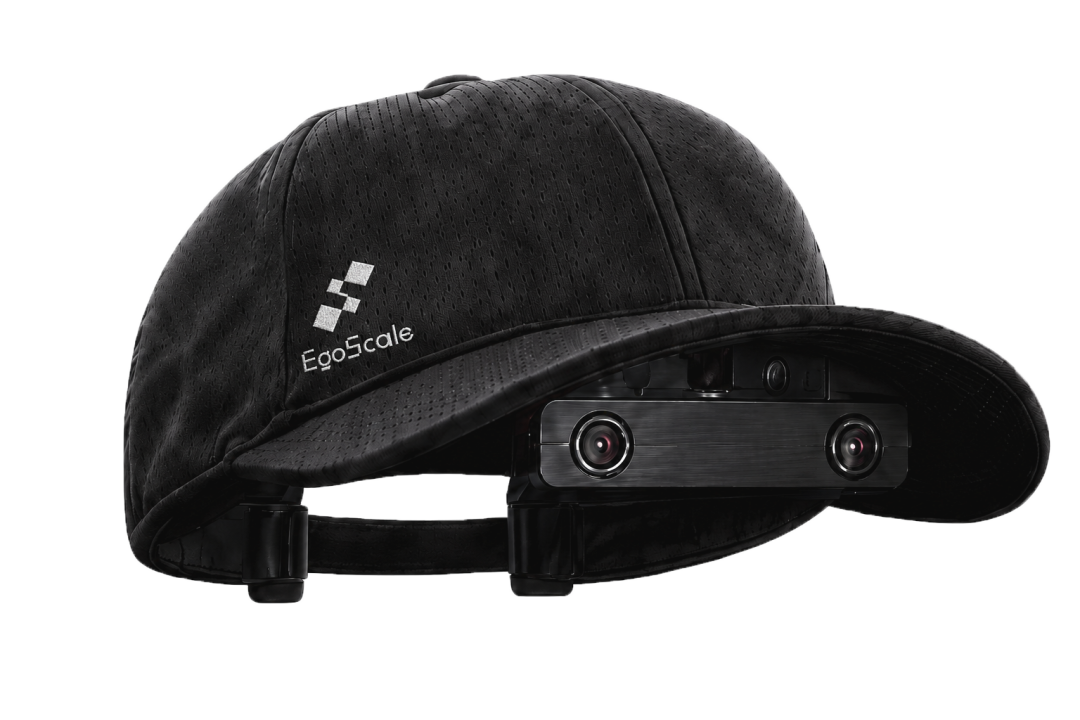
While everyone else builds headband-style collection rigs, EgoScale made a cap with binocular cameras. Most companies design collection hardware from a purely technical standpoint, he says, and almost nobody asks whether the person wearing it would willingly keep it on for ten hours a day.
While the leading players announce targets of a million hours, he argues that competing on data volume may be the industry’s single biggest misconception, and that scene richness and task variety matter far more than accumulated hours. The result of that logic is an operation rotating 1,500 collectors a month, managed by a full-time team of under twenty people, with an effective capture rate of 80 per cent.
A hundred thousand hours can be worth nothing
Asked who is in the market, Yuan divides it into three groups. First, startups with their own hardware collecting raw multimodal data, usually synchronised ego and UMI capture. Second, companies built on annotation pipelines that source material externally and process it, including firms that pivoted from autonomous driving data services and firms that distil ego data out of first-person video on the internet. Third, data companies incubated inside the embodied intelligence ecosystem.
There are many companies in the field, he says, but no more than five teams in the whole of China can deliver at scale and pass acceptance with top-tier customers. EgoScale has entered the supplier systems of several leading domestic and international technology groups, model companies and embodied intelligence firms, and has completed multiple delivery batches.
On what stops the rest, his answer is homogenisation. One major customer told the company it had reviewed forty or fifty demonstrations, domestic and foreign, and that several of the datasets looked exactly alike.
The cause is the collection model, and overlapping sources. Plenty of companies crowdsource by contracting a few business-to-business labour agencies to organise collectors. Those agencies serve several clients at once, so the same location gets shot repeatedly. Think about it from the agency’s perspective, Yuan says: it takes a job from company A, finishes filming, and then has idle staff, so it approaches company B and films the same thing again. Both clients end up with data captured by the same crews. Even paying a premium for an exclusive data agreement leaves you with undifferentiated second-hand material at the supply chain level.
The alternative, collecting inside data factories, has its own limit, because the range of scenes and tasks available there is extremely narrow. A hundred thousand hours drawn from ten to fifty factories is overfitting by construction, highly repetitive, and of low marginal value for training a world model or a vision language action model.
EgoScale runs its own collectors instead, spread across the country, which is how it captures a genuinely varied set of real environments. Data comes down to two things, he says, collection and processing, and outsourcing collection entirely leaves very little core asset underneath.
On scale he is unequivocal. Companies routinely claim a hundred thousand hours in hand. Between two datasets of the same size, one covering fifty scenes and one covering fifty thousand, the second is worth far more. Most of the industry is building the first kind, because piling up hours is much easier than expanding coverage.
Diversity in his definition is not only scene count. It includes tasks, actions, objects, tools, people, environments, operating paths, successful and failed attempts, and anomaly and recovery behaviour. A further difference, he says, is that the data is highly structured and meets the requirements for direct model training.
Homes, not factories
Against the argument that general-purpose data is unrealistic today and teams should simply fill whatever skill gap they have, Yuan draws a distinction based on the goal. If you only need a demonstration that completes one industrial grasping pose, a company can hire a few people and collect it itself, with no need for a third-party data supplier. Most of EgoScale’s customers are building general embodied models, and what those need underneath is large-scale, generalised real human life data, including a share of corner cases.
The company concentrates on domestic and commercial settings and essentially avoids industrial capture. Home data is a priority in China and abroad, and home robots are especially popular overseas. Yuan spent time with high earners in Silicon Valley last year, including people in consumer products and executives at Tesla, and found a common anxiety about coming home to a large pile of housework. Even on an annual income in the millions of dollars, paying tens of thousands of dollars a month for domestic help does not feel worth it.
Industrial settings involve doing fixed things in a fixed environment, he adds, so a few fixed cameras are enough and ego capture is unnecessary. Before May last year every ego data company was collecting industrial data, which in his view never made sense.

The cap
The collection device is a cap. Yuan describes it as the first binocular data collection device anywhere and the first in cap form, in continuous use but never publicly launched, to avoid being copied. A small power bank fixed with hook and loop tape supports ten hours of continuous shooting, with no complicated mechanical structure, and it adds almost no perceptible weight. Wearing a cap also means neither the collector nor the people around them find the situation awkward, so the work looks natural.
A lot of comparable products are assembled from parts and marketed as in-house designs when they are really built around a GoPro, he says. The EgoScale hardware is custom designed end to end. When investors ask how the company competes with its peers, his response is to ask how they intend to compete with EgoScale.
Smart glasses were tested for a year. If anyone understands glasses-based collection better than we do, he says, it can only be Meta. The conclusion was that glasses hit bottlenecks on weight, battery life, heat dissipation, cost and specification.
On why the design converged on two cameras rather than the six some rivals use, he says conversations with overseas academic communities produced a core judgement. The question is whether you are collecting the environment or building training data for hand manipulation. If the aim is to train a brain to execute manipulation, watching the two hands in front is enough, so why look behind. The value added by six cameras does not necessarily cover the hardware and hidden costs, because every extra camera multiplies data volume and raises the cost of transmission, processing and storage.
Same day up, next day out
Data goes to local storage and then uploads wirelessly. No card removal, no shipping units back to a factory, no manual copying. Capture, upload and feedback happen the same day, and tasks update automatically the following morning. A six-camera setup cannot do that, because one more camera makes it impossible to finish uploading within the day. Nobody else in the world has closed that operating loop, he claims, and the reason rivals do not do wireless transfer is product thinking rather than technology.
Card-based transfer forces centralised management, which looks efficient in theory but delivers low diversity at high cost, requires offline supervision and leaves intermediaries taking a cut. EgoScale recruits consumer-side collectors online, ships and collects devices, and handles the whole relationship remotely.
The collection system turns over 1,500 people a month, most of them mothers at home, and the annotation system runs to 800, with allocations adjusted dynamically. The company has fewer than twenty full-time employees, and had only six before April, relying on automation to manage collectors online.
With people scattered across the country, quality would seem hard to control. EgoScale reports an effective capture rate of 80 per cent, against 50 per cent or even 10 per cent at many competitors. The difference, Yuan says, is understanding human nature. What collectors care about is earning money, so training does not lecture them on standards. It tells them that shooting from the wrong angle means earning less.
Product people over technical people
That framing is unorthodox in a field full of technical founders with doctorates. Yuan has been starting companies since 2015, built two successful products as an undergraduate that gave him his first capital, has done angel investing, and worked as a product manager at Ant Group. Understanding product and understanding people matters more than understanding technology, he argues. It is what allows the hardware to be light and comfortable enough that someone will wear it for ten hours, and what tells him customers do not want a complicated quotation but a standard product priced by the hour.
Product specialists are harder to hire than technical specialists, in his view, because technical requirements are standardised while people who understand hardware, software, operations and automation together are scarce.
Asked whether ego data collection is really just organising people to shoot video, and whether the field has any technical barrier at all, he concedes the first hour is trivial. Collect one hour of data, post-process it, and there is no barrier whatsoever. The real barrier is whether you can produce high-quality, directly trainable data continuously, at scale and efficiently.
What that looks like in practice is a delivery package that goes well beyond raw video. It includes synchronised binocular imagery, IMU readings, timestamps and calibration parameters, together with training-grade material such as task descriptions, action segmentation, hand pose and trajectory, quality scores and scene metadata. Handling that volume of processing at scale rests on an automated system built from three parts: collection, annotation and operations.
Editor’s note: this English report is an adapted translation of a Chinese-language original published by LeiPhone (leiphone.com). Figures, dates and direct quotations follow the source.