From Optimus to Atlas, and on to the humanoid pilot running inside BMW plants, carmakers have become one of the main forces pushing embodied intelligence towards industrialisation. Behind the different routes they have chosen, a contest over the future of manufacturing has already started.
The past decade put the car industry through electrification, intelligence and software-defined vehicles in quick succession. In 2026 a new shift is visible: more and more vehicle manufacturers are turning into significant participants in the humanoid robot industry. Tesla is accelerating volume production of Optimus, Hyundai is exploring commercialisation through Boston Dynamics, and BMW has brought humanoids into a real production system. Carmakers are moving from users of robot technology to parties shaping how the sector works.
This is not simple business extension. The core capabilities a humanoid demands, which include precision manufacturing, supply chain management, volume production, patient capital and complex systems integration, happen to be exactly what the car industry has spent a century accumulating. In a sense the humanoid is becoming the next class of industrial product that the car industry is trying to redefine, after the electric vehicle.
The different paths taken by Tesla, Hyundai and BMW also reflect the central disagreement about how embodied intelligence gets commercialised. Is a robot a new consumer and industrial product, or is it the next generation of manufacturing tool?
Musk’s number
Understanding Tesla’s ambition means understanding Elon Musk’s narrative logic first. He has said repeatedly that the long-term value of Optimus may exceed Tesla’s car business, and has tied it directly to the company’s valuation, arguing that anyone who does not understand Optimus does not understand Tesla’s future. The judgement rests on market size: the global labour market is worth far more than electric vehicles, and if robots can replace or exceed human labour, the ceiling is close to unmeasurable.
Not everyone is buying it. Adam Jonas at Morgan Stanley is a firm bull, and his team believes the Optimus business could contribute a substantial share of Tesla’s valuation within a decade, making it one of the core drivers of a re-rating. Others are more reserved. Goldman Sachs has noted in research that humanoid commercialisation timelines have been repeatedly overestimated in the past, and that Tesla’s volume targets carry execution risk on supply chain and reliability that has not been fully disclosed.
Rules out, reasoning in
Against that background Tesla has taken the most aggressive productisation route. The most significant technical change in the third-generation Optimus is not hardware specification but control architecture. Tesla has ported the end-to-end neural network approach developed for full self-driving into robot control, and integrated the semantic understanding of large language models.
The difference is substantial. Traditional industrial robot control is rule driven: engineers write precise instructions for every movement and the machine executes a fixed programme. It is efficient and reliable but barely adaptable, and a new task usually means reprogramming. Tesla’s end-to-end approach is closer to how people learn. The robot observes large volumes of demonstration data showing how humans complete a task, then generates its own behavioural policy. Tesla’s AI team has described this as a closed loop from observation to action, in which the robot does not consult a rule book but reasons its way through objects and scenes it has never encountered.
Hardware improved too. Degrees of freedom in the dexterous hand have multiplied, allowing finer manipulation, and new motion control algorithms have made walking and turning steadier. Combined with a pressure sensing system, the robot can feel and adapt to contact surfaces of different hardness and shape. Each of these maps to a hard requirement of real factory work, because a robot that cannot handle irregular parts and falls over on a wet floor is of no use in production.
Opinions on the approach differ. End-to-end methods have a theoretical advantage in generalisation, but their brittleness cannot be ignored, because model behaviour outside the training distribution is hard to predict, which is a serious matter in safety-critical industrial settings. Tesla’s answer is continuously expanding internal deployment: more robots in more complex situations produce more failures and more correction data, and that in itself is the route to reducing brittleness.
Making a robot the way you make a car
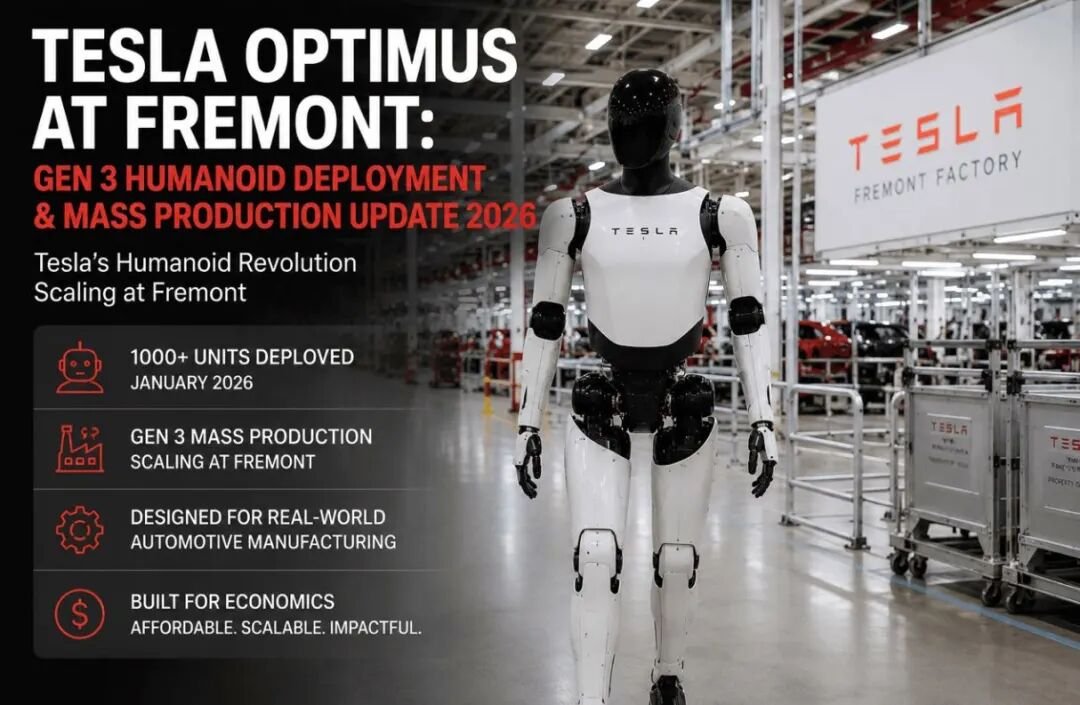
One of Tesla’s core advantages is its ability to apply car manufacturing thinking to robot manufacturing. The clearest expression of that is the conversion work at Fremont, where a dedicated robot production validation area has been set up inside the plant. The implied ordering of strategic priorities is unmistakable: future profit is expected to come from embodied robots rather than luxury electric cars.
Planning for a second production base at the Texas gigafactory reinforces the point. The goal is not a few hundred units a year for research institutions but genuine volume at the scale of a million units. That number still sounds fanciful today, although it is worth recalling the scepticism that greeted Tesla’s announcement in 2012 that it would build a million Model 3s a year.
Volume depends on cost. Tesla is targeting a price of 20,000 to 30,000 dollars for its embodied robot, roughly equivalent to a Model Y and about a tenth of what high-end industrial robots currently quote. Getting there relies on scale effects driving down component costs and on heavy reuse of the automotive supplier network. The supply chain Tesla has built over years in motors, battery management and sensors provides ready-made infrastructure for robot production.
Supply chain specialists generally accept that the reuse advantage is real, while pointing out that robots demand higher component yield and consistency than cars do. A car with an occasional minor fault can be recalled and repaired. A robot working alongside people in a factory can cause a safety incident with any unexpected failure. Tesla therefore has to compress cost and simultaneously build a higher standard of quality control, and those two objectives are naturally in tension.
By 2026 Tesla has deployed more than a thousand Optimus units internally, mainly on factory logistics and battery assembly. Media coverage tends to read that number as commercial progress, but its deeper significance is data collection. Every internally deployed robot is a data-generating node. They perform tasks in a real factory, fail, feed data back and drive model iteration. It is a self-reinforcing training loop: more robots in more complex scenes make the model stronger, and a stronger model lets robots handle more complex tasks and reach more settings.
The flywheel closely resembles Tesla’s path in full self-driving. Andrej Karpathy, Tesla’s former AI director, has said more than once that the company’s real competitive barrier is not hardware but real-world data at scale. He was talking about driving, and the logic transfers. The Optimus fleet on the factory floor is now supplying raw material for the next generation of embodied models.
The experience of Tesla’s own workers is often left out of this discussion. Reports suggest some Fremont employees found working alongside robots uncomfortable during the adjustment period, not because they feared for their jobs but because robot behaviour remains hard to anticipate, forcing people to give way where paths cross. Tesla engineers are working on improving how robots express intent, but human and machine collaboration still needs smoothing out.
Hyundai and BMW take the other road
If Tesla is pursuing a mass-market, product-native route, Hyundai and BMW represent the other typical choice of established carmakers: use mature global supply chains and outside partners to slot humanoids precisely into existing manufacturing and service systems. Neither is in a hurry to reinvent the wheel. Through acquisition, cross-sector partnership and limited pilots, they are looking for a more pragmatic balance between hardware limits and engineering delivery.
Hyundai has taken a technology flagship and commercial innovation route, and its main weapon is Boston Dynamics, brought fully in house in 2021. The all-electric Atlas, which stepped into the foreground in 2026, represents some of the most advanced dynamics control in bionic robotics. Where Tesla emphasises end-to-end AI reasoning, Atlas shows the absolute advantage of hardware maximalism in adapting to unstructured terrain, in fluidity of movement and in action-level control for complex assembly.
Hyundai’s ambition is to turn that hardware asset into a durable commercial moat. On one side it has integrated an AI ecosystem with Google DeepMind, using reinforcement learning to add cognitive reasoning and fill the software gap. On the other it has broken with the traditional hardware sales model and is pushing an aggressive robots as a service subscription approach. With the first Atlas units landing in Hyundai’s own plants, the group is attempting to export rentable advanced robot hours to global manufacturing.
BMW offers a more cautious and pragmatic European alternative. It has no plan to build its own robot brand and has announced no million-unit expectations. Its strategy is to select the right external partners and run controlled pilots on real production lines. In the prudent style typical of European manufacturing, the humanoid is not a disruptor of existing automation but an efficiency supplement inside a human and machine collaboration framework.
The approach shows a clear engineering culture and a deliberately hard-first deployment logic. By bringing in Figure 02 from the Silicon Valley startup Figure, BMW first cleared process validation at its Spartanburg plant, putting robots through real production-line durability testing on high-value, high-precision operations. It has also introduced Hexagon’s wheeled humanoid Aeon, using the stability and movement efficiency of a wheeled platform on flat floors to sidestep the control risk of bipedal balance. Full testing at the Leipzig plant in the summer of 2026 marks the point where these pilots move towards real deployment.
BMW has locked robots onto three categories of work: monotonous repetition, operations carrying high ergonomic injury risk, and tasks involving high-voltage electrical hazard. People retain exception handling and quality inspection. This incremental strategy hedges against asset write-downs while the technology route is unsettled, and it passes through Europe’s demanding regulatory and trade union frameworks, including the AI Act, far more easily than a narrative about robots replacing labour.
Two camps, one lights-out factory
Placed on the same axis, the three companies fall either side of a reasonably clear line. Is the robot business an independent product and ecosystem platform, as at Tesla, or a manufacturing and optimisation tool, as at Hyundai and BMW?
Tesla’s answer is the most explicit. The robot is a core standalone product line, sold to outside customers, with the goal of building a new platform ecosystem. Hyundai and BMW form the integration camp. Hyundai sits between the two poles, using robots as a service to define the robot as an exportable industrial service capability, which is still fundamentally a carmaker extending beyond cars. BMW treats robots purely as a tool for iterating manufacturing, with no separate business model, and values them for solving structural labour shortages and safety problems in its own production.
The split determines where each side wins. The independent product camp sees a valuation re-rating soonest. The integration camp is better placed to create demonstration effects in high-value industrial settings and to advance pilots inside European manufacturing.
For all their differences, both camps share one industrial vision: the lights-out factory. Humanoids free production facilities from the fixed tracks of conventional robot arms and allow machines to reuse human tools and workstations directly, which is what makes full automation plausible at scale.
Three contradictions nobody can route around
The first is between the technology dividend and the employment transition. Companies pushing the technology emphasise that robots are meant to reduce the burden on staff, but once the technology matures, economic rationality points to labour substitution. The McKinsey Global Institute has repeatedly estimated that tens of millions of factory jobs worldwide face substantive change by 2030, with the sharpest impact on developing countries that depend on low-cost labour. Embodied robots threaten semi-skilled roles requiring situational adaptation, which is the largest single group among manufacturing workers. Policy has diverged as a result. The European Union is tightening safety and worker protection provisions for industrial robots through the AI Act, while the United States has a federal policy vacuum. Regulatory uncertainty is now the largest external variable constraining either camp.
The second is the gap between the vision of general industrial intelligence and the technical ceiling. Both camps run into the same structural bottlenecks. One is dexterity: fine operations such as stitching wiring harnesses or handling flexible materials remain an engineering problem. The industry broadly agrees that fusing tactile and force sensing, so that a robot genuinely feels contact, is among the hardest obstacles in robotics today and considerably tougher than motion control. The other is the generality gap. Existing control systems perform well on specific fixed tasks but stay extremely fragile when confronted with a toppled shelf or a part of unknown shape. The merger of large models and embodied control is moving quickly, yet it largely remains capability validation in controlled settings, several technology generations away from general industrial intelligence able to cope with real factory complexity.
The third is the mismatch between total cost of ownership and the lifespan of hardware and software. Once maintenance, training and systems integration are included, the real five-year cost of ownership of a robot at Tesla’s stated 20,000 to 30,000 dollar price is still higher than conventional automation equipment. One view holds that the flexibility premium only covers the cost when robots can switch tasks frequently. The more serious systemic problem is the mismatch between brain and body. AI models can iterate weekly over the air, but expensive physical actuators and hardware last for years. A robot bought today may in three years be unable to carry the capabilities of new algorithms. That mismatch in iteration cycles is heavily suppressing genuine purchasing appetite downstream.
Why carmakers
Back to the original question. The structural advantages of the car industry matter, including supply chains, manufacturing culture and tolerance for long-cycle capital, but the deeper reason is that carmakers need robots to solve their own problems more urgently than any other sector. Labour shortages from an ageing society are steadily eroding the manufacturing workforce. The shift to electric vehicles has changed assembly processes and demands more flexible line configuration. Manufacturing reshoring driven by trade friction runs into the hard constraint of high labour costs in developed economies.
Put differently, carmakers are investing in robots both to solve their own problems and because they have found a new market. That pattern of self-use driving external commercialisation resembles the development of Amazon Web Services. Amazon built cloud infrastructure to support its own retail operation, then realised the capability could be sold to everyone, and created a growth engine larger than the retail business. Tesla’s most attentive investors have already begun to reassess the potential contribution of Optimus along the same lines.
Viewed at the level of industrial structure, large-scale humanoid production would fundamentally reorganise how manufacturing works. In a world where labour cost is no longer the main variable, the logic of where to locate a factory changes, and brand, design, supply chain flexibility and delivery speed become more important competitive dimensions than cheap labour. The effect on the global manufacturing map would run far deeper than any tariff adjustment.
Tesla, Hyundai and BMW have entered the same race at different speeds and from different angles. There is no absolute winner among the routes, only different bets and different timetables. Their success will be shaped not only by their own technology and execution but by the pace of general AI breakthroughs, the speed at which regulatory frameworks take shape, and how far manufacturing customers are willing to go. The year 2026 is a decisive one, but it is not the year the answer arrives.
Editor’s note: this English report is an adapted translation of a Chinese-language original published by OFweek Robotics (robot.ofweek.com). Figures, dates and direct quotations follow the source.