Six rounds in half a year
Delta Intelligence, a Chinese humanoid foundation-model company founded in January 2026, has closed an angel++ round worth close to 500m yuan, the sixth financing the company has raised in the six months since incorporation. Investors in this round include listed-company strategic backers and tier-one financial institutions.
Proceeds will fund continued iteration of the company’s humanoid foundation model, mass production of its in-house data-capture hardware, a closed-loop data pipeline and expansion of the core research team, with the goal of pushing the technology through engineering validation in real industrial settings.
The bet is native 3D
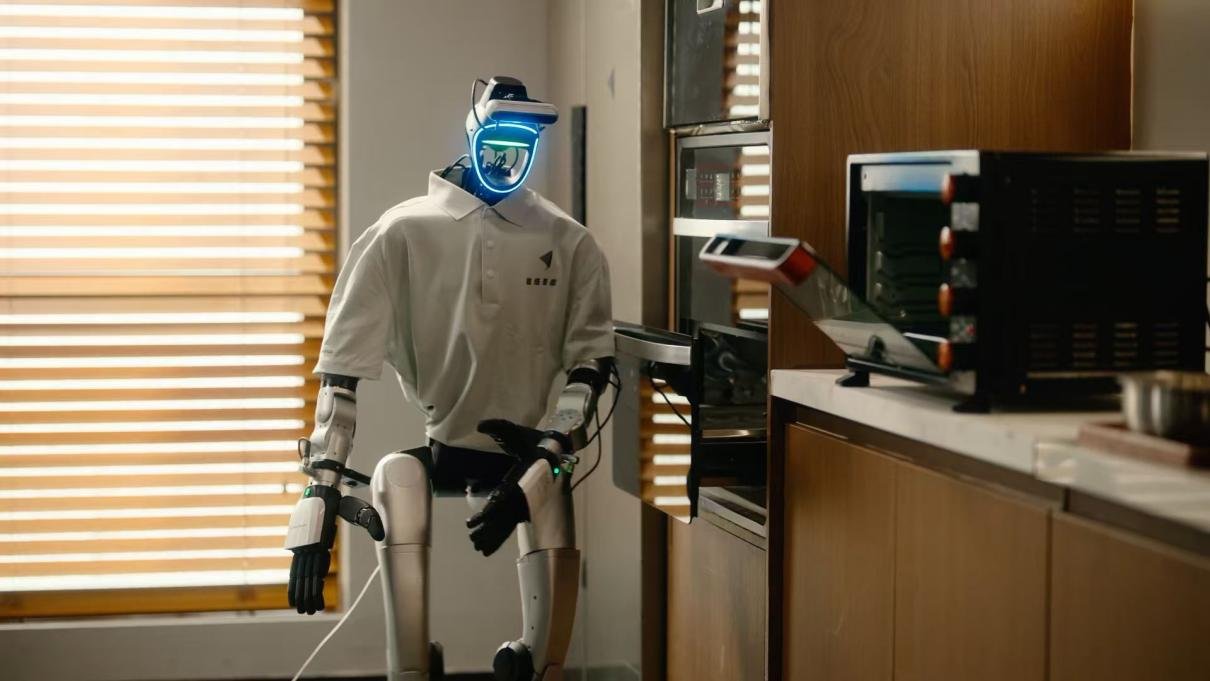
Delta’s research direction is described as a native general-purpose humanoid foundation model, and the word native is doing work. The company’s argument is that today’s mainstream embodied models build their spatial understanding on 2D visual representations, where a monocular image has no real depth. Estimating distance from pixels alone produces large errors. A robot standing in front of a door struggles to judge how far the handle is, which way it swings and how much clearance its body needs. Such fuzzy judgements accumulate once the robot is dropped into a real factory and tasked with long-horizon continuous work.
Delta replaces the substrate. The company has built an in-house native 3D world engine that uses 3D representations as the model’s core input, capable of consuming point clouds, Gaussian splatting and other 3D scene representations directly. Native 3D understanding, reasoning and prediction of future environment state sit on top of that engine.
Cerebrum, cerebellum and a force-position layer
On top of the engine runs a three-layer collaborative architecture the company calls the brain plus cerebellum plus force-position hybrid.
The brain handles environment perception, long-horizon task planning and manipulation decisions, and is trained almost without simulation data. Simulators struggle to reproduce soft deformation and the multi-contact forces that matter in real manipulation, so the brain has to rely on real-robot native interaction data.
The cerebellum handles whole-body balance and low-level control, trained in simulation through large-scale reinforcement learning, converting the brain’s sparse intent into tens to hundreds of hertz of full-body motor commands. A force-position hybrid layer then outputs compliant control. The three layers divide labour cleanly and run in a closed loop.
Where does the data come from
Brain training depends on real-robot interaction data, and there is no off-the-shelf source.
Most data-collection schemes on the market only capture local actions such as hand movements, and models trained on that data struggle to grasp full-body interactions with the environment, or tasks that depend on whole-body coordination such as climbing ladders or pushing heavy doors, Delta founder and chief executive Ma Xiaojian says. A humanoid must capture full-body interaction with the environment in order to build a world model without cognitive bias.
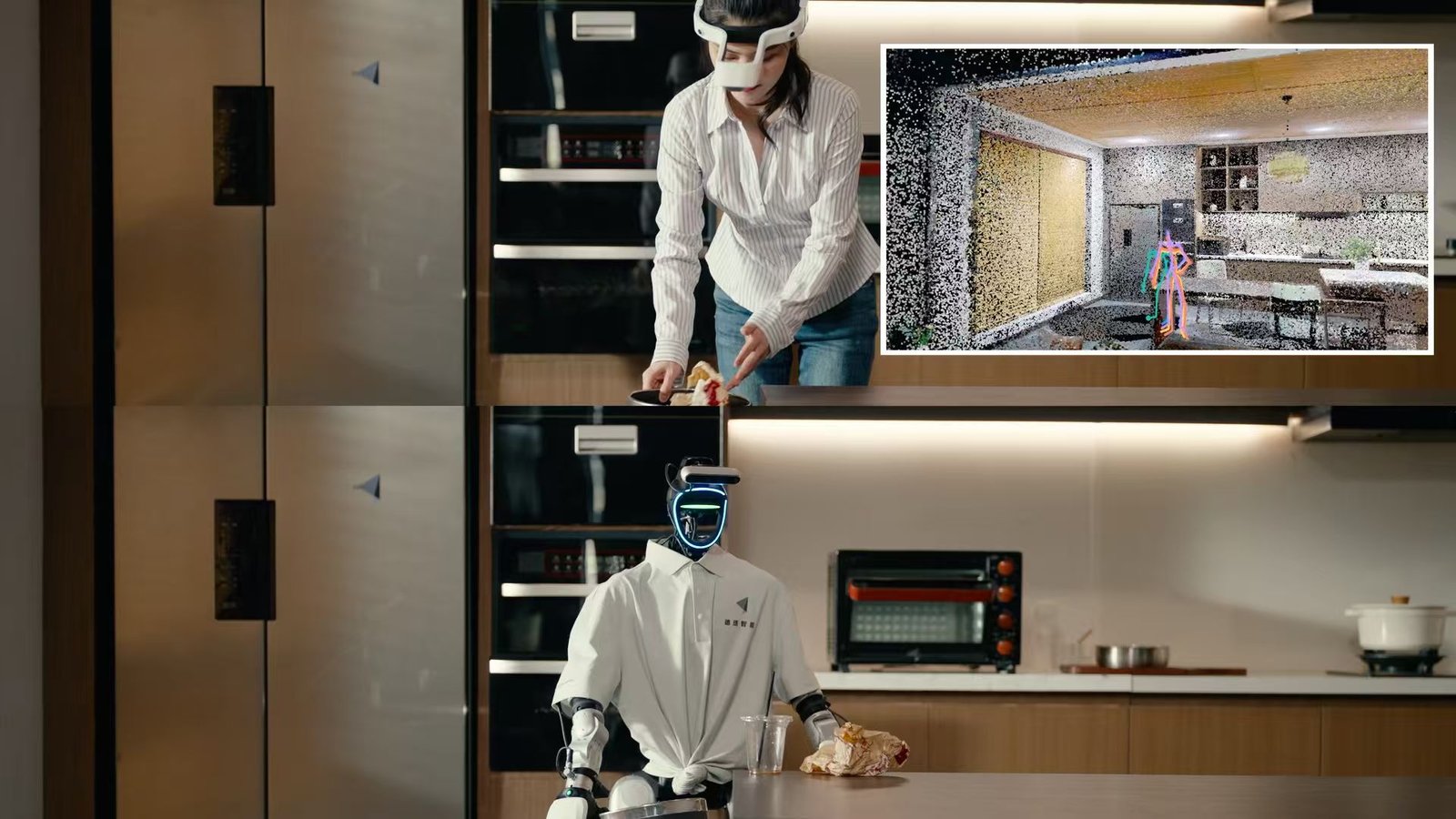
The industry’s mainstream collection output is upper-limb video, where the work process is recorded and sliced into clips, and the model learns from frames. Bipedal humanoid whole-body coordination training needs a different shape of data: full-body skeletal data, motion trajectories of more than a hundred key points across the body, resolved by algorithms into structured data and time-aligned with visual information. There is no mass-production scheme for this kind of data on the market today.
Delta D1, released alongside the new funding round, was built to produce this data at scale. The wearer works as normal, no robot body, no motion-capture studio, no site refit. The device records first-person panoramic vision and full-body joint trajectories simultaneously, with global positioning accuracy kept inside 2cm, and the data is training-ready as soon as collection ends. For fine-grained two-handed manipulation, a handheld accessory called D1-Gripper works with the head-mounted device to fill in end-effector details.
The data gap in embodied intelligence is far beyond what any single company can collect, and Delta is opening the collection system to the industry. The company wants to build an embodied data infrastructure with hardware makers, research institutes and industrial partners. After cross-body retargeting, the collected data can be used to train algorithms on humanoids from different makers, including Unitree’s G1 and H2, AgiBot’s Lingxi X2 and A3, Leju’s Kuafu Gen 4 and Gen 5, and Stardust Intelligence’s Kengo.
Earlier, Delta jointly released an Industrial Dataset 2.0 with the China Academy of Information and Communications Technology, in which workers wearing the D1 collected data on real production lines without interrupting operations.
From demos to physical work
Delta’s foundation model has already entered real work. Power-grid full-body inspection requires a robot to move through complex spaces such as substations while operating equipment. Automotive parts loading and unloading and SMT bin sorting test mobile grasping and continuous transport. These are exactly the kind of tasks for which whole-body coordination must pay off.
What supports the pace of deployment is a standardised cross-body adaptation pipeline: full-body motion-capture data collection, cross-body motion retargeting, cerebellum simulation reinforcement learning, and fast cerebrum fine-tuning. Adapting to a new body does not require re-collecting massive datasets or retraining systems from scratch. With a complete underlying technology stack, Delta has established long-term cooperation with leading humanoid makers including AgiBot, Leju, Stardust Intelligence and Unitree, and the standardised adaptation pipeline allows the model to migrate quickly across different hardware platforms.
The competition in embodied intelligence is moving from motion demonstration to physical work. What determines whether a humanoid can actually do the job is the precision of its 3D spatial understanding and the reliability of coordinating dozens of joints across the body. After six funding rounds in half a year, Delta is supplying the whole-body intelligence substrate for general-purpose humanoids.
The team
Ma Xiaojian, founder and chief executive, did his undergraduate degree in computer science at Tsinghua and his PhD at UCLA. He worked at Google Robotics and NVIDIA Research on robot learning and large-scale machine learning, then served as a researcher at the Beijing Institute for General Artificial Intelligence, leading cross-body embodied intelligence projects that pushed the same model to migrate across different makers’ hardware.
Liu Hangxin, co-founder, did his undergraduate degree at Virginia Tech and his master’s and PhD at UCLA in mechanical engineering and computer science. He is an assistant professor at Peking University’s Institute for Artificial Intelligence, with publications in Science and Nature sub-journals. He was previously a researcher and director of the robotics laboratory at the Beijing Institute for General Artificial Intelligence, working on robot perception, cognition and learning and human-robot interaction.
Huang Siyuan, co-founder and chief scientist, did his undergraduate degree in automation at Tsinghua and his PhD at UCLA. He is director of the embodied-robotics centre at the Beijing Institute for General Artificial Intelligence, and previously worked at DeepMind and Meta. He proposed a unified model of spatial intelligence covering generation, understanding and planning, and a unified theory of force-position hybrid control, with related work winning the CoRL Best Paper Award.
Editor’s note: this English report is an adapted translation of a Chinese-language original published by LeiPhone (leiphone.com). Figures, dates and direct quotations follow the source.