Since the middle of 2025, continual learning has been treated as the hardest mountain on the road to artificial general intelligence. Richard Sutton, father of reinforcement learning, argued in a September 2025 conversation that the real world is too vast and too changeable. An agent must learn as it goes through direct interaction. Static pretraining alone cannot produce general intelligence and ends up mimicking existing human text. In October, Andrej Karpathy said on a podcast that agents cannot work like human interns precisely because they lack continual learning. You cannot hand them a task and expect them to remember it and change their behaviour. He estimated such underlying cognitive flaws would take roughly a decade to smooth out. In April 2026, Demis Hassabis was still saying in a Y Combinator interview that current models lack one or two key pieces, with continual learning, long-horizon reasoning and memory at the top, and that the fix likely needs new theory or architecture rather than bigger context windows.

Why does it matter? Ilya Sutskever put it plainly in a November 2025 interview. Pretraining packs the enormous knowledge humans have projected into text into a model, but generalises far less efficiently than a person. A teenager learns to drive after a dozen hours on real roads. We cannot cram every edge case and every future data point into pretraining and expect a model to be omniscient at birth. If AI is to leave the question bank and take real work in the open world, it must figure things out by trial and error in unfamiliar situations and learn as it goes.
For more than a year the topic was endlessly discussed and barely moved. Through 2025, industry progress came in context window length, a form of temporary working memory. Long-term memory, which continual learning actually depends on, barely moved. At the end of that year, Yoshua Bengio and dozens of colleagues published A Definition of AGI, a systematic check of frontier models against ten cognitive dimensions. General knowledge, literacy and maths were near expert level. Long-term memory storage scored 0 per cent.
Late 2025 brought end-to-end test-time training and Google Research’s Nested Learning, new paradigms that modify local parameters during inference so a network grows memory as it runs. Neither has triggered a real architectural shift in mainstream commercial base models.
A folder, a wiki and no instructions
The first half of continual learning, updating memory during operation, was solved in the first half of 2026 as agent engineering exploded. Agents no longer just remember your name and job and paste them into a system prompt. They search a warehouse of past information for relevant clues on demand. With Markdown state files and layered indexes spreading through the community, the granularity of that search keeps sharpening.
The second half, whether a model knows what to remember and which facts will help on an unfamiliar future task, stayed open. Through the second half of 2026, papers on context compression, memory selection and external memory pipelines poured in. I read more than twenty. Most remained in the phase of humans writing rules, designing elaborate flows, scorers and routers to tell the model how to take notes.
Two Meta papers from autumn are typical. Context Language Models, published at the end of September, uses targeted post-training to teach a model to add, delete and compress context. Routed Continual Learning from Meta FAIR on 28 October uses a large-model router to sort memories into prescribed modules and formats, cutting call costs by 65 to 72 per cent on mixed task streams against a single global history. Both are engineering advances, but the premise holds. The model cannot manage memory on its own and needs a special post-training environment or an external router.
Then in early November Anthropic published an engineering report, The Components of Agent Memory, with a striking claim. The latest frontier models may already have learned what to remember. A cognitive gap Karpathy thought would take a decade had closed almost unnoticed.
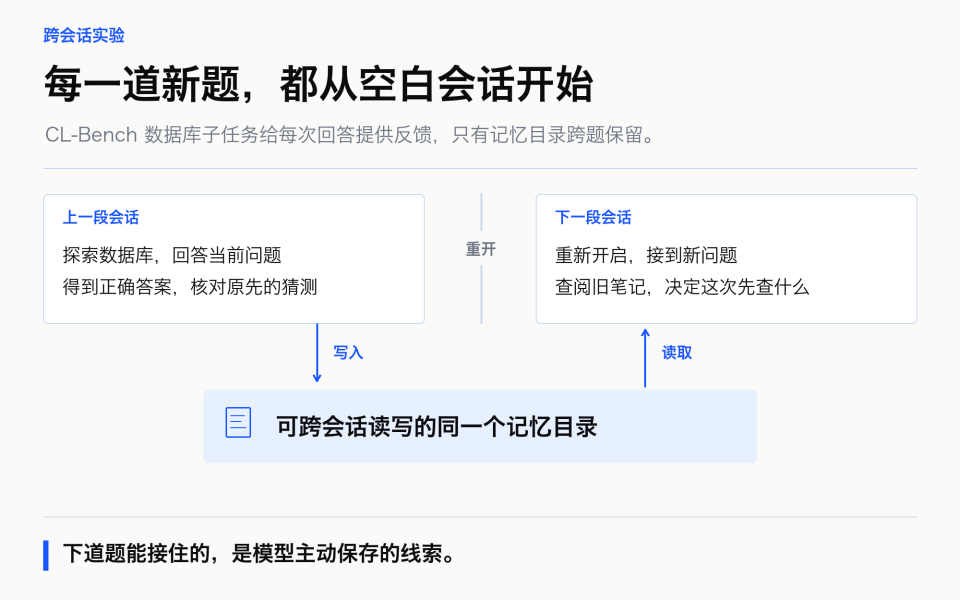
Most commentary focused on the engineering, on the four-layer memory architecture, file line limits and background tidying jobs. The most disruptive information was at the very start. In the baseline experiments, the model got only two minimal configurations. In a single long task, a folder it could read and write freely, and control of file operations. In cross-session scenarios, a standard long-term document directory built from an index file and bidirectional links. Claude’s task was to explore existing files, organise valuable information into linked wiki pages, merge duplicates and cross-check sources.
Nothing else was specified. When to read memory, when to write notes, how to structure folders, how to sort relationships. Human engineers dictated none of it. A year earlier, that much freedom would have produced a pile of noise. Under this almost hands-off framework, the latest frontier models showed autonomous selection of what matters, generalisation of experience and self-correction. Those simple notes actually solved problems the model could not solve in a single pass.
Watching learning happen
Anthropic’s first test was CL-Bench, a benchmark built for continual learning. An agent faces an unfamiliar environment with hidden rules and constraints. Early mistakes are expected. What matters is whether it extracts the implicit pattern from feedback and carries it forward. When CL-Bench appeared in June, the picture was grim. Mainstream models and dedicated memory frameworks such as Mem0, ACE and structured notepads were all tested. Every purpose-built external memory system lost to the dumbest approach of stuffing the full context in. The best configuration captured only 25.4 per cent of the theoretically learnable space. On dynamic tasks like Texas hold’em, taking notes produced large negative returns because the model clung to an early wrong judgement.
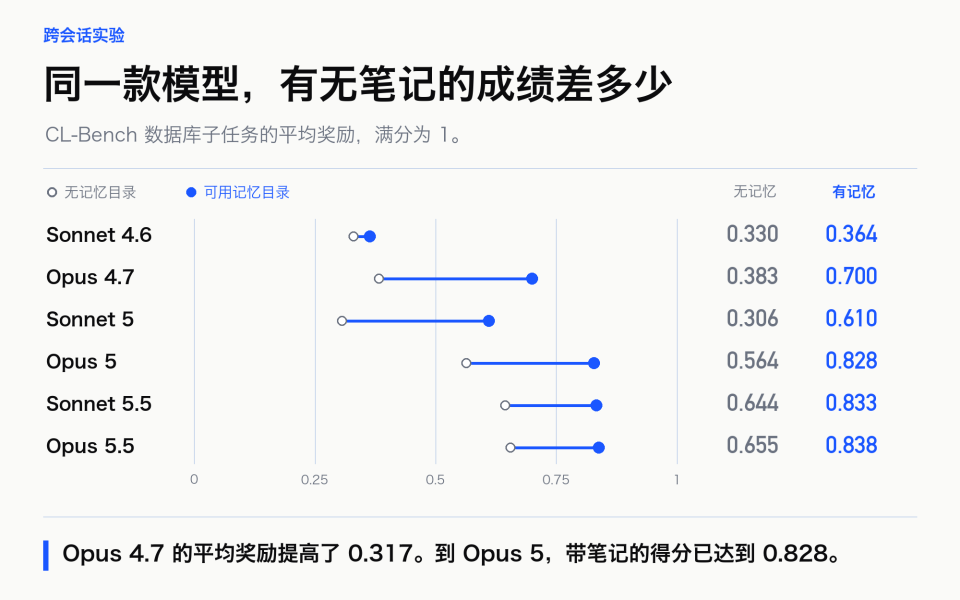
In Anthropic’s experiment, Claude started a fresh session for every problem. The previous chat disappeared. Only what it wrote into the folder carried over. Claude Sonnet 4.6 scored 0.330 with no memory and moved to just 0.364 with a memory folder, a net gain of 0.034, about 5 per cent of the remaining headroom. It remembered to check existing notes in fewer than half the rounds and often wrote initial guesses into documents as established fact, sending later steps down a wrong path.
With Claude Opus 4.7, the model began gathering scattered clues into one main document and, without being taught, separated conclusions verified against environmental feedback from untested hypotheses. Average reward rose from 0.383 with no memory to 0.700, a net 0.317, more than half the remaining space. By Sonnet 5, in nine out of ten cases the model checked old notes at the start without any prompt. By Opus 5, and the latest Opus 5.5 and Sonnet 5.5, a full experience-learning loop had formed. Their notes contain the extracted rules, the evidence used to confirm each rule, past answers and explicit warnings about data traps. With those self-grown notes, Opus 5.5 lifted its CL-Bench score from 0.655 with no memory to 0.838. A full score of 1.0 means zero probe queries and a first-shot answer. At above 0.83, the model has mostly skipped blind table probing on later problems thanks to notes accumulated on earlier ones.
One detail is revealing. Researchers expected that adding human-written note-taking rules, such as a hard instruction to record only failures, would clean up memory. Those rigid rules helped early weak models slightly. On Opus 4.7 and Opus 5, total scores fell. The high-end model’s own judgement about whether a task needs positive patterns, failure cases or intermediate state has become better than a static rule a human wrote in advance.
The same generational split showed in a ten-thousand-step run of Pokemon Red. Early Sonnet 3.7, given file write access, fell into mechanical hoarding. It made 225 folders and 413 fragment files. Every encounter, item pickup and passer-by conversation got its own file, even the gold count and map coordinates already visible on screen. The directory became so messy the model could not navigate it. Most steps went to editing memory and it earned one gym badge. Fable 5, facing the same empty directory, built a clean two-tier structure on its own. A short global.md held overall progress and current goals. Two subfolders, locations and gameplay, held just ten documents. It recorded no transient screen state, only hidden mechanics and validated plans. One note read that after three consecutive failed capture attempts with a ball, you should stop repeating the identical action and change timing or the opponent’s state to escape a pseudo-random loop. With that self-written guide, Fable 5 won four badges in the same number of steps.
Where the ability came from
Anthropic’s memory report shipped on the same day as Project EVE, in which Claude played EVE Online. Across a six-month simulated market, several generations wrote their own scripts to earn bid-ask spreads and traded profitably. Once a script worked, most agents never questioned it again. When the game raised sales tax in March 2025 and killed the arbitrage, Opus 4.7 took two and a half days to notice, and 43 per cent of Opus 4.6 agents never noticed at all. Conventional long-horizon reinforcement learning already gives models ten-hour-scale verification and note-taking, but that instinct does not handle change across much longer cycles.
Dreaming supplies the missing environment with the simplest double-link directory and periodic offline wake-ups, turning short tactical notes into durable experience. The system has four layers. Raw transcripts record every instruction, tool call and real return as an unchangeable factual base. Memory notes are the scattered experiences written during the day, immediately usable but limited by a single session’s view and prone to guesses and stale facts. A structured representations layer of topic Markdown files with metadata headers and bidirectional links forms a knowledge map. At the top, the leanest index is injected into context at each new session, Claude Code by default loading only the first 200 lines or 25 KB of MEMORY.md, so the model knows where to look without drowning its attention.
An asynchronous Dreaming pipeline ties the layers together. It wakes during idle periods or scheduled nightly jobs. It verifies and refines. A lead agent splits logs among parallel analysers. Each reads one full raw transcript, checks existing memory against real tool returns, corrects disproven conclusions, marks obsolete commands, and writes verified parameters, causal mechanisms and lessons into the right topic page with links. Then a separate organiser sweeps the whole library, merges pages that collided during concurrent writes, and when two records contradict with no clear ordering, preserves both sources and flags the conflict rather than guessing. The next day’s agent mounts the tidy library read-only, scans the top index and deepens along links when needed.
In Anthropic’s published bill, processing 50 long session logs, about 12 MB of text, took roughly ten minutes and USD 8 in API cost. It turned tangled multi-round records into a clean, time-stamped knowledge base. The system showed self-correction and the ability to see structural flaws across fragments. In Pokemon, a model had recorded the wrong side of Mt Moon for a Pokemon centre and assumed it had crossed the mountain. Dreaming checked the raw trajectory, corrected the landmark and told the next run to re-enter the cave. Vector retrieval alone would keep recalling that bad note at the same mountain and misdirect every decision.
On enterprise documents, Anthropic tested Opus 5 over roughly 350,000 files and 420 million tokens from the company it acquired in May, Stainless. As offline dreaming grew from 2 sessions to 128, answering 25 cross-library questions from the self-built wiki alone rose from 13 per cent to 48 per cent. Combined with search tools it reached 61 per cent, above 53 per cent for search alone, and saved about 20,000 tokens per question. On the Harvey LAB legal benchmark, 24 questions requiring cross-document comparison and numerical checks scored 87 per cent with the wiki against 73 per cent with plain retrieval.
In a simulated contract review, agents first wrote summaries into one shared clause table, produced rough work and overwrote each other. Only 41 of 57 key facts survived. Researchers did not patch the rules. They had the model review its own failure, rewrite the build instructions and start over. It identified the shared-table concurrency flaw and the loss from summary compression, then required one agent per contract page and verbatim extraction of core clauses. The retest went from 72 per cent to 100 per cent. A second dreaming pass found nine dangling links to uncreated pages, redirected them and built a master index.
Other labs crossed the same threshold in the same window. On 3 November Nvidia published You Don’t Need Long Context. A one-step compression strategy with no extra fine-tuning let off-the-shelf frontier models write a state summary when context filled, clear tool outputs and continue. On SWE-bench Verified it scored 70.2 per cent, slightly above 70.0 per cent for keeping full history, while cutting median peak context to just 8K tokens. GPT-6 Astra’s ARC-AGI-3 result in September told the same story. With only self-selected text notes carried forward it scored 62.7 per cent, against 7.8 per cent for GPT-5.6 Sol. With the official scaffold allowing retained reasoning state and native compression, it hit 99.9 per cent, ran 3.66 times faster, used nearly half the tokens and beat the human median on step count in 96 per cent of levels.
Across Anthropic, Nvidia-tested open and closed models, and GPT-6 Astra, learning how to learn was not a secret recipe hidden in one lab. It was an emergent property across the entire frontier model community.
What produced it was not a memory module. It was ordinary agentic reinforcement learning, rolled out to solve long, complex tasks. Two mechanisms matter. Longer tasks force attribution and verification. Zhipu’s GLM-5.3 report says it uses exactly the same base as GLM-5.2, with every gain from post-training and compute. Research agents faced environments equivalent to days of senior engineering work, up to 600 interactions and ten hours of runtime. With GRPO, the score depends only on whether the task was completed. In a black-box sandbox lasting hundreds of rounds with hidden variables, guessing or building on an unverified hunch wastes everything. A wrong assumption at step ten invalidates four hundred steps of correction. To survive that binary reward, models developed a muscle memory of probing, verifying and then concluding. Anthropic’s Claude Mythos Preview system card records that after large-scale agentic RL, models read context and run small verifications before editing code without any prompt.
The second mechanism is cross-compression trajectory RL within a single long task. In six-to-ten-hour software, kernel or vulnerability tasks, work cannot continue without compression. A long trajectory must hand over to a fresh context, and the model must train on the handover summaries. Zhipu included all sub-trajectories before and after compression in RL optimisation. Moonshot’s Kimi K2.5 trains the main model to decompose complex tasks into subagents with limited context. Compression and handover are things a model must learn.
Pure compression is not learning unless the useful experience survives. OpenAI’s GPT-6 Astra report says the most important information in a summary is why a fix failed and how a component actually works. In a ten-hour task containing dozens of sub-experiments, if the first shift loses the reason it hit a wall before the window resets, the amnesiac second shift falls into the same hole and drags the whole trajectory to failure. The score forces the model to compress core mechanisms and avoid-pitfall guides before context runs out. Anthropic reported a phenomenon it calls context anxiety. As models sense the window filling, they scramble to write state, verification progress and environment understanding to disk, and cross-examine subagent conclusions until they are sure.
Columbia’s Memento and MemAct show the same behaviour can be grown in small models with the right post-training. Memento used an 8B Qwen3 model in a 20K window to read up to 2.5 million tokens of novels. Two steps were essential. Cold-start ignition, injecting demonstration notes into correct trajectories as supervised fine-tuning to lift memory tool use from zero to non-zero. Then cross-window credit assignment, sharing trajectory advantages across windows with GRPO and low-confidence rollback. An 8B model went from 36.9 per cent to 67.8 per cent. On the multi-hop NovelHopQA set, it beat a 753B flagship by 29.3 points, because that flagship had been trained with an external scaffold that rang the compression bell and fed a fixed summary template. In a scaffold where the model must decide when to save on its own, that passive muscle memory failed. Zhipu’s own CompactionRL paper admits the limitation. Remove the scaffold and the model scores 61.8 per cent, below the 64.0 per cent RL baseline that never trained compression at all.
The engineering lesson is counter-intuitive. A well-meaning scaffold that dictates every timing decision suppresses the emergence of autonomous memory. Giving the model a plain file system and fewer instructions forced real memory to appear.
Looking back from November 2026, pure algorithm and architecture progress looks quiet. A review of more than a thousand architecture changes since 2020 found that only mixture of experts and linear attention produced real efficiency jumps since GPT-3. For modern bases already using both, architecture leaves about 2 per cent on the table. GRPO variants still dominate post-training. And yet, in a year when the base models looked short of new ideas, at least two entirely unexpected abilities emerged. Continual learning and world models. Neither was born in a greenhouse built to train it. Both arrived because several underlying conditions met by accident in environments built for other problems.
Columbia’s October paper on data scaling in agentic RL found that with identical token and compute budgets, shifting the split between environment count, task variety and samples per task changed success on unseen worlds by 14 points. Across 21 experiments, environment and world diversity mattered most at 0.41 to 0.44, then task diversity at 0.26, then repeated sampling at 0.11. Diverse environments create pressure to extract reusable patterns instead of memorising tricks. When a narrower route stays open, models take it. Harvard and MIT gave a model all Kepler-era orbital data and it produced three calculation patterns, not Newton’s law of gravitation. It predicted orbits accurately and had no reason to abstract higher. OthelloGPT, once celebrated for growing an internal board model, turned out on inspection to hold hundreds of scattered tricks rather than an 8 by 8 geometry. As Krakauer puts it, models raised on question banks never faced the low-bandwidth efficiency pressure of evolution. They can clear a single-step problem and reset, with parameters to spare.
To force emergence, the detour has to close. Longer tasks and lost context across conversations finally built a narrow gate. The model had to extract coarse-grained high-dimensional variables that filter out 99 per cent of micro noise, or it could not survive. When Blender scripts and other human-distilled geometry and physics code are laid down as a ready medium, and a small model needs a demonstration to light the path, evolution speeds up. Then the unexpected appears.
Many years ago, people asked a network to predict the next word on the internet and got GPT. The lesson of 2026 may be similar. Build a narrow gate, build environments, offer a scaffold, add a hint if needed, and AGI emerges where you did not expect it. The gate will keep narrowing and the environments will keep widening. There is little reason to think AGI will not arrive.
Editor’s note: This is an adapted translation of the original 36Kr report. It has been trimmed and restructured for readability for an international business audience. The full original (in Chinese) is at https://36kr.com/p/4077623328379784.
The author’s views are their own and do not necessarily reflect the publisher’s position or constitute investment advice.