The embodied intelligence sector has moved from demo videos to live work tests. The first real proving ground is not the home or the coffee shop. It is the warehouse.
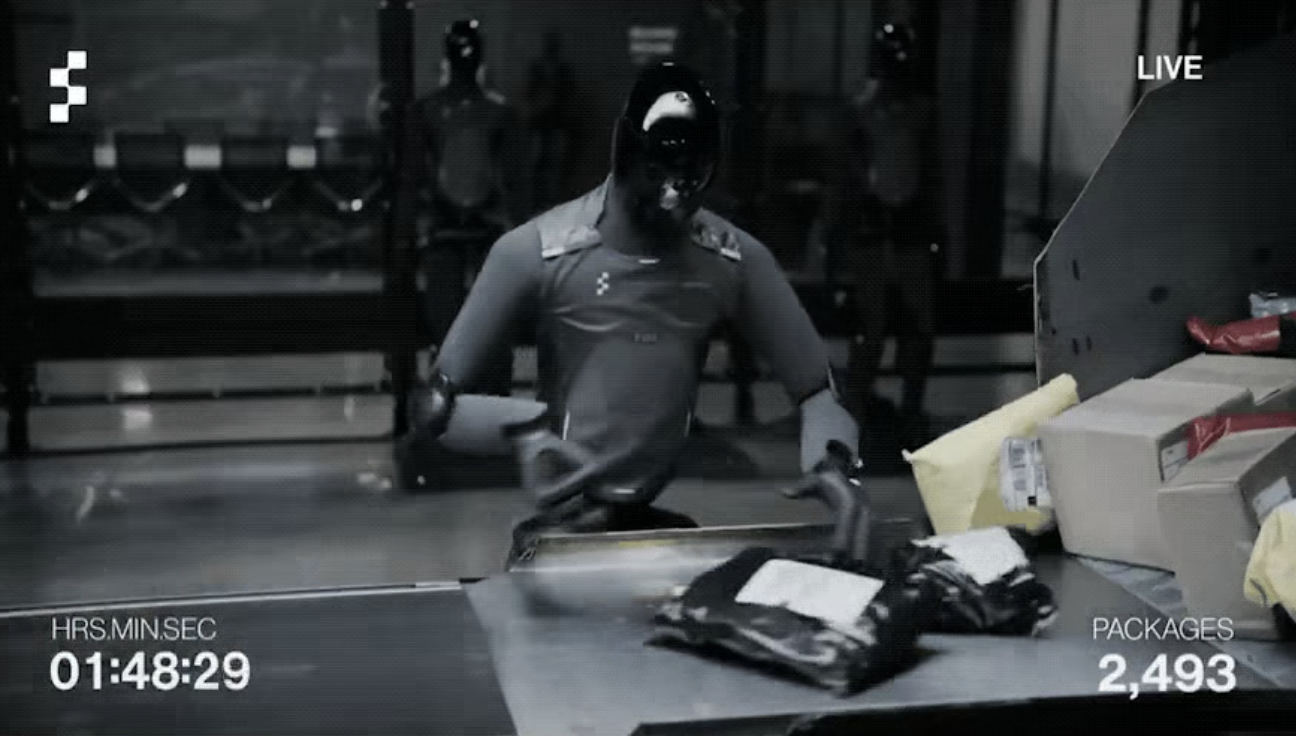
In May 2026, Figure live-streamed its Figure 03 robot sorting packages on a conveyor belt for 200 hours. The machine handled roughly 249,600 parcels, or nearly 21 per minute, in a demonstration that the article treats as a milestone for logistics-oriented humanoids.
Chinese companies are moving in the same direction. Galaxea is working with SF Express and China Post, deploying its M7 upper-body robot in more than ten logistics centres. The unit can handle up to 1,200 items per hour, or more than 85 per cent of human speed. Zhiyuan has partnered with JD Logistics on the Genie G2 Max, a wheeled humanoid that handles inbound palletising and tote moving. Geekplus, the warehouse-robot leader, set up an embodied-intelligence subsidiary and launched Gino 1, a general-purpose warehouse robot planned for mass production in the third quarter.
Why logistics first
The article lists three reasons warehouses are the preferred first stop. First, demand is real and urgent. Sorting, picking and palletising jobs are repetitive, physically hard and hard to fill, especially night shifts. For logistics operators, robots are not a nice-to-have efficiency tool. They are an operational necessity.
Second, the skills transfer. Moving an object from point A to point B is a foundational capability that can be reused across retail, manufacturing and eventually home settings. Roland Berger estimates the logistics robot market at roughly 700 billion yuan in 2025, mostly inside factories and warehouses.
Third, the environment is a good match for current technology. Warehouses are semi-structured, with defined tasks and low failure cost. A dropped package can be picked up. The same error in a hospital or a home might not be recoverable. JD Logistics uses a “three highs, one low” rule for scalable deployment: high frequency, high standardisation, high measurability and low cost of failure.
The barriers before mass deployment
Three obstacles stand between pilot projects and large-scale rollout. The first is the capability floor. JD’s logistics robot lead says the industry needs 99.99 per cent task completion rates and autonomous recovery from errors. A 95 per cent success rate sounds good in a press release, but in a warehouse handling tens of thousands of items a day it means thousands of human interventions.
The second is cost and durability. Dexterous hands from leading suppliers last 300,000 to 500,000 cycles. A warehouse robot making 8,000 to 10,000 grasps a day will hit that limit in roughly a month. Geekplus is addressing this with a self-developed three-finger hand that trades maximum dexterity for industrial reliability.
The third is systems integration. Robots must plug into warehouse management systems, scheduling software and existing workflows without forcing expensive rebuilding. The article notes that the integration workload can be as large as the robot development itself.
Long-term, the prize is global. Interact Analysis predicts wage growth of 16 to 22 per cent by 2030 in mature markets such as the United Kingdom, Sweden and Australia, and more than 100 per cent in some emerging markets. That cost pressure makes warehouse automation an attractive export market for Chinese robot makers.
Editor’s note: This is an adapted translation of the original Gasgoo Embodied Intelligence report. It has been trimmed and restructured for readability for an international business audience.