Horizon Robotics has released HSD V2.0, the latest version of its assisted-driving software. The headline change is the addition of a world model and end-to-end reinforcement learning on top of what the company calls a one-stage end-to-end architecture.
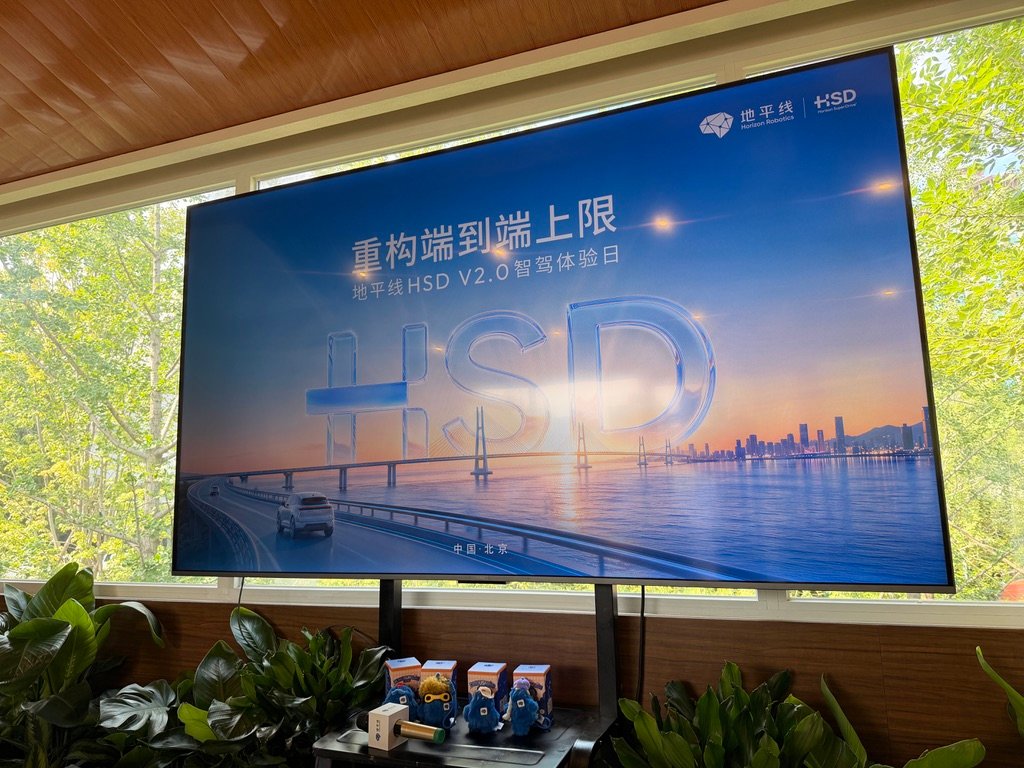
Leiphone joined a 12-kilometre test drive in Beijing that covered campus roads, urban streets, main arteries and the Sanlitun shopping district. Horizon’s reported metrics are: 56 per cent improvement in hands-free mileage, 20 per cent reduction in system response latency and 167 per cent improvement in interactive negotiation ability.
World models for everyday driving
The world model lets the system predict what other road users will do and what will happen if the ego vehicle takes a particular action. Horizon says the goal is not to impress with extreme-case stunts but to make the 40-minute daily commute smoother and less stressful. The software is trained on a base of real driving data from good human drivers, augmented with synthetic scenarios generated by the world model to cover long-tail cases.
One of the more demanding demonstrations was a multi-point reverse turn in a narrow road. Most assisted-driving systems either ask the driver to take over or freeze after repeated failed attempts. HSD V2.0 switched between drive and reverse within a single model, calculating each movement as part of a continuous trajectory rather than as separate steps triggered by fixed thresholds.
The system also showed what Horizon calls social common sense. It slowed for puddles, anticipated pedestrian intent at crossings and yielded to ambulances by understanding the emergency context rather than following a hard-coded rule. Traditional systems require engineers to write rules for every variation of an ambulance encounter. A world model approaches the problem by learning the semantics of the scene.
Parking and road semantics
HSD V2.0 also integrates parking and driving within the same model. Horizon claims it can park in any available space, including side-in, slanted and extremely narrow spots. A vision-language model reads traffic signs in real time, allowing it to recognise time-of-day bus lanes and tidal lanes without relying on high-definition maps.
The article frames the release as the payoff from a one-stage end-to-end architecture. The same model handles perception, prediction, planning and control, and it can improve through a closed loop of real-world data and simulation. Horizon is one of the largest Chinese suppliers of advanced driver-assistance chips and software, and HSD is its bid to move from a component vendor to a full-stack driving-system provider.
Editor’s note: This is an adapted translation of the original Leiphone report. It has been trimmed and restructured for readability for an international business audience.