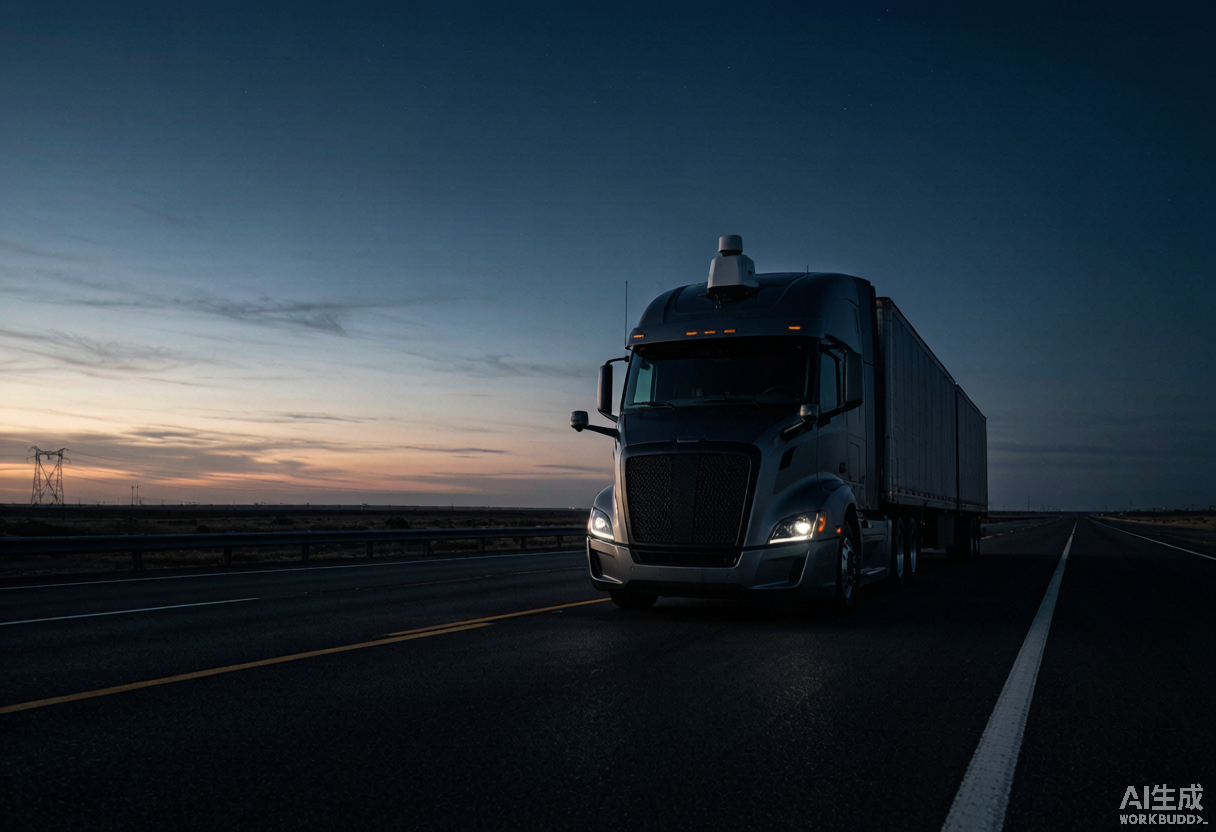
Cui Dixiao joined autonomous-truck startup PlusAI in 2017, straight from a lectureship at Xi’an Jiaotong University, where he earned a doctorate under autonomous-driving pioneer Zheng Nanning. Seven years later, in 2025, he left as chief scientist. What he learned reshaped how he sees the industry.
‘I underestimated the complexity of autonomous driving,’ he says now. His core conviction is that L4 is fundamentally about redundant safety, yet most teams stake passenger lives on a single algorithm they believe can be made infinitely reliable. That, he argues, is the wrong mental model.
Why we still cannot remove the safety driver
Cui’s answer is unromantic: nobody has built a truly safe, reliable redundant system. He has long pushed for aerospace-grade redundancy, triple or quadruple and dissimilar, the logic being that more independent, dependable observation and decision sources mean lower failure odds. The catch is cost, and the fact that a good redundancy system is invisible because the vehicle never misbehaves.
At PlusAI he ran a project called D2S, double to single, asking whether autonomous tech could cut a two-driver long-haul roster to one before full driver-out is possible. The work measured cognitive and physical fatigue through eye-tracking, bio-signals and heart rate, comparing four hours of manual driving against assisted driving. If assisted driving let one driver safely cover ten hours, the case for a second driver weakens.
Miles per intervention is the wrong scoreboard
Cui is sharp on metrics. Miles per intervention measures how often a human must take over, which by definition means a scenario the system could not handle. ‘Using a need-human metric to judge a driverless system is contradictory,’ he says. Real L4 judges risk before failure, like sounding an air-raid siren early, not reporting what blew up after the fact.
Resource freight versus commercial freight
He divides trunk transport into two very different problems. Resource haulage moves raw materials like metals and coal on fixed, high-volume routes, often in Xinjiang and Inner Mongolia, where lower speeds cut failure risk sharply. Commercial express, by contrast, demands next-day delivery at highway speed, leaving almost no margin and capable of triggering sector-wide trust collapse after one accident.
His preferred fix is unglamorous: dedicated roads that physically separate manned and unmanned trucks. KargoBot’s model, binding closely with government on easier resource routes, is the template he points to.
Regional players, not a national champion
Cui’s most pointed prediction: L2-plus assist trucks may produce national players, but L4 driverless trucks will fragment into regional ones. Stable cargo and open road rights are both regional by nature, so the business splits along geographic lines. That collides with the trillion-yuan market thesis every trunk-autonomy startup once sold.
On Tesla, he is cautious. He worries its robotaxi design may also be ‘betting on probability’, lowering failure odds without enough redundancy, a sound commercial call but not a scientific L4. He notes Pony.ai and Baidu run robotaxi reasonably, and that passenger-to-truck tech transfer is real, yet a trucking team’s true edge is deep understanding of logistics operations and customer needs.
His own ambition is to build a firm whose mobility capability becomes a utility, like water, electricity, gas and networks, the ‘fifth element’. The essence of autonomy, he insists, never changes: move goods or tasks safely and efficiently from point A to point B.
Editor’s note: This is an adapted translation of the original LeiFengWang report. It has been trimmed and restructured for readability for an international business audience.