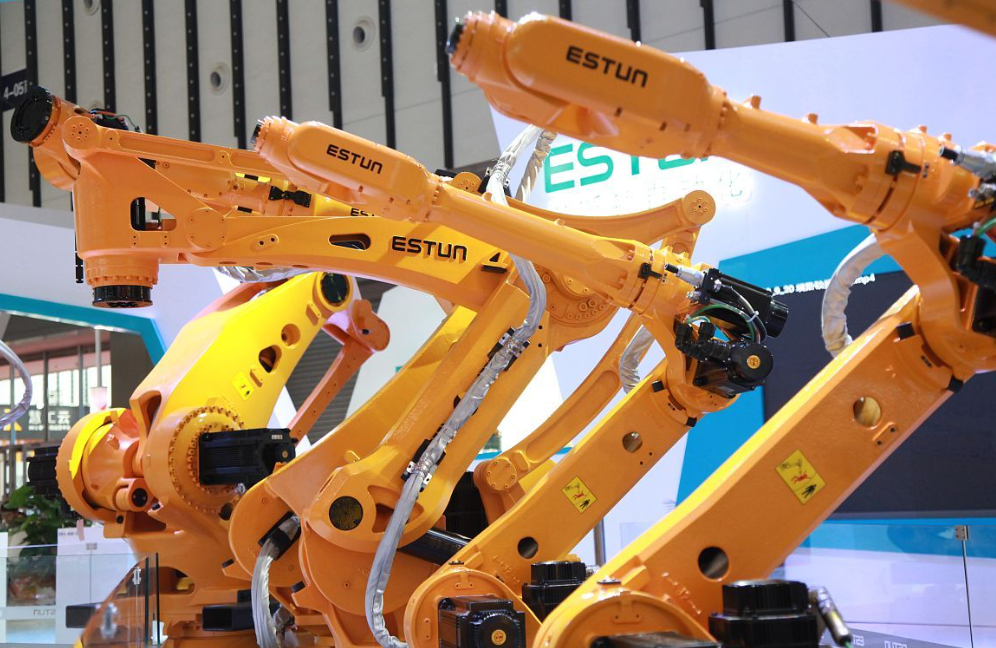
A good name can hide a company’s ambition. Estun spells out its own: ‘Est’ from the Spanish for east, ‘un’ for one. The ‘number one in the East’ vision looked bold in the 1990s, when overseas giants monopolised China’s industrial-robot market.
Estun made it real. Its 2025 report shows eight consecutive years as the top domestic robot maker, and it became the first local vendor to surpass FANUC and ABB in China shipments. First-half 2026 guidance puts net profit at 150 to 180 million yuan, up as much as 2,594 per cent. The 2025 domestic market rebounded with more than 300,000 units sold, up over 13 per cent, and Estun rode the wave first.
Its edge is twofold: fast local substitution at home with a cost-protecting supply chain, and a 36.75 per cent overseas gross margin, about 10 points above domestic. It spends roughly 10 per cent of revenue on research, with nearly 30 per cent of staff in engineering, and runs a full chain from components to systems across 96 models from 3 kg to 1,200 kg. In March 2026 it became the first industrial-robot firm with an A plus H listing.
The profit is thinner than it looks
The bright first-half number carries water. The surge leans on non-recurring gains, while deducted profit is only 60 to 70 million yuan. In 2025, total profit was 77 million, of which non-recurring items contributed 67 million. The core business is not yet a stable profit engine.
The pursuit of ‘number one’ came with aggressive deals. After 2016, Estun bought Germany’s M.A.i., Cloos and TRIO, which lifted goodwill from 96 million yuan in 2016 to 1.49 billion in 2019, far above net profit. In 2024, impairment on four firms plus asset write-downs drove an 810 million yuan loss. The goodwill bomb still hangs overhead.
Scale first, profit later
Against peer Inovance, gross margins are close, both near 30 per cent, with Estun slightly ahead in early 2026. Net margin tells a different story. Since 2017, Estun’s net margin has never topped 10 per cent, while acquisition-driven management and integration costs eat profit. Its management expense ratio has long sat above 10 per cent, hitting 16.4 per cent in 2016, against Inovance’s steady 5 per cent. Heavy research spend on one side and high overhead on the other squeeze profit from both directions.
From ‘scale number one’ to ‘profit number one’ is a long road. The hard fix is returning to self-sustaining core profit: lean on non-recurring gains less, make robots the profit centre, improve post-merger integration and cost control, and balance research with cost discipline. The market rewards results, not slogans. Estun has taken a solid first step in scale. The profit battle is only beginning, and it mirrors China’s own industrial-robot journey from catch-up to leadership.
Editor’s note: This is an adapted translation of the original OFweek report. It has been trimmed and restructured for readability for an international business audience.