A good name often hides a company’s ambition. Estun takes its English name from EST (Spanish for east) and UN (one), a No. 1 in the East vision that looked bold in the 1990s when overseas robot makers monopolised China’s market.
Did that vision come true? Yes. Estun’s 2025 report shows it held the top domestic robot spot for eight straight years, and its domestic industrial-robot shipments surpassed overseas giants Fanuc and ABB for the first time, becoming the first domestic maker to lead the Chinese market. Its H1 2026 pre-announcement is bright: net profit of 150 to 180 million yuan, with the top growth rate reaching 2,594 per cent year on year.
The timing is the industry tailwind. As the world’s largest industrial-robot market, China’s domestic market recovered in 2025, with annual sales above 300,000 units and growth over 13 per cent. Estun, at the front of the pack, was first to benefit.
The ground is dual domestic and overseas advantage. Domestic substitution accelerated, with local supply chain and scale as a moat. Overseas, product premium showed: 2025 overseas gross margin was 36.75 per cent, about 10 points above the domestic market. The people factor is devotion to technology: under the All Made By Estun strategy, it spends about 10 per cent of revenue on R&D, with R&D staff near 30 per cent in 2025.
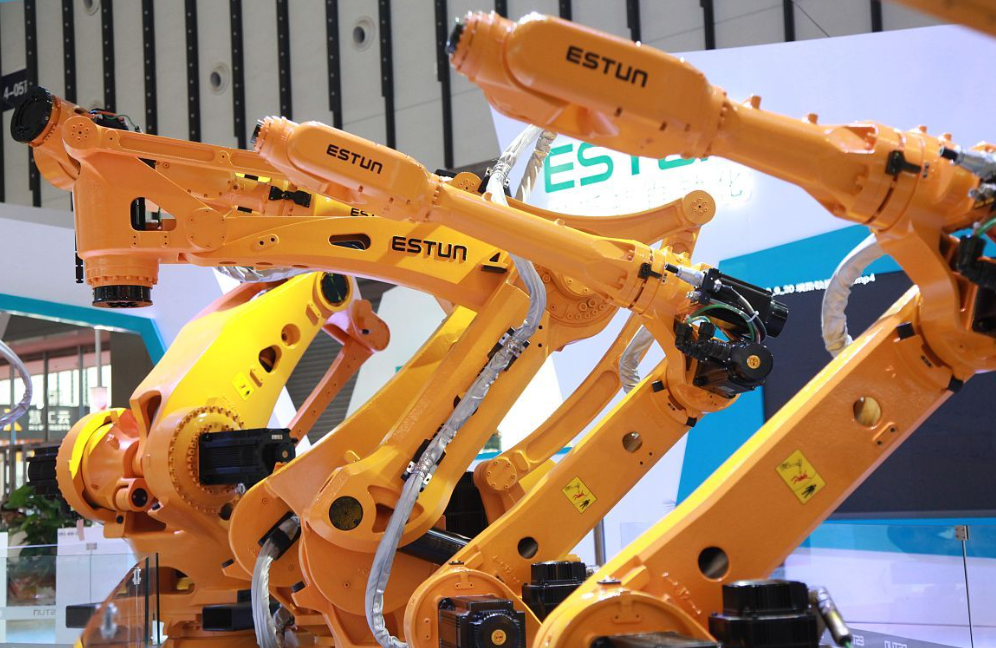
From a machine-tool CNC system in 2002 to becoming China’s first A plus H listed industrial-robot company in March 2026, Estun built full independent coverage from core parts to manufacturing systems. Its 96 robot models span 3 kg to 1,200 kg payloads.
But under the halo, worries follow. The H1 2026 profit jump leans heavily on non-recurring gains. Deducted non-recurring net profit was only 60 to 70 million yuan. In 2025, total profit was 77 million yuan, but investment gains, fair-value changes and non-operating income contributed 67 million, so the core business’s cash generation is far from solid.
Estun’s M&A path was aggressive. After 2016 it bought Germany’s M.A.i., Cloos and TRIO, completing its layout but planting two hazards. One is high goodwill: from 96 million yuan in 2016 to 1.486 billion in 2019, far above net profit. In 2024 it took goodwill and asset impairments on four firms, swinging net profit to an 810 million yuan loss. The other is cross-border integration cost, steadily eroding profit. Next to peer Inovance, gross margins are similar at about 30 per cent, but net-margin gaps are vast: Estun has not beaten 10 per cent since 2017, while M&A’s management and integration costs eat the profit. Its management-expense ratio stayed above 10 per cent, hitting 16.4 per cent in 2016, while Inovance holds about 5 per cent.
From scale No. 1 to profit No. 1, Estun has far to go. The breakthrough is returning to the core business’s cash generation: rely less on non-recurring gains, make robots the profit core, improve post-merger integration efficiency, cut management cost, and balance R&D with cost control. Business rewards results, not slogans. Estun’s No. 1 in the East has taken a solid first step in scale. The hard battle for profit has just begun.
Images
Editor’s note: This is an adapted translation of the original OFweek report. It has been trimmed and restructured for readability for an international business audience.