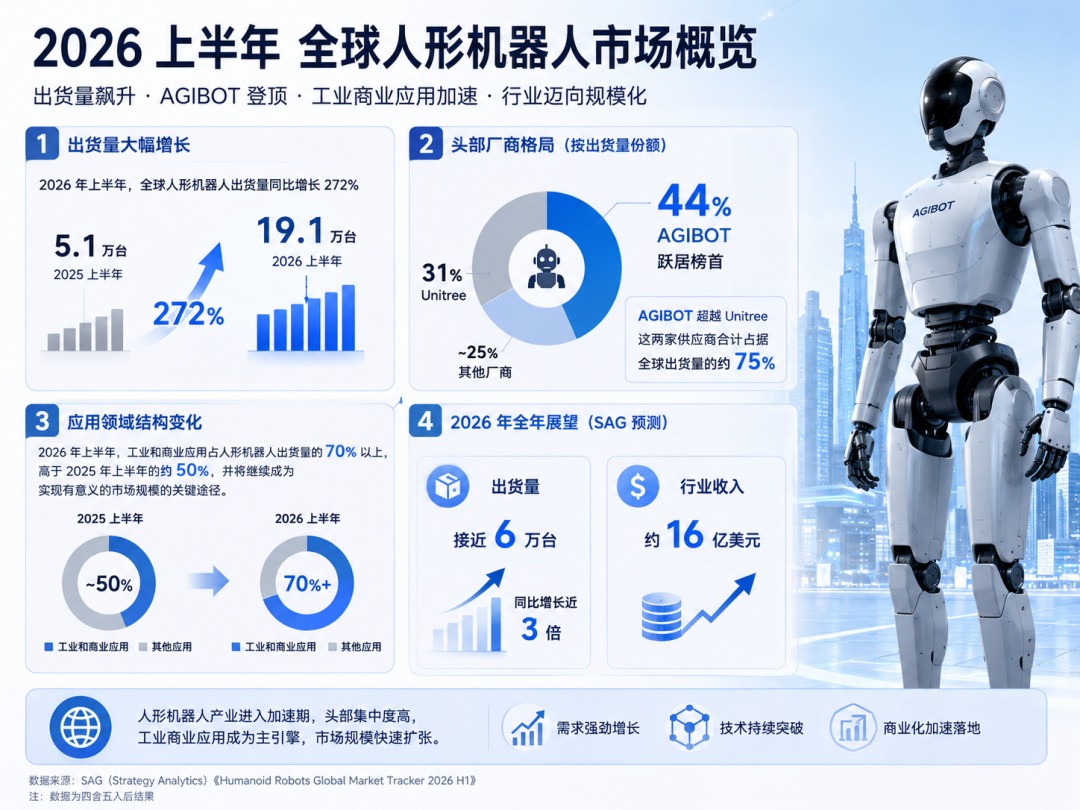
A report from SAG has re-ranked the humanoid-robot race. The numbers are striking: in the first half of 2026, global humanoid robot shipments reached about 19,100 units, up 272 per cent year on year. Chinese makers took more than 97 per cent of the shipment share, and AgiBot (Zhiyuan) topped the world for the first time with 8,400 units and a 44 per cent market share, overtaking Unitree.
But beyond who leads, a different figure matters more: industrial and commercial applications now exceed 70 per cent of deployments, up from about 50 per cent a year earlier. That is the real inflection point, the moment humanoids move from showing off to doing work.
AgiBot and Unitree hold 75% of the world AgiBot shipped 8,400 units in the half, up 562 per cent year on year. Unitree shipped 5,900, up 170 per cent. Galaxy General came third with just 900, and UBTECH (700) and Leju (600) trailed. A clear gap has opened between the leaders and the middle. Together, AgiBot and Unitree hold 75 per cent of the global market.
Why did AgiBot pull ahead? Its route differs. It follows scenario-defines-product, covering full-size biped, small biped and wheeled forms, focused on industrial and commercial use. Put simply, it builds whatever customers need. Industrial scenes have a benefit: demand is standardised. How many kilograms to move, what repeat-positioning accuracy, how many hours of battery life, these can be quantified, accepted and replicated in volume. Prove the return on investment and customers pay, and shipments climb. AgiBot has already gone overseas, with real deployments in Britain and Germany.
Unitree’s main model, the G1 small biped, has cumulative production of 11,000 units. But its focus sits more in research, education and performance, scenes with demand but not the commercial explosive power of industrial use. Neither route is right or wrong, only at a different stage. Early on, the contest was who was more agile and drew more attention. In the commercial phase, it is who can deliver in volume and make customers pay.
What 70% commercial share means The 70 per cent figure matters more than who is first. A year earlier commercial and industrial share was about 50 per cent. In one year it rose 20 points. That slope says humanoids are genuinely moving from show floors into factories and warehouses. StarBot’s L7, high-jump champion at last year’s World Humanoid Robot Games, is now on the production line at China Post and SF Express, grabbing a parcel, flipping its wrist, turning the label up and placing it steadily on the sorter. High heat, noise and night shifts, the environments workers hate, are exactly where robots excel.
State Grid bought 500 humanoid robots this year for power inspection. SF introduced robots for sorting. Airbus ordered 100 UBTECH Walker S2 units for aviation precision assembly. These are real commercial orders, not demos.
Industrial scenes deploy fastest because structured environments land most easily. Factory lines and warehouses have fixed layouts and repeat tasks, asking less of the robot’s generalisation. Start there, build volume, accumulate data, then push into harder scenes. The roadmap is clear.
SAG puts it well: hardware scale is growing faster than the maturity of the underlying technology. We can now mass-produce robots that walk, stand and carry, but in real-world data, model generalisation and manipulation precision, the tech has not fully caught up. Today’s large deployments essentially place robots in the most structured environments to avoid their intelligence gaps. That supports current shipment growth but not broader penetration.
China’s 97 per cent share sounds rousing, but leadership and a moat are different things. Advantages: supply chain, cost, speed, a complete domestic chain from motors and reducers to sensors and control. AgiBot’s 8,400 units in a half means about 46 units a day, a mass-production ability only China has today. And China has the scene advantage: the world’s largest manufacturing base, many factories, many scenarios, low trial cost.
But the worries are clear. First, shipments are not earnings. AgiBot and Unitree are still in heavy investment. more shipments mean faster burn. Some shipments come from government centralised procurement, not pure market demand. Second, core technology has gaps: dexterous hands are a typical case, with 25 billion yuan raised in the half yet no unified standard hand has emerged. Third, and the biggest variable, geopolitics: at the end of July the FCC added humanoid and quadruped robots to its controlled list, forming a systematic containment framework from product bans to supply-chain review to investment limits.
Eighty-five per cent of demand is still domestic. But a globally competitive industry cannot rely on one market. Going overseas is strategic necessity, not a luxury.
The H1 2026 data marks a mountain crossed. We used to ask can it walk, jump, flip. Now we ask how much can it carry, how many screws, how much labour saved. Attention has shifted from performance metrics to economic ones, the sign of an industry moving from concept to landing. AgiBot overtaking Unitree is news. The bigger news is that the whole industry’s logic has shifted from who builds the cooler robot to who builds the more useful one. The shipment race is only phase one. Next comes who accumulates the most valid data in real scenes, who achieves reusable breakthroughs in embodied models, who builds a sustainable commercial channel overseas. Chinese makers won phase one. The endgame is far from here.
Images
Editor’s note: This is an adapted translation of the original OFweek report. It has been trimmed and restructured for readability for an international business audience.