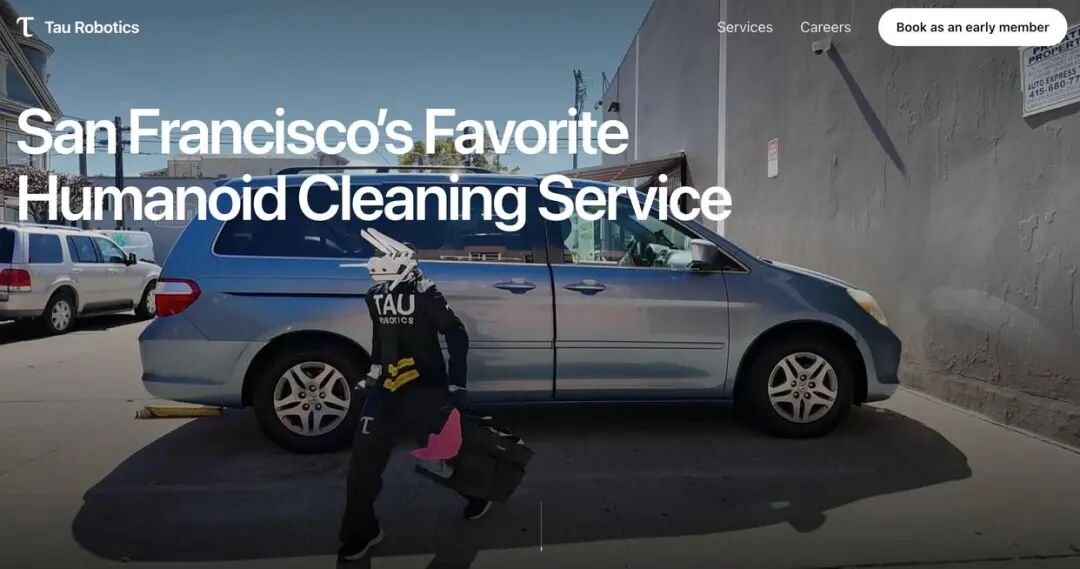
In late July, San Francisco startup Tau Robotics launched a humanoid home-cleaning service at US$30 an hour, about RMB 200. It is invite-only, covering the city’s Mission and Noe Valley neighbourhoods.
Tau runs three robots named Chelsea, Elon and Tony, in black uniforms with assigned roles. Chelsea tackles kitchen counters and mirror water marks. Tony handles whole-home vacuuming and corner dust. The hardware comes from Chinese firm Unitree, the G1 model. Tau designed the cameras, grippers and on-board computer itself.
Tau’s robots are not autonomous. CEO Alex Koch admits current AI cannot fully self-drive a humanoid. Each robot links to a human teleoperator. AI only handles visual recognition and path fine-tuning.
US$30 buys data, not cleaning
The US$30 price does not even cover cost. Tau’s Unitree G1 EDU runs from US$20,000 to 70,000. At US$30,000 a unit, three-year depreciation and six effective working hours a day, hardware depreciation alone nears US$7 an hour. A San Francisco robot teleoperator earns US$25 to 28 an hour. Just labour plus depreciation already matches the US$30 sale price.
What Tau sells on the surface is cleaning. What it really buys with the loss is manipulation data from real homes. How a human decides to wipe where first, what to do with a stain, how much force to use on a counter, that data is exactly the scarce fuel for training fully autonomous systems.
It is like Uber using subsidies to train user habits. Tau uses a US$30-an-hour loss price to buy a data ticket to its future autonomous robots.
American brand, Chinese body: a compliance game under the ban
The timing is telling. Tau launched just after the US FCC banned imports of new Chinese humanoid robots as whole units, yet Tau uses Chinese Unitree hardware.
It is a precise compliance game: the ban covers whole-unit imports, but Tau’s hardware comes from Unitree while cameras, grippers and on-board computer are designed and assembled in the US. Hardware is the Chinese body, software the American brain. This Sino-American hybrid exactly slips past the ban’s wording.
When Tau’s CEO announced the service on X he may not have said it aloud, but the subtext was clear: you can ban the whole unit, but not the division of global supply chains. Taken apart, joints from China, sensors from the US, algorithms from Silicon Valley, that is the real shape of the global tech industry.
A US$30-an-hour cleaning service is, on the surface, housekeeping. Underneath, data collection. On the surface, American entrepreneurship. Underneath, Chinese manufacturing. As the US tries to cut off Chinese robots with a ban, Tau used one Unitree G1 to prove one thing: the roots of global supply chains run deeper than politicians imagine.
Images
Editor’s note: This is an adapted translation of the original OFweek report. It has been trimmed and restructured for readability for an international business audience.