Funding that compounds
Shutu Technology has closed a Pre-A round of nearly RMB 100 million. The round was co-led by CDH Baifu and the Kunpeng Fund, a national-level fund focused on big data, with Guangzhou Industrial Investment and Yihe Capital joining and existing shareholder Trend Investment following on with an oversubscribed stake. It is the company’s third financing within a single month.
Beyond its existing video-upscaling data product, the new capital will fund research and validation of tactile data representation and the iteration of its SynaTac tactile product line, while speeding up its push into contact-strategy training and on-device deployment for robots.
From a demo to a deliverable
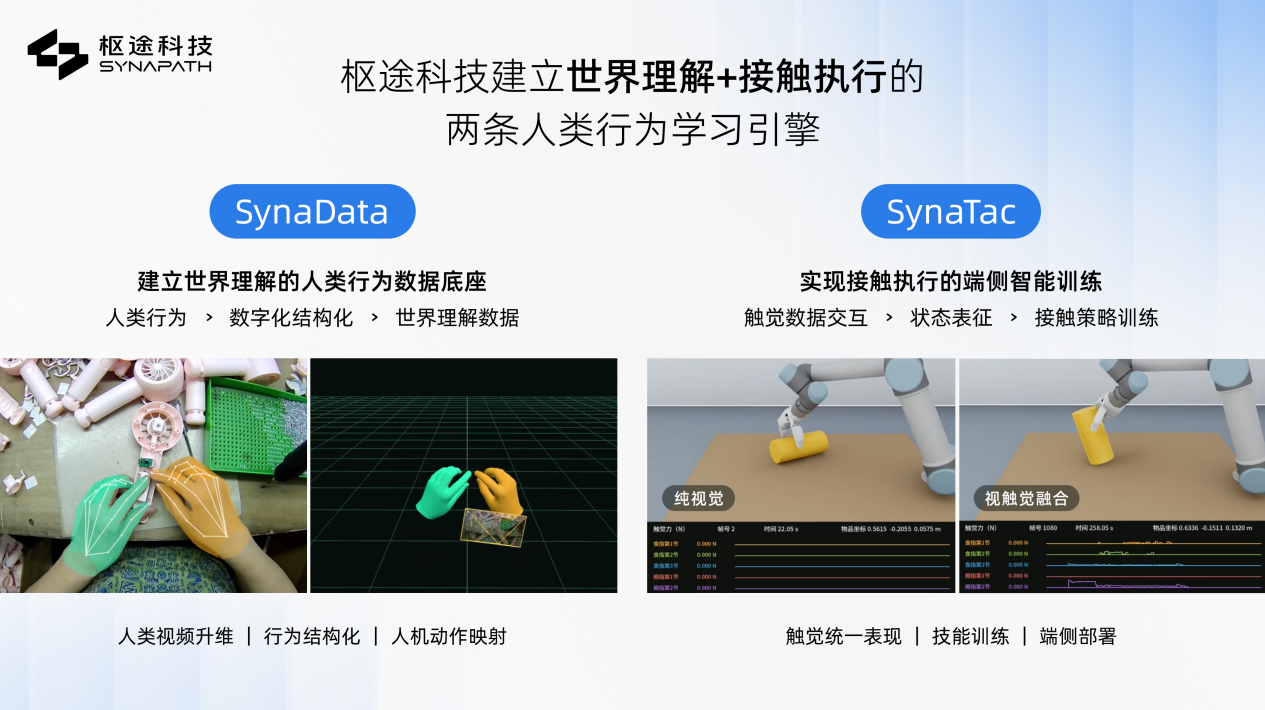
Shutu is building a dual-engine stack aimed at physical-AI infrastructure. CTO Dr Mu Wei previously served as VP of research and development and China software lead at Covariant AI, the Silicon Valley embodied-AI pioneer, and the core team is largely the original Covariant algorithm group. The company argues the gap between “can demo” and “can deliver” is not solved by better algorithms alone but by iterating data, training and verification around real-site problems.
It divides the embodiment gap into a brain layer that under-understands the world and a cerebellum layer whose contact execution is unstable. SynaData turns human-action video into structured multimodal training data covering motion trajectories, object poses and contact information, and already serves more than 60 per cent of embodied-AI unicorns valued above RMB 10 billion, with bulk purchases from leading technology vendors. SynaTac builds on unified tactile representation, fusing vision, touch and robot state to train contact strategies with high-frequency feedback.
Why the bet matters
The company’s first public evaluation framework for embodied data and skills links data supply, model training and robot execution, feeding results back into production, representation and iteration. Its pitch is to anchor the physical-AI infrastructure niche and give the supply chain a common substrate, cutting duplicated effort when new devices and tasks appear.
Editor’s note: This is an adapted translation of the original Leiphone report. It has been trimmed and restructured for readability for an international business audience. The full original (in Chinese) is at https://www.leiphone.com/category/robot/zVCVfjhnzD1S34Pm.html.