How expensive is AI, really? We once measured compute in GPU counts. Now OpenAI and NVIDIA measure it in gigawatts.
On 17 August, the PORTS-Pike project disclosure showed OpenAI building world-class AI infrastructure in Ohio. OpenAI said it has secured about 8 GW of IT capacity at the site, with NVIDIA providing credit support for the initial 4.25 GW of related construction, the whole park dedicated to NVIDIA AI compute.
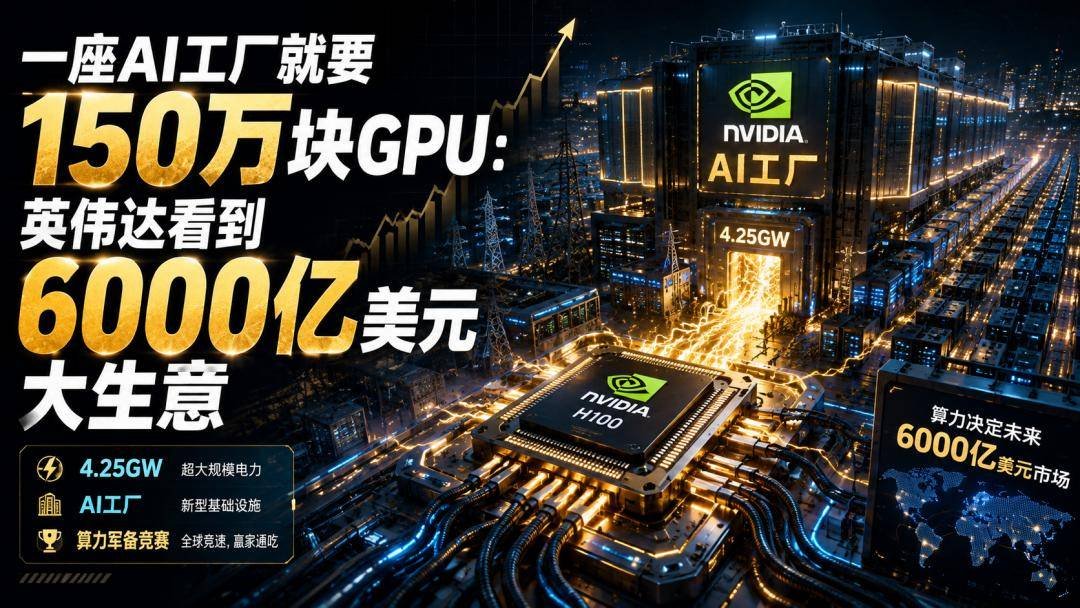
By NVIDIA’s own maths, the initial 4.25 GW deployment could imply about 1.5 million GPUs per generation of AI factory system, representing a US$150 billion to 200 billion NVIDIA revenue opportunity. If the partnership extends further, OpenAI-NVIDIA compute could push toward about 16 GW.
NVIDIA’s own number is more extreme: by 2030, the relevant NVIDIA compute opportunity could reach about US$600 billion. Note this is not a US$600 billion GPU order signed today, but NVIDIA’s long-term market estimate from potential compute expansion. Even so, it signals one thing: the era of AI truly burning money may just be beginning.
What is 1.5 million GPUs?
Set aside the US$600 billion. The 1.5 million GPUs alone are staggering. Investors once thought 100,000 or 200,000-card clusters were huge. Now the industry discusses million-scale GPU infrastructure.
And note: it is not a one-time permanent install of 1.5 million GPUs. PORTS-Pike runs 20 years with several GPU generations. Today Blackwell or Rubin, a few years later a new architecture. An AI data centre is not built once and used for 20 years. It may get an expensive new heart every few years. That is why NVIDIA sizes a 4.25 GW project’s long-term revenue at US$150 billion to 200 billion. The valuable part is not the first GPU sale, but generation after generation of upgrades, like a smartphone refresh cycle, except the unit is billions of dollars of infrastructure.
Why gigawatts?
GPUs are too many to count by chip. One gigawatt is 1 million kilowatts of load. OpenAI’s locked 8 GW approaches a super-large industrial base’s power draw. The first 800 MW should be ready around 2028, then new generation, transmission and supporting infrastructure are needed.
AI is changing in an important way. An internet company’s core question was: enough servers? An AI company first asks: where does the power come from? Then: enough GPUs? Enough transformers? Enough optical modules? Can the cooling hold? Can the grid push that much power in?
So AI looks more like heavy industry. Models live in code, but the means of production behind them are land, power plants, grid, GPUs, HBM, network and cooling. That is why NVIDIA likes the term AI Factory. It really is becoming a factory, except traditional factories make cars, steel and chemicals, while AI factories make tokens and intelligence.
Why NVIDIA dares eye US$600 billion
Because OpenAI’s appetite keeps growing. As early as September 2025, OpenAI and NVIDIA announced a strategic tie-up targeting at least 10 GW of NVIDIA systems, millions of GPUs, with NVIDIA investing up to US$100 billion in OpenAI as compute lands. PORTS-Pike expands the physical footprint further. OpenAI said the Ohio project creates about 35,000 construction jobs and 2,500 permanent operating jobs over six years. Data centres are built, owned and run by SB Energy, leased to OpenAI for 20 years. NVIDIA also announced a US$1.5 billion investment in SB Energy.
Notice NVIDIA’s role has quietly changed. It once only sold GPUs. Now it reaches deep into chip supply, network, software, data-centre design, capital investment, even project finance. Why? If AI compute is truly a hundreds-of-billions market, what matters most is not just making customers buy its GPUs, but ensuring customers actually have money, power and data centres to take them.
The biggest winner may not be GPUs alone
Many see US$600 billion and ask how much NVIDIA earns. But building 10 GW or larger clusters pulls far more than one company. GPUs are the most expensive core equipment, needed for training, inference and scaling. But GPUs do not work alone. High-performance AI chips need vast HBM high-bandwidth memory and advanced packaging to link GPU and storage. At million-GPU scale, HBM consumption is astronomical. That is why memory draws market attention this cycle.
Connecting 1.5 million GPUs is not an ordinary networking problem. GPUs swap data at high speed. Data centres must interconnect. Switches, optical modules, fibre and high-speed network chips all scale with cluster size.
Power. Without power, every GPU is an expensive metal box. The most-watched line in PORTS-Pike is not the 1.5 million GPUs, but OpenAI stating the first 800 MW can use existing infrastructure while later expansion needs new generation and transmission, including natural gas.
When projects cross several gigawatts, the constraint changes. Chips can be bought. Power plants cannot ship the day after order. High-voltage transformers are not infinite. Transmission takes time. Siting needs water, power, land and permits. So the truly scarce resource of future AI compute spreads upstream: whoever supplies stable, cheap, large-scale power earns the right to build the next AI factory.
That is why US tech firms now discuss natural gas, nuclear, storage and grid so often. AI has circled back to the oldest business: energy.
The US$600 billion warning: compute depreciation
The frenzy is not risk-free. The biggest risk is GPU refresh speed. A traditional power plant runs 30 years. An office building decades. But today’s top GPU may be clearly surpassed in a few years, meaning AI data centres face a peculiar problem: huge assets, but core equipment depreciates fast. GPUs bought for tens of billions today may need upgrading in three or four years.
For NVIDIA that is good, continuous replacement is continuous revenue. For OpenAI and data-centre investors it is real: earnings must cover vast capital spend. OpenAI earlier estimated cumulative compute spend could reach about US$600 billion by 2030, needing revenue and financing to sustain expansion. So the industry must answer: do the tokens these GPUs create actually sell for enough? That is the core of whether the US$600 billion story holds.
The investment logic has changed
For two years markets asked whose model is best. Investors may soon ask: who owns the most power, who builds the largest data centres, who holds GPUs, HBM and network, who actually runs an AI factory. AI competition is rapidly upgrading from a software war to an industrial-infrastructure war.
OpenAI locking 8 GW and NVIDIA entering investment and finance both point to one trend: compute is becoming new-era infrastructure, like railways, grids, highways and oil in the 20th century, and GPU, power, data centre and high-speed network in the 21st.
The biggest lesson of US$600 billion: do not just watch NVIDIA. If AI infrastructure moves from 10 GW upward, the world must rebuild how much power, network, server and data centre it needs. That may be the most astonishing part of this capital spend.
We thought AI was a software revolution. It is increasingly an infrastructure build-out on the scale of the energy and industrial revolutions. Models decide what AI can do, but what decides how far models run is the plainest stuff: chips, power, land, network and capital. PORTS-Pike’s million-GPU plan simply puts the scale of this compute arms race in front of everyone for the first time.
Images

Editor’s note: This is an adapted translation of the original Sohu IT report. It has been trimmed and restructured for readability for an international business audience.