On the WRC main forum on 20 August, Unitree founder Wang Xingxing opened with an unsettling fact: his robots can already do simple assembly on a factory line, but slower than a person, and a new task still needs re-tuning. So there is no mass rollout yet. In a market high on ‘mass-production year’ slogans, the candour landed.

The last few millimetres
The wall has a precise name: generalisation. Wang said most AI models, given enough data in one fixed scene, reach near-100 per cent task success. Change the object or nudge the environment and success collapses. The failure is not the big motion but the tail: the robot looks about to grip, then a few millimetres of error cannot be corrected, and the whole task fails. Language models live in a bounded vector space, so their input and output stay tight; a robot touching the physical world loses a little on every input and output.
His bar for the real inflection: a robot dropped into an unfamiliar setting that, through voice or text, finishes about 80 per cent of tasks across 80 per cent of those scenes. His timeline is two to three years at best, five to ten at worst. Until then, the field grinds on those last millimetres.
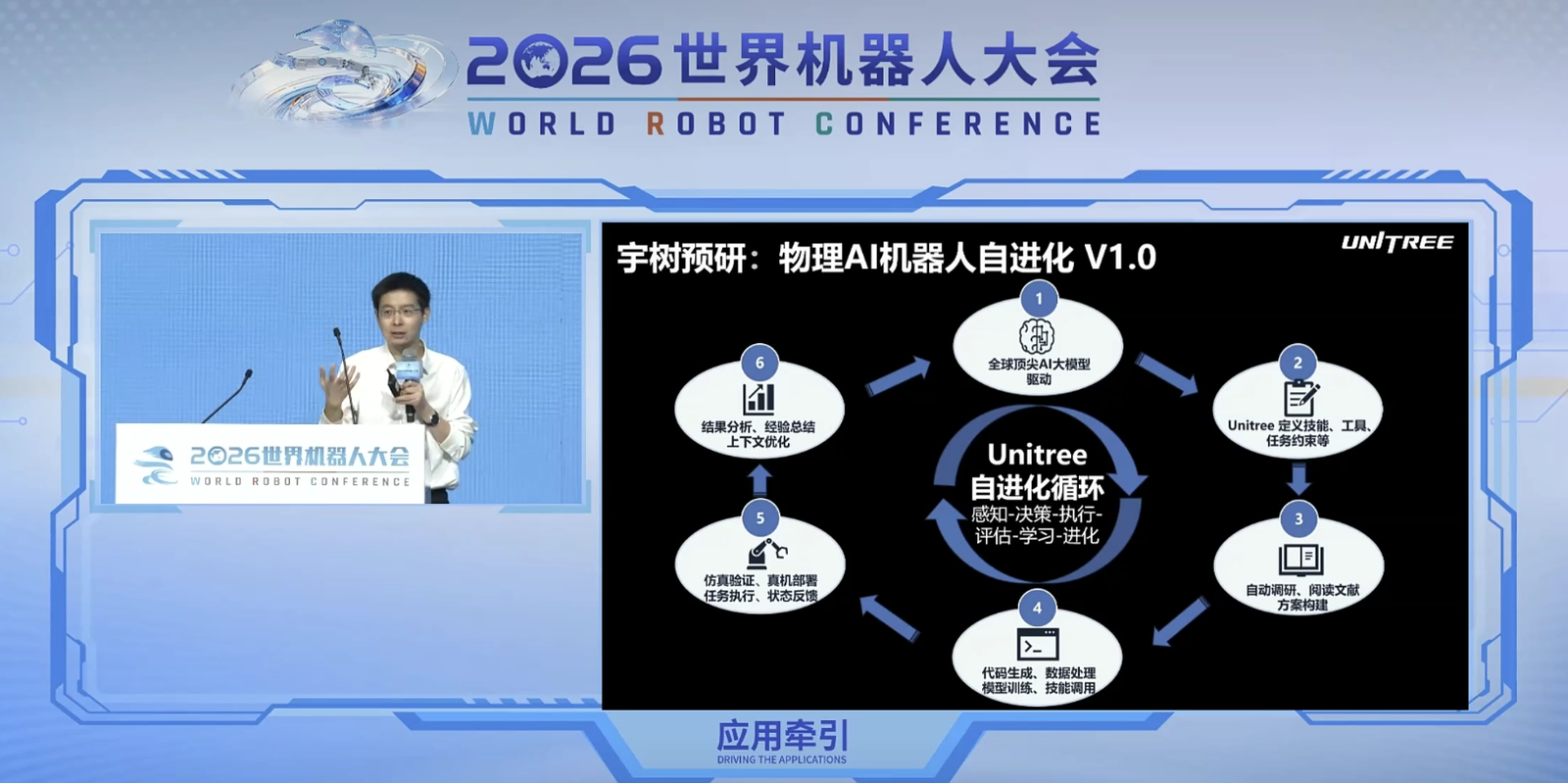
Letting AI write the robot code
Unitree’s next move is to let AI run the development loop. A top model defines the skills, tools and constraints, then searches the latest papers and open-source work, writes the control code, runs it in simulation, deploys to a real robot, and scores it with AI and humans before feeding the result back. Today’s norm is ‘human iteration’: an engineer codes, tunes, tests, fails, repeats, and a skill built Tuesday can die in a new scene Wednesday. A closed self-improvement loop, if it holds, changes who writes the skills, not just how fast. For European observers the candid bit is the most useful: the bottleneck is not the hand, it is the model’s grip on the physical world, and the winner is the one that closes the loop, not the one with the smoothest clip.
Editor’s note: This is an adapted translation of the original Gasgoo report. It has been trimmed and restructured for readability for an international business audience.