The embodied-AI industry is not short of robots that can deliver one pretty demo. What it lacks is robots that repeat the same task ten thousand times in a real setting and stay reliable. PaXini says it has just crossed that line. The company disclosed a 1 billion yuan strategic round and said cumulative funding now approaches 4 billion yuan, the largest cumulative raise in global tactile-sensing history.
According to public information the lead investor is a global consumer-electronics and semiconductor leader widely read as Samsung, joined by BOC International Investment, the Kunpeng Fund, CDH Venture and others, with earlier backers adding more. At the same time PaXini moved its headquarters to Beijing and completed a joint-stock restructuring. Three moves at once signal a shift from a technology company to an industrial system that can deliver predictable robot capability at scale.
Embodied intelligence enters the “failure pricing” stage
For years the industry’s most shareable asset was the demo video. In a factory or warehouse the question changes: how many times can an action run consecutively, does it still work with a different batch of material, and who fixes it when it fails. A vision system can see a cup but not whether the wall is deforming or the liquid is shifting; a planned trajectory may miss the real contact force. In software, one error means recompute; in the physical world, one error means damaged goods, downtime and manual takeover.
That is exactly where touch earns its keep, feeding contact changes back into control before failure happens. Capital has started scoring a new metric: the total cost of one successful operation, including depreciation, energy, calibration, failure, downtime and human takeover. Touch is worth far more than its sensor price if it trims any one of those.
What “full stack” really buys
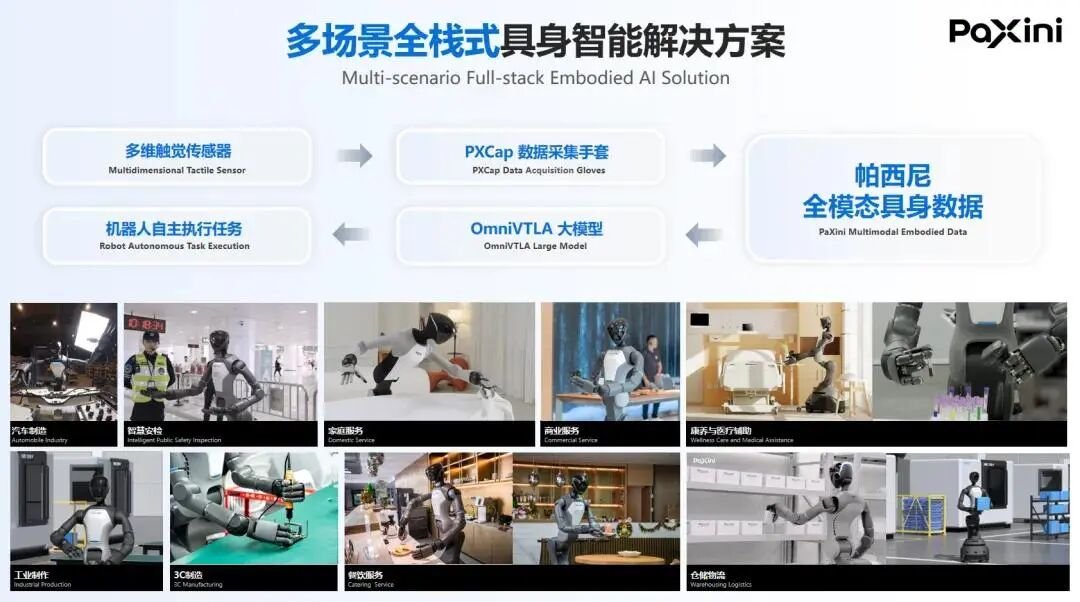
PaXini runs tactile sensing, full-modality data capture, dexterous hands and the robot body as one loop. The point of the full stack is not product count but blame. When a grab fails, the company can trace it to material, structure, calibration, communication, model or control, and fix it. For investors that learning speed, not a single spec, is what separates winners.
Its PX-6AX GEN3 fingertip product is documented at up to 717 tactile channels, 1000 Hz output, IP68 protection and over 10 million measurement cycles. Over the past year PaXini consumed nearly 1 million self-developed tactile chips, and its full-modality data has been adopted by several embodied-base-model labs and large internet firms. Near 4 billion yuan later, PaXini is past the demo and into scale. The thesis it must now prove is that a complete system can keep lowering the variance of real-world robot performance.
Editor’s note: This is an adapted translation of the original OFweek report. It has been trimmed and restructured for readability for an international business audience.