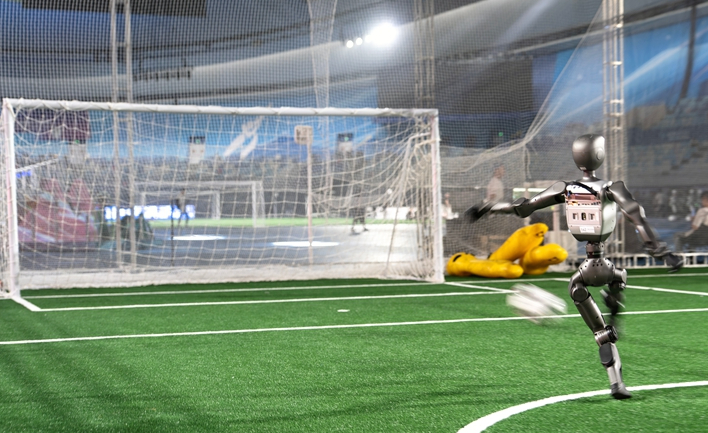
On 22 August the second World Humanoid Robot Games opened at Beijing’s National Speed Skating Oval, themed “Competing intelligently toward the future”, hosted by the Beijing municipal government and China Media Group. The event runs five days, up from three, with 51 events and 1,301 matches. It drew 666 teams and 2,056 robots from 16 countries across six continents, a 138 per cent rise in teams and a quadrupling of robots versus the first edition. The United States, Germany and Japan all showed up; Brazil fielded five RoboCup teams as a national squad, and 157 domestic companies took part.
51 events, 1,301 matches: not just about winning
Of the 51 events, 30 are competitive and 21 are scenario based, covering nine real settings: industry, hotels, homes, logistics, emergency response. Assembly feeding, housekeeping, fire rescue, shelf tidying, each task maps to a real industrial need. Where the first games were solo acts, this edition pits pairs head to head. The competition is escalating, and so are the standards.
The games are essentially “train through competition, set the standard through competition”. Every extra centimetre cleared or kilogram lifted reflects iterated work on joint motors, reducers, precision machining and testing. The rules will harden into acceptance criteria: whoever runs faster, lifts more and operates more precisely is defining the industry’s passing line.
The real world is the true exam hall
The scenario events earn their weight by dropping robots into reality: factory lighting changes, home spaces constrain, logistics throws random interference, variables a lab can never simulate. They test the “last metre” of real work, not performance under ideal conditions. Buyers sit in the stands; a good show means a signed order. The games fuse a product launch with a procurement fair.
After the games the Speed Skating Oval becomes a permanent training base, open for visits and study. The event is not a one-off but a running ecosystem. From “one race” to “always racing”, the robots will iterate faster.
Editor’s note: This is an adapted translation of the original OFweek report. It has been trimmed and restructured for readability for an international business audience.