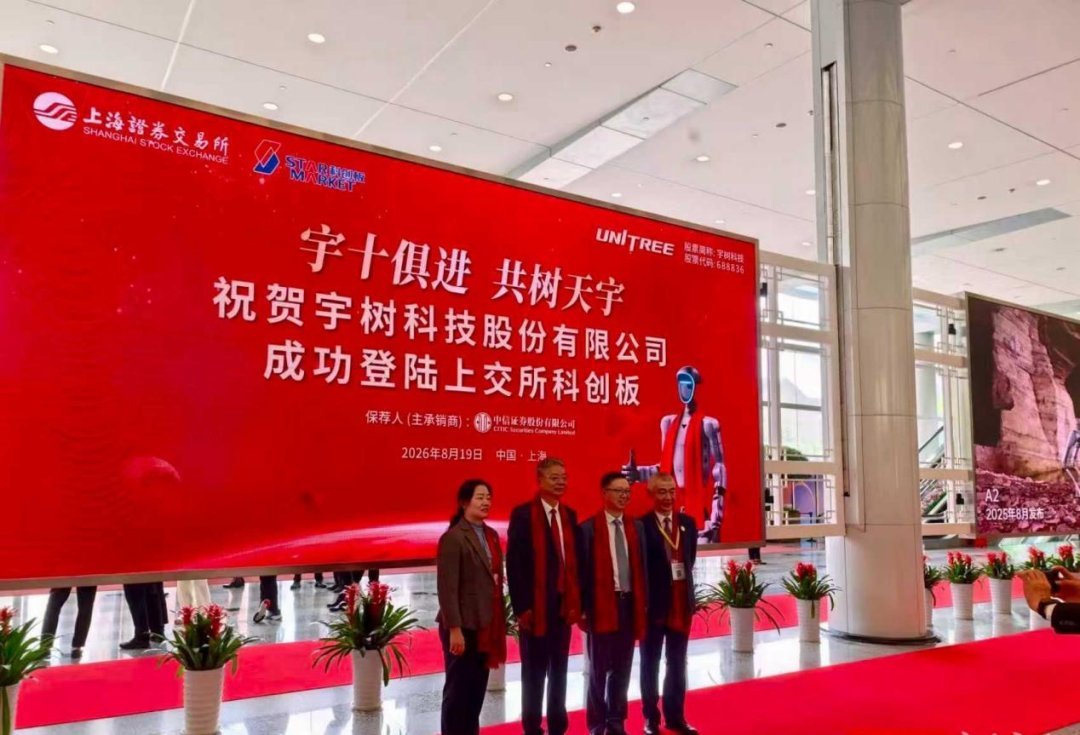
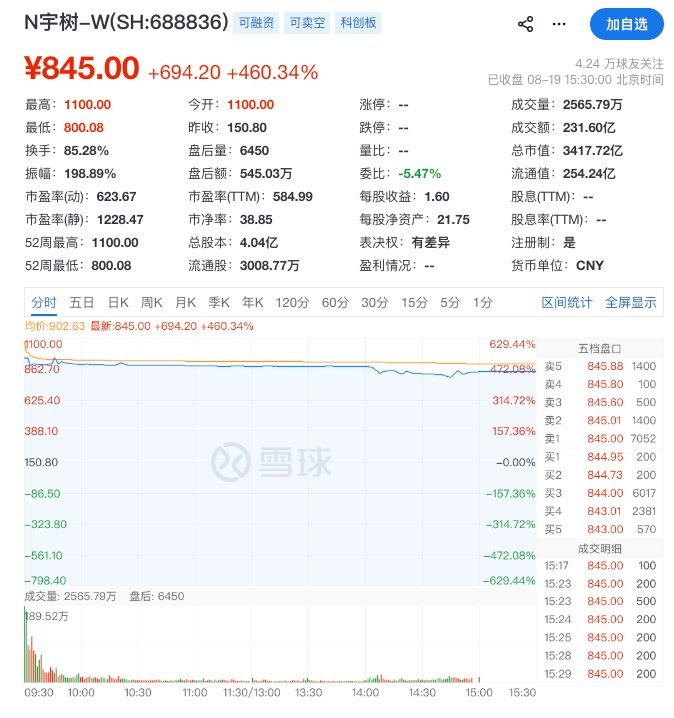
Unitree Technology rang the opening bell and its shares exploded higher at the start. “The first humanoid-robot stock” formally listed on the Shanghai STAR Market. On its first trading day Unitree opened at 1,100 yuan per share, a surge of 629.44 per cent over the 150.80 yuan issue price, and its total market value instantly topped RMB 444.9 billion, making it only the second A-share newcomer after PixArt Imaging to break 1,000 yuan on debut.
Unitree could not hold the peak. After the open, the price swung lower, dipping to 882 yuan intraday, and closed at 845.00 yuan, up 460.34 per cent.
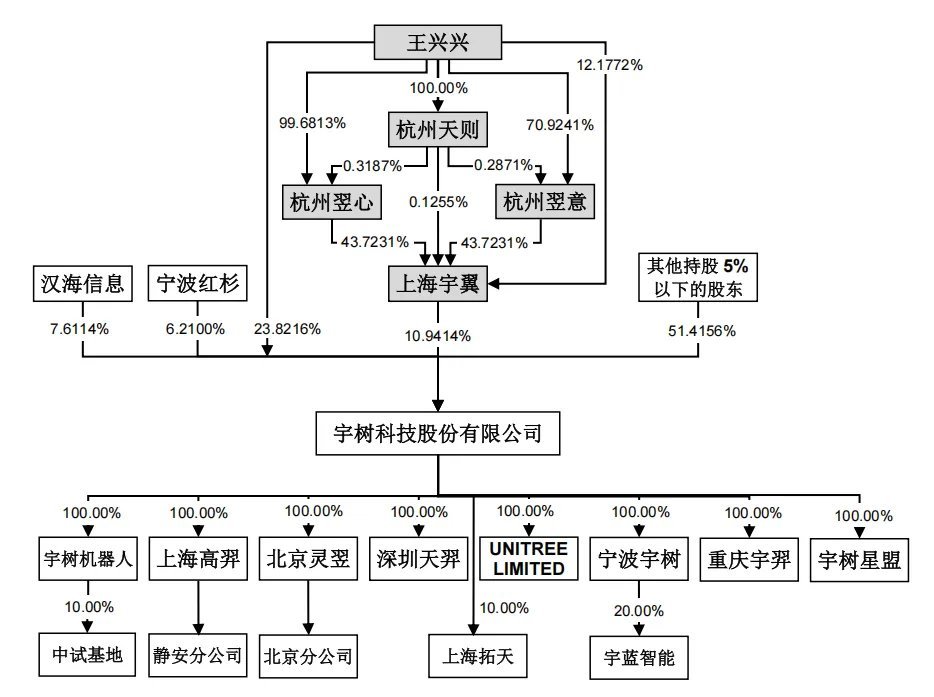
Behind the frenzy, the biggest winner is founder Wang Xingxing. Per the prospectus, chairman, general manager and chief technology officer Wang Xingxing directly holds 86.714964 million shares, or 21.4395 per cent of post-issue capital. Through an incentive platform, Shanghai Yu Yi, he also indirectly held 9.5367 per cent before the offering. Combined, his direct and indirect stake is about 30 per cent, and at the opening price his holding was worth over RMB 100 billion, overtaking Insta360 founder Liu Jingkang as the newest post-90s billionaire.
The listing was also a collective wealth release. Early options granted cheaply to core staff between 2017 and 2021 became hugely valuable after the more than 490 per cent first-day gain, putting young leaders such as director Yang Zhiyu and Chen Li into the billion-yuan club. Of 171 employees in the strategic allotment, 23 joined the ten-million-yuan ranks. Early backers Sequoia China and Matrix Partners also scored rich returns. Entities linked to DeepSeek’s Liang Wenfeng, via High-Flyer, took about 1.1916 million shares through strategic and offline allotments, a paper gain of over RMB 1.1 billion at issue price.
Notably, a DJI-affiliated fund had a chance to join Unitree’s capital increase in 2018, but the investment never closed. Had it held, that stake would be worth over RMB 3.5 billion, and at the opening price the missed gain exceeded RMB 25 billion.
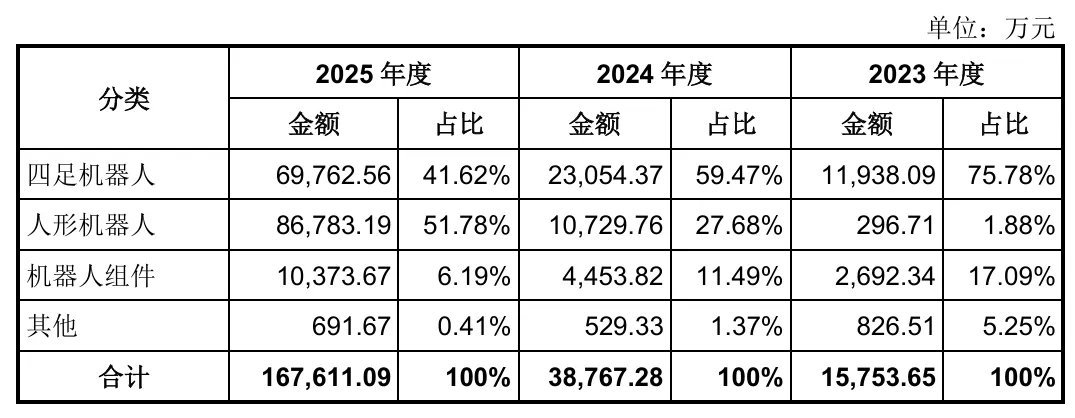
Behind the share-price celebration, Unitree’s financials deserve a look. From 2023 to 2025, revenue was RMB 159 million, RMB 393 million and RMB 1.699 billion, a three-year compound growth rate of 226.78 per cent. In 2025, attributable net profit after adjustments was RMB 591 million, and gross margin on the core business rose from 44.22 per cent in 2022 to 60.13 per cent in 2025. By end-2025, cash and wealth-management products on the books totalled about RMB 1.7 billion, liabilities were just 18.82 per cent of assets, with no short-term borrowings and healthy cash flow.
In 2025, Unitree’s humanoid-robot business surpassed quadrupeds for the first time as its largest revenue source, shipping over 5,500 humanoids, the global leader. Its quadruped global share is about 60 to 70 per cent, and its self-development rate for core components exceeds 90 per cent.
Yet signs of a growth gear-shift are already visible. In the first half of 2026, Unitree posted revenue of about RMB 1.152 billion, up 48.54 per cent year on year, and attributable net profit of RMB 274 million versus a loss of RMB 32.02 million a year earlier, but adjusted net profit fell 19.34 per cent to RMB 244 million, mainly as R&D and selling expenses rose sharply. As the revenue base grows and industry hype cools, the high-growth phase is giving way to a finer-grained competition.
From a 50-square-metre office in Hangzhou in 2016 to a STAR Market value above RMB 440 billion in 2026, Unitree has travelled a full decade. That decade is both Wang Xingxing’s journey from a boy teachers thought “a bit slow” to a post-90s billionaire, and the story of China’s embodied-intelligence industry moving from a cold niche to the centre of the capital-market stage. As Wang puts it, listing is like the “gaokao” university entrance exam, a milestone toward more mature management and operations. But for Unitree the real test is only beginning. Capital markets have granted a multi-hundred-billion valuation. What they will ask next is no longer whether robots can run or jump, but whether they can be delivered reliably, profit consistently, and truly enter industrial, service and home settings. As Tesla, BYD and other giants accelerate in, Unitree must build new moats fast. Whether this “first humanoid-robot stock” can convert first-mover advantage into lasting competitiveness sits not in today’s share price but in every robot that actually goes to work.
Editor’s note: This is an adapted translation of the original OFweek Robotics report. It has been trimmed and restructured for readability for an international business audience.