World models were the soul of this year’s WAIC conference, and the question running through every session was blunt: how does a model actually understand the physical world and step into it? At a dedicated forum on 19 July, Kunlun Wanwei chairman and chief executive Fang Han declared 2026 the first year of the world model, and the company’s answer to the question is Matrix-Game 3.5.

Object permanence, the basic question that broke world models
The company built its release around a failure that embarrassed the entire field. A benchmark called MemoBench, released jointly by Harvard, MIT, IBM and Google, tests object permanence: if an object leaves view and returns, does the model know it is the same object, what it looks like and how its state changed? A three-year-old scores full marks; ten mainstream world models scored below 0.58 out of 1.
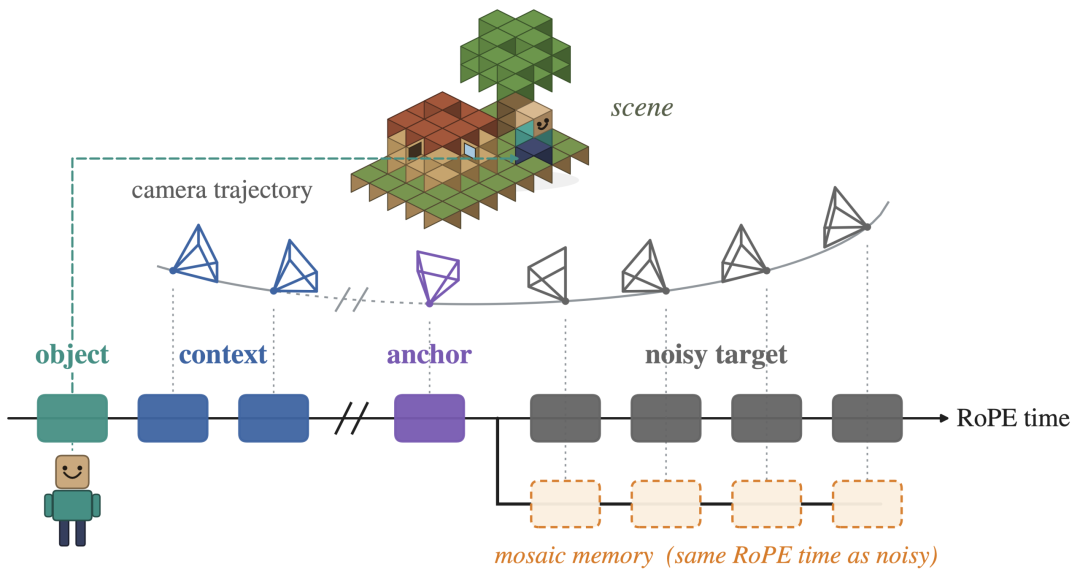
Matrix-Game’s diagnosis is that most models only render predictions without understanding current state or forecasting the next state. It breaks object permanence into three failures and claims a fix for each. First, forgetting. Transformer attention dilutes early information as context grows, and even Google’s Genie 3 keeps consistency for only about a minute before scenes degrade. Matrix-Game 3.5 replaces time-indexed memory with space-indexed memory, storing observations as geometry-aligned three-dimensional patch memory. The model remembers that an object sits at coordinates in space rather than at frame five, top left, so memory no longer grows with sequence length.
Second, recognition. Because a camera angle changes pixels completely, the model needs to know which real-world point a pixel came from, not just where it sits on screen. Matrix-Game 3.5 encodes camera projection matrices directly into positional encoding and separates dynamic objects from static scene structure during memory writes, so a moving person is not mistaken for several different people. Third, incorrect state change. Instead of training state understanding and action generation separately, the model jointly generates state and action under one loss function, building causal reasoning into the training objective itself rather than hoping it emerges from data.
Three gates between games and the real world
Kunlun Wanwei’s ambition runs past gaming toward robot control. The path crosses three gates. The first is data with physical scale. Internet video lacks depth labels, so models learn relative geometry without knowing distances or directions. The company built three automated pipelines that survey thousands of games for high-value sources, estimate camera pose and metric depth for every clip, and score scene quality. The result is more than five million high-quality video slices and over 10,000 effective training hours across 1,200 game and physical scenes.
The second gate is latency. For robot control, delay is a safety line, not a performance metric. Matrix-Game 3.5 compresses diffusion sampling to three steps, quantises the transformer feed-forward layers, caches key-value pairs and prunes about 75 per cent of its video encoder. A 5-billion-parameter model then generates 720p output at roughly 20 frames per second on a single GPU, fast enough to move from watching the world to intervening in it.
The third gate is compute. Rather than piling on parameters, the model adds almost no new weights for interactive features: all interaction ability comes from architecture design, and the framework can be grafted onto different video foundation models without rewriting them or sacrificing open-content generation quality.

Why open source gives China the definition rights
Kunlun Wanwei argues its edge is timing and openness. It declared an all-in AGI strategy in 2022, opened Matrix-Zero in 2024, and released Matrix-Game 1.0 and 2.0 in 2025 and 3.0 and 3.5 in 2026, publishing weights with every release. Matrix-Game was the first 10B-parameter spatial-intelligence model from industry when it opened in May 2025, and Matrix-Game 2.0 was the first open scheme for real-time long-sequence interactive generation. The company claims it is the only Chinese open scheme able to benchmark against Google’s Genie.
The bet is that openness builds the standard. Saining Xie, the DiT author and NYU professor who co-leads the JEPA world-model line with Yann LeCun, built the first multiplayer video world model, Solaris, on Matrix-Game 2.0. Nvidia and Zhejiang University released world-model work on Matrix-Game 3.0. Nvidia’s SANA-WM and Adobe’s RELIC both use Matrix-Game models as comparison baselines. The logic runs open source to feedback, feedback to iteration, iteration to leadership, and the ecosystem wall thickens with each cycle.
The closing argument
Kunlun Wanwei’s corporate structure supports the model play: its 4 plus 3 AGI strategy pairs four model foundations, covering video, music and audio, world models and base text and multimodal, with three platform economies in AI short drama, AI music and AI games. Data flows from platforms to models, and model capability flows back into platform experience.
The ultimate pitch is that a world engine removes the cost of physical trial and error. Robot training no longer needs a million real-world attempts when a robot can drop ten thousand bowls in simulation for the price of electricity. Autonomous-driving simulation no longer needs expensive closed test grounds when storms, night and sudden crossings can be generated on demand. That requires behaviour that is true, not just imagery that looks true: cups break, walls hold, and when you return ten minutes later the cup is still there. Code-driven game engines cannot do that. Matrix-Game 3.5 argues that geometry understanding, spatial memory and causal reasoning finally make a model world that behaves like the real one.
Editor’s note: This is an adapted translation of the original Leiphone report. It has been trimmed and restructured for readability for an international business audience. The full original (in Chinese) is at https://www.leiphone.com/category/industrynews/bugwcjvZxhFyiRY1.html.