For a while, Scaling Law ruled embodied intelligence. To make a robot arm handle complex pick, align and assemble tasks, most work pushed vision-language-action (VLA) models to 7 billion or even 8.5 billion parameters. Bigger helped semantics, but long-horizon instability did not disappear.

Many large VLA models suddenly fail at step 10 or beyond. The core cause is cumulative error propagation: a millimetre-level positioning slip early on amplifies through later steps until the grasp fails or the motion stalls. More parameters sharpen semantics but do little to correct deviation late in the action.
A team from East China Normal University and Shanghai Jiao Tong University proposed S2-VLA, authored by Xie Zhipeng and Han Zongyi as co-first authors, Zhao Jing as corresponding author and Sun Shiliang. Instead of stacking parameters, they added a belief state and adaptive dynamic gating so the model shifts attention by stage. A 2-billion-parameter model reached 96.4 per cent success on LIBERO-Long, beating most 7B and 8.5B models.
Why tiny deviations amplify
In decoupled VLA, an upper policy head maps vision and language features to control commands. Most methods use static fusion: the weights of vision, language and action history stay fixed for the whole task. Fine early, but in long sequences it shows two flaws: a millimetre slip cannot be corrected because visual weight will not rise, and at subtask switches the model loses high-level intent and stalls mid-air.
S2-VLA shifts with the stage: when precise alignment is needed it raises visual weight to correct; at a subtask switch it raises intent weight to re-lock the goal. Static fusion uses one attention recipe for every phase; S2-VLA tunes it per phase.
Belief state plus three-way adaptive attention
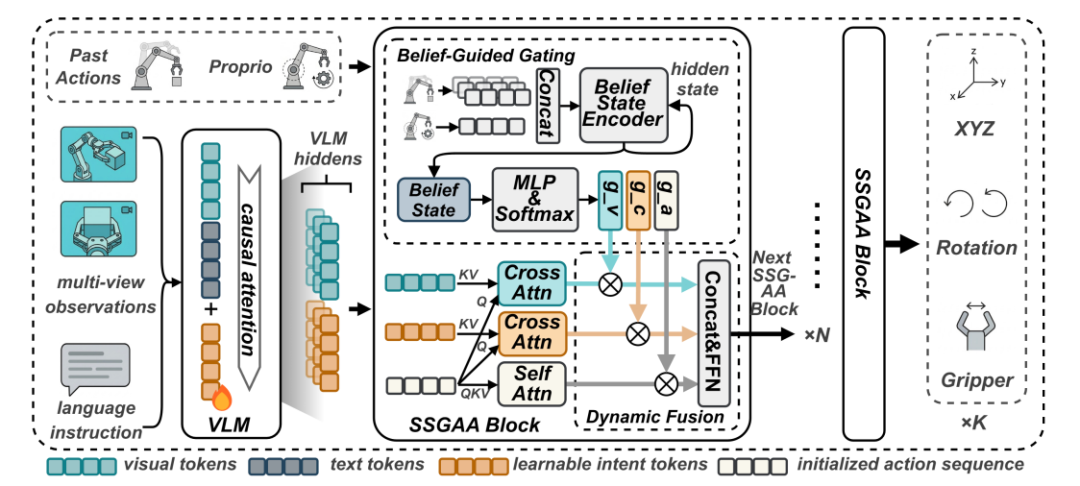
The architecture splits into two parts. A lightweight recurrent network takes the previous action history and joint feedback as a belief state that judges where the task stands and whether deviation has appeared, without outputting actions directly and without manual stage labels. The SSGAA module then splits the policy head’s feature fusion into three parallel channels: a local visual cross-attention for fine spatial alignment, a global intent cross-attention for subtask planning, and an action self-attention for temporal coherence across predicted steps.
The belief state generates dynamic gating weights by stage. Need precise positioning and the visual channel rises; need a subtask switch and the intent channel rises; in steady movement the action self-attention dominates. Ablation shows placing the gate at a middle layer, around layer 12, works best.
Attention shifts across 31 steps
In a task of putting a cheese box and butter into a basket, the 31 inference steps align with keyframes. At aim and locate frames the green visual-weight curve rises as the end-effector nears the target; at grip, put and task-change frames the red intent-weight curve rises to keep the chain unbroken; in steady transitions the blue action-self-attention stays high to keep motion smooth.

Dynamic attention, layered decoupling, edge efficiency
S2-VLA’s path echoes spatial-intelligence and world-model debates in three ways: attention shifts with the task stage instead of staying fixed; high-level semantics and low-level control are decoupled, as LeCun and others argue, letting a small model stay stable on long tasks; and it is edge-ready. Inference needs about 7 GB of memory at 80.8 Hz, versus a few hertz for typical 7B models, so homes or factories need no server tethered by remote control.
The value is not a few points of success rate. It shows that in long-horizon control, raw parameter count is not enough; what matters is assigning compute to the right place at the right stage. Static fusion treats every phase as one need and lets errors amplify; dynamic gating looks more when correcting, more at intent when switching, more at coherence when moving. For embodied systems, stage-adaptive scheduling may outlast simply making models bigger.

More from the original report

Editor’s note: This is an adapted translation of the original Leiphone report. It has been trimmed and restructured for readability for an international business audience.
Translated and adapted from Leiphone (https://www.leiphone.com/category/private/wTgqKxi0pIXPuau0.html).