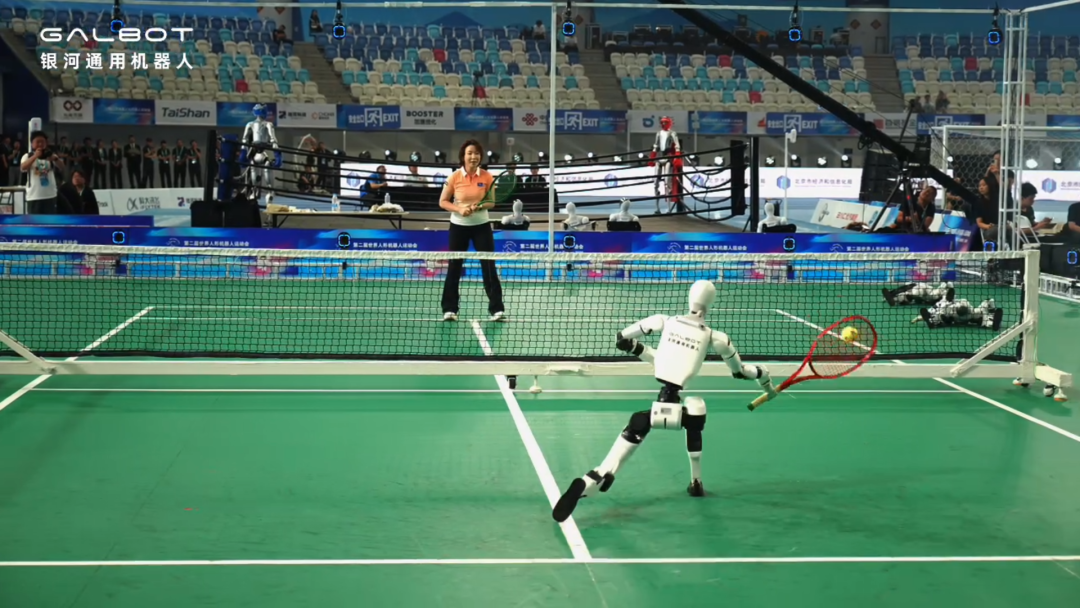
On 22 August at the National Speed Skating Oval in Beijing, the opening of the second World Humanoid Robot Games put a camera on a real tennis court. A humanoid stood inside it, and against incoming balls travelling above 50 km/h it judged the bounce, moved its feet, turned its body and swung, the ball clipping the net and landing in.
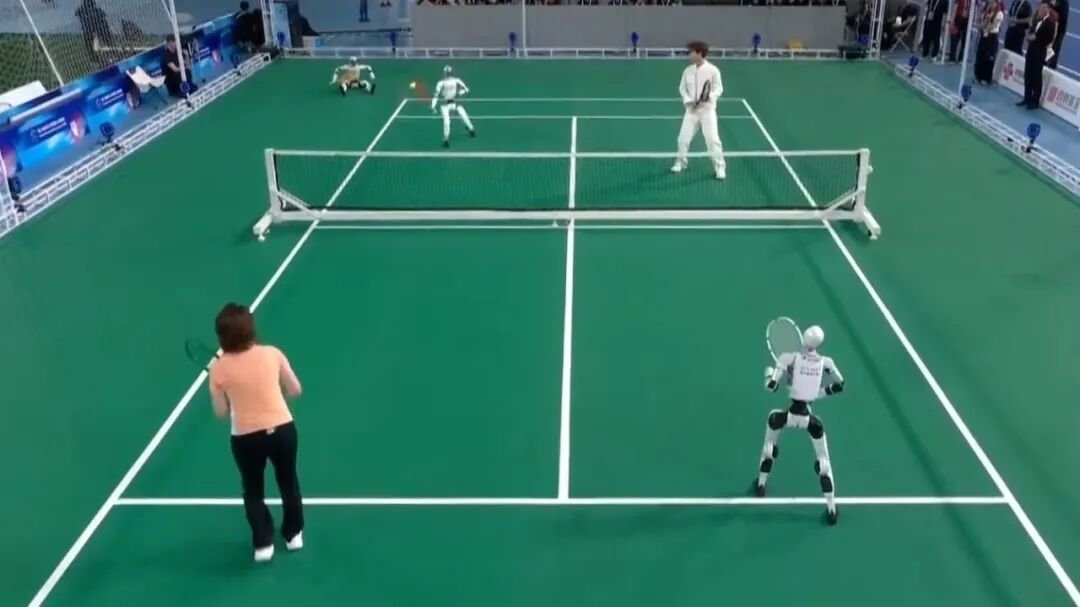
It served, hit forehands and backhands, worked the baseline and the net, and in a warm-up doubles match it covered for a human partner and swapped tactics. In one high-speed rally it made a diving save, crashed hard to the floor, pushed itself up and kept playing. Galbot, the Beijing humanoid maker, built the first fully autonomous humanoid to play a complete tennis rally.
A brain that decides, a cerebellum that swings
What the machine showed was not a fixed routine. Its play is anthropomorphic: feet first to position, body driving the arm, upper and lower body working together, clean contact and precise placement. It handles serves, forehands and backhands, singles and doubles, and shifts strategy by the format. Against a partner it shows tactical awareness and makes decisions on the fly.
The engine is AstraBrain, an embodied large model that welds three jobs into one system. The brain understands and decides: where the ball lands, how to play it, how to organise tactics, how to cover a partner in doubles. The cerebellum runs motion control: whole-body balance at speed, explosive swings, human-like movement. A neural bridge translates the brain’s decisions into the cerebellum’s action commands.
Older stacks split those three jobs into separate modules with interfaces that fail under pressure. AstraBrain ships them as one model, which is why Galbot calls it the world’s first fully end-to-end whole-body brain-cerebellum-nerve-control model. On the court the value is visible: a ball arrives, the brain decides in milliseconds whether it is deep or short, attack or defend, and the cerebellum is already sliding left, squatting and drawing the racket. At the instant of contact the brain updates again.
This real-time think-while-playing loop is only possible with a unified architecture. A June CVPR release of AstraBrain-WBC 0.5 pushed zero-shot generalisation to 92.58 per cent and inference latency below 1.5 milliseconds in the lab. AstraTennis is the same system’s first appearance in real adversarial play.
Learning from imperfect human data
Galbot founder and CTO Wang He calls tennis the ultimate exam for a humanoid: whoever answers on the court has solved both the cerebellum and the brain. Teleoperation cannot capture a rally no human can react to, and motion capture of a full match is all but impossible to afford. So Galbot took the opposite path with AstraBrain Latent, a real-time whole-body planning algorithm that mines the latent rules of how to play from imperfect, incomplete human clips.
Instead of expensive perfect demonstrations, the team collected ordinary fragments, a forehand here, a slide there, and let the algorithm combine, correct and generalise them into a full tennis skill. A latent-action barrier keeps the motion in a human-like envelope while random perturbations during training teach self-correction, so the robot plays a live ball and adapts.
Practising against thousands of itself in a virtual world
Galbot also built its own virtual tennis world on top of GalaxySpace, a billion-scale embodied dataset. Training runs in two steps: massive rehearsal in simulation against virtual opponents of varying skill, then light calibration on the real machine. The key step is multi-agent play: the robot plays itself, and abilities no one explicitly taught emerge from the volume of data.
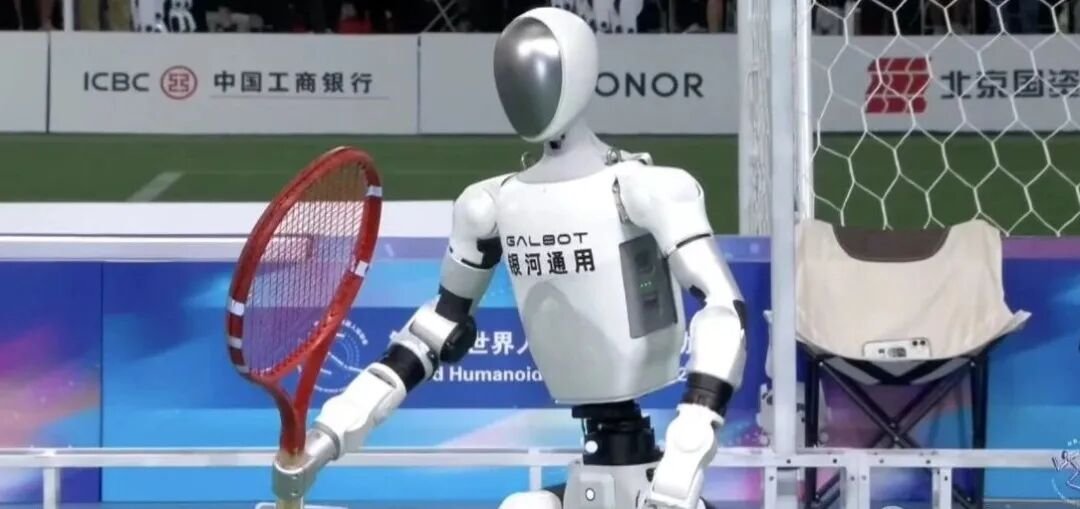
The skills learned in the virtual world transfer to the real court, which is why AstraTennis showed up in a global livestream rather than a lab video. The full chain is clear: AstraBrain thinks and acts, AstraBrain Latent distils skill from broken data, GalaxySpace supplies the arena and opponents.
Fell, stood up, walked on
The most striking frame was the fall. At speed the robot misread a sharply struck ball, hit the floor, and with no staff rushing in, stood up on its own and prepared the next return. That detail beats any specification: the motion control is strong enough to recover from real-world surprise.
The path Galbot walked, brain decision, cerebellum execution, data emergence as one system, gives the whole embodied industry a reusable template. A general motion base means dancing, inspection, rescue and housework can share one body operating system, with marginal cost falling as scale rises. The capability is already running elsewhere: in smart pharmacies a robot picks a target from thousands of items and hands it to a rider, and on industrial lines Galbot’s S1 dual arm lifts 50 kg loads. Tennis is simply the newest tile it lit up.
Editor’s note: This is an adapted translation of the original Leiphone report. It has been trimmed and restructured for readability for an international business audience.
Translated and adapted from Leiphone (https://www.leiphone.com/category/ai/DtuJryomWlykalLZ.html).