A robot company eight months old, which had announced close to RMB 1 billion of orders, has been accused of failing to pay wages at all.
On 23 October the National Business Daily reported that staff at Nanjing Wujing Dynamics allege three to four dozen employees are owed close to RMB 8 million in total, and that work at the company has stopped.
Four months earlier the company had raised RMB 110 million and signed framework orders worth nearly RMB 500 million with several state-owned enterprises, plus a further RMB 500 million of reserve orders.
How does a company travel that distance in a few months. The answer is that a signed order and a paid delivery are separated by a very long corridor.
RMB 1 billion of orders, four months
Wujing Dynamics was registered in Nanjing’s Jiangning development zone on 11 February with RMB 10 million of capital, building industrial quadruped robots, the machines commonly called robot dogs. The target market was power, petrochemicals and energy mining. A standard quadruped inspects and collects data. Wujing’s plan was to add an arm so the machine could reach out and operate a switch after finding a fault.
Founder and chief executive Yuan Haihui entered Shanghai Jiao Tong University at 16 and began founding companies at 20. About 20 core staff came from Tsinghua, Zhejiang and other universities, some by way of the Zhijiang Lab, AgiBot and Robot Era. Corporate filings list Cui Xiaofei as the actual controller.
Local support was generous. Yuan described investment in the tens of millions of yuan from a district fund and the Huarui park, plus a dedicated research building with furniture and staff apartments already in place. His phrase was that the company could move in with a suitcase.
Orders followed quickly. On 15 June local media reported that four months after founding the company had signed about RMB 500 million of framework orders with state-owned enterprises, held another RMB 500 million of local reserve orders, and had RMB 110 million of funding in the bank. In July the Jiangning district government website profiled a substation inspection robot that walked a set route, detected an instrument anomaly and used its arm to operate a switch. Delivery was planned for October.
Two words in that RMB 1 billion deserve attention. Framework, and reserve. A framework order still depends on later purchasing decisions. A reserve order may be further from a transaction still. Power companies typically buy a handful of units to test first, checking whether the machine survives the site and identifies faults reliably, before scaling. A robot that completes a demonstration at a trade fair and a robot that works a substation for months are different problems.
How much of the announced RMB 1 billion converted into formal purchase, delivery and payment has not been disclosed.
The money stopped in August
Wujing’s trouble arrived earlier than outsiders assumed. Staff told the National Business Daily that wages stopped in August, housing fund payments stopped in September and social insurance in October. Some have filed for labour arbitration. The company was still demonstrating product in July. By August people said they were not being paid.
Staff also say the actual controller Cui Xiaofei stopped coming to the office, and that the head of the R&D department joined the queue of claimants. Yuan, reached on 22 October, said he could no longer reach Cui and declined to comment. Cui’s phone rang busy.
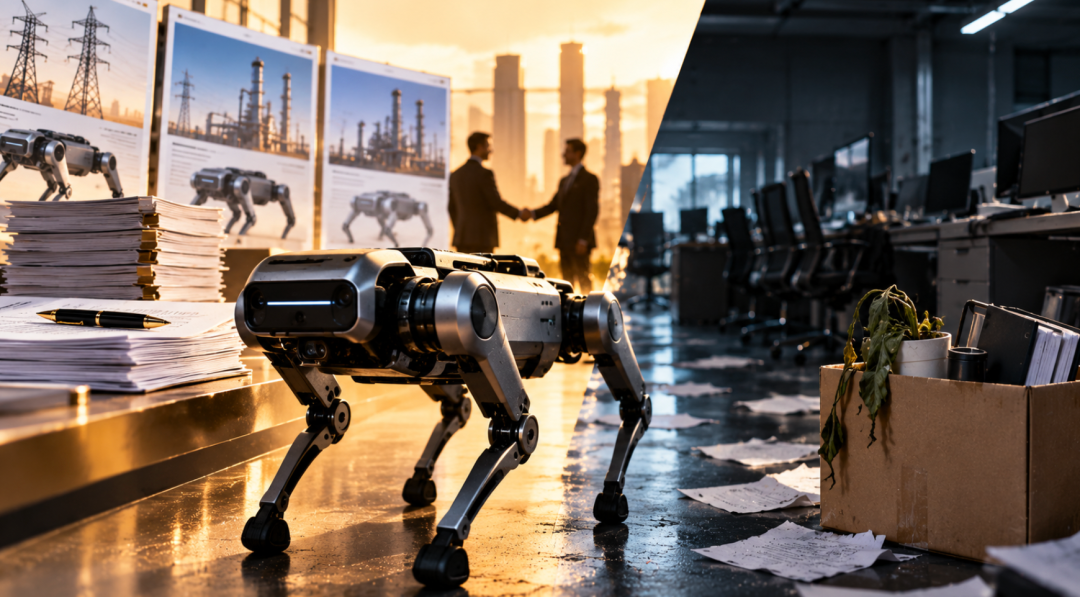
The funding is the more confusing part. How does a company that announced RMB 110 million in June report unpaid wages in August. Public records do not explain where the money went, but the equity history is worth reading.
Wujing was initially wholly owned by Suzhou Chaoguang Micro Medical Technology, controlled by Cui. In June Juncheng Technology, listed on the Beijing Stock Exchange, said it would participate in a RMB 32.01 million fund investing in Wujing. The structure was unusual. The fund would first invest in Chaoguang Micro, the original shareholder, then acquire Wujing equity through a share swap.
The first RMB 16 million of the fund closed in July. In August Wujing’s shareholder changed, Chaoguang Micro exited, and a newly formed holding company took its place. Cui still controlled Wujing. Whether the RMB 32.01 million was ever completed, and whether any of it reached Wujing, has no clear public answer. Nor is it the same money as the RMB 110 million previously announced.
Big orders do not save every robot company
Robot companies are expensive in a specific way. Algorithms, mechanics and control engineers command high salaries. Building a quadruped means buying components. Training models means servers and compute. Cash leaves before revenue arrives.
Listed companies show the pattern. UBTech reported RMB 2.001 billion of revenue in 2025 and a loss of about RMB 790 million, with RMB 507 million spent on research. Dobot put about RMB 45.1 million into embodied intelligence research that year against roughly RMB 20.04 million of revenue from the business.
Those companies have products and revenue and still need to keep spending. A startup taking several projects at once must hire and buy equipment ahead of the work, while customers may pay the balance only after acceptance.
The comparison cases are not encouraging. Shenlan Robot, a delivery and disinfection robot maker backed by a technology group once valued at RMB 14 billion, had planned to export 25,000 disinfection units within two years and built a Shangqiu plant rated above 20,000 units annually. Its LG order did not scale as intended, pandemic demand shifted, and in May 2026 a Shanghai court accepted a bankruptcy liquidation case. By September, claims for 102 employees had been confirmed at more than RMB 23 million, of which unpaid wages and compensation exceeded RMB 21 million.
CloudMinds raised about RMB 5.4 billion, reached a valuation above RMB 20 billion with SoftBank and Shanghai Guosheng on the register, and completed more than RMB 1 billion of funding in 2023. By March 2025 parts of its Shanghai base were empty. Founder Huang Xiaoqing acknowledged severe difficulties, layoffs and restructuring. In October a Beijing court accepted a bankruptcy liquidation case.
Wujing has not reached that point. But the shape is familiar. Funding, orders and product plans all looked excellent. Turning them into durable revenue is the part that does not follow.
The companies likely to survive fall into two groups, according to one embodied intelligence executive who spoke to Pencil News. Those with a technology moat nobody can copy, and those with delivery capability strong enough to embed in a specific industry and get the arithmetic right.
Customers will calculate whether the robot works reliably, how much labour it saves and what maintenance costs each year. If the product is unstable and expensive, the first order of a few units is the last order.
Editor’s note: This is an adapted translation of the original OFweek report. It has been trimmed and restructured for readability for an international business audience. The full original (in Chinese) is at https://robot.ofweek.com/2026-10/ART-8321202-12003-30708688.html.