A brain-inspired world model claims better navigation with far less data
On 14 September Shanghai-based EBKernel released Cog-WM 1.0 at a brain-inspired embodied intelligence forum it hosted during the 2026 Pujiang Innovation Forum, described as the first dedicated forum on the topic.
Cog-WM 1.0 is presented as the first brain-inspired latent-space predictive world model built on a systematic set of neural mechanisms, and it has been validated across both active-exploration embodied navigation and value-guided manipulation. The model borrows from human cognitive mechanisms to build a unified architecture driven by latent-space prediction, so that a robot can plan, follow semantic instructions and manipulate in unfamiliar environments without relying on prebuilt maps or enormous datasets.
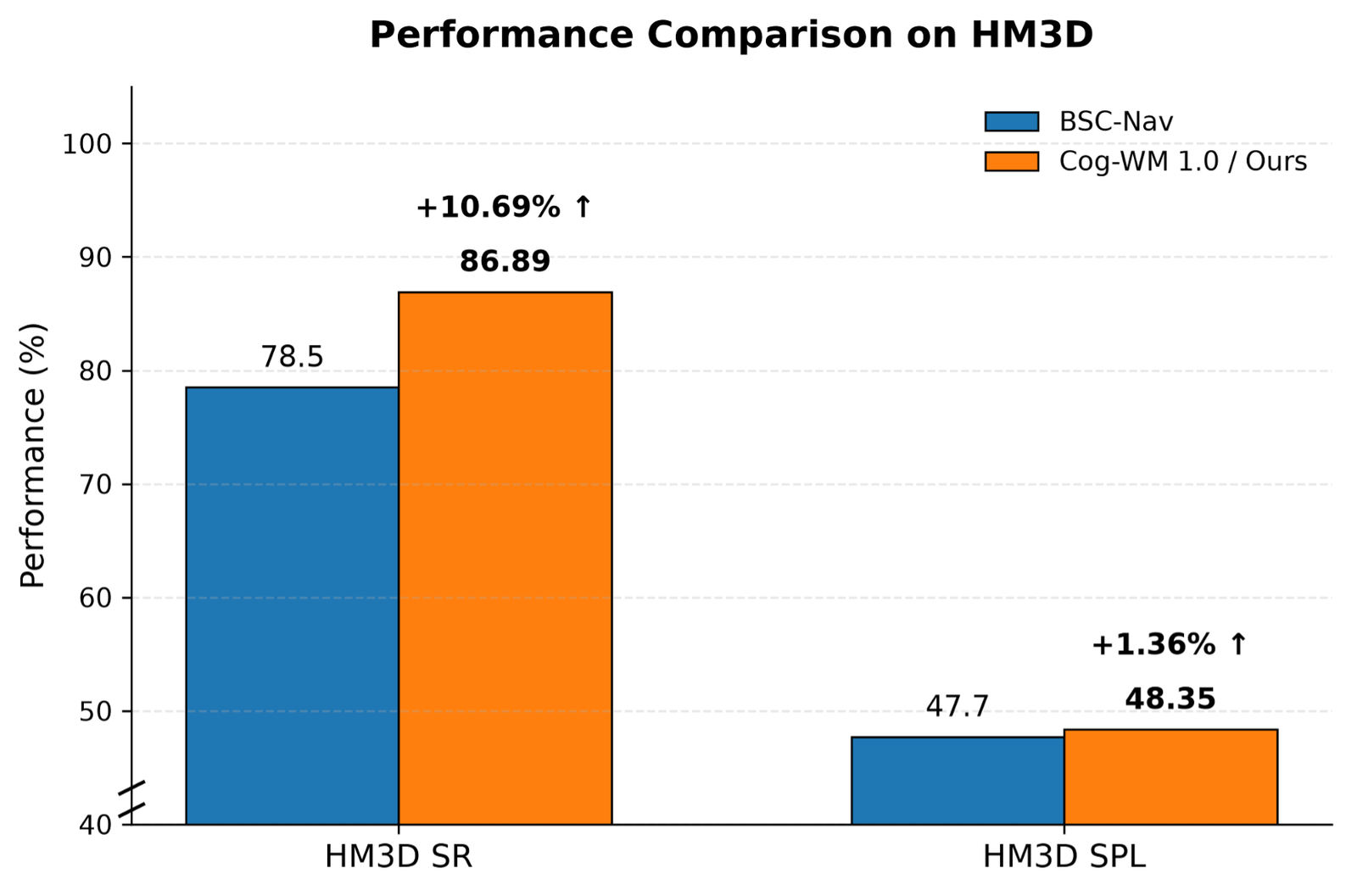
The claims rest on published benchmarks. Against BSC-Nav, described as the state of the art in cognitive-map navigation and published in Nature Communications, Cog-WM 1.0 navigates without a prebuilt map and improves the success rate by more than 10 percentage points. On embodied manipulation benchmarks it outperforms pi-0.5, a state-of-the-art model pretrained on very large datasets, by up to 16 percentage points.
The model has been deployed across wheeled humanoid and quadruped bodies, completing autonomous navigation and path planning without prebuilt maps, spatiotemporal memory retrieval, spatial relation question answering and object search. Manipulation capability has been validated on a wheeled humanoid, giving a technical basis for out-of-the-box use in open worlds.
Three questions that cannot be avoided
Finding a potted plant in an unfamiliar room may require crossing several areas, remembering where it has already looked and deciding where to go next while the target has not yet appeared. Completing a continuous task such as tidying objects requires knowing what each action will change and how those changes affect what follows.
Different as they look, the two tasks point at the same set of challenges. How can dependence on massive task data and environment-specific tuning be reduced? How can historical information actually be used? How can long-horizon tasks be completed more often?
EBKernel’s judgement is that these are not local problems solvable with two more years of engineering. They are structural problems at the level of paradigm. Scaling data tenfold and parameters tenfold does not automatically produce cognitive understanding of the physical world or real interactive capability. The company’s answer is to stop extrapolating along the path of adding more data for more scenarios and to return to the origin of intelligence, the human brain.
Core mechanisms
The underlying idea draws on how the brain’s cognitive map organises memory, selectively updates information and predicts subsequent states, combined with a joint embedding predictive architecture to learn how the future changes inside the abstract feature space the model extracts. In plain terms, it focuses not on how pixels change but on how task-relevant space and state change, and it acts on that basis.
Three systematic mechanisms support the approach. Perceptual encoding and goal modulation rebuild the world in latent space rather than at pixel level, and only predict the abstract representations useful for decisions, so a smaller learning target means a smaller data requirement. Separation of content and structure in spatiotemporal memory treats spatial structure as reusable across tasks, so learning roughly what a room looks like means a new room does not have to be learned from scratch, and surprise-driven updating means the system invests learning only in the unexpected rather than reprocessing what it already knows. Multilevel latent prediction forecasts at several spatiotemporal scales, supporting long-horizon exploration in unfamiliar environments.
Within that shared framework navigation and manipulation use different implementations. The navigation side builds explicit spatial memory and predicts exploration direction from it. The manipulation side learns state changes across different time spans during training and improves policy from execution experience. The same brain-inspired mechanisms were validated first on one task domain and then the other, which is what distinguishes Cog-WM 1.0 from a single-point algorithmic improvement. Full methods for both directions have been published as arXiv papers, putting testability at the paper level.
Navigation results
As a robot moves through an environment it keeps seeing objects and passing through regions. Organising those scattered observations and calling on them in a later task has long been unsolved. Cog-WM Nav 1.0 binds spatial memory to lookahead prediction, combining task goals and existing environment memory inside the memory latent space to predict subsequent spatial representations and exploration subgoals, then choosing the next action from goal semantics and path cost. It can head straight for a target when it has the information, and judge where to explore when it does not.
On the HM3D-ObjectNav subset the navigation success rate rose from 78.50 per cent to 86.89 per cent, 8.39 percentage points above BSC-Nav, a relative improvement of 10.69 per cent, with path efficiency improving from 47.70 to 48.35. No prebuilt map prior is required. The result is that success rates rise while training data requirements fall, and the low-data, high-generalisation route has been validated on a public benchmark for the first time.
Cog-WM Nav 1.0 has been deployed on quadrupeds and is in use at customer sites for inspection and patrol. It had previously been validated and adapted on several wheeled humanoid configurations.
Manipulation results
Every step in a continuous manipulation task changes the conditions for what follows. The manipulation branch of Cog-WM Manip 1.0 uses multiscale prediction so the model learns both near-term action consequences and later task states during training, building a link between the current action and task progress. It also introduces value-guided experience learning, using effective execution trajectories to learn environment change and then steering policy improvement by how much an action segment contributes to progress. An effective correction inside a failed task still supplies learning information, and inefficient steps inside a successful task can be distinguished.
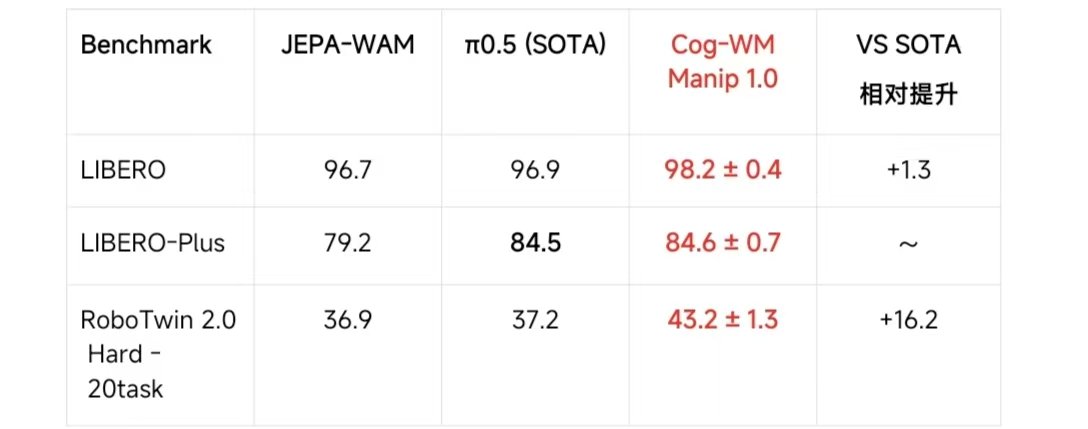
Under a unified reproduction protocol, Cog-WM Manip 1.0 beat industry baselines pretrained on very large datasets across all three mainstream manipulation benchmarks, including RoboTwin 2.0 Hard, one of the hardest currently recognised. More persuasive than the score increase is the attributability of the mechanism. Ablations show capability stacking layer by layer, from 80.0 per cent with policy alone, to 81.6 per cent with local prediction, to 82.0 per cent with multiscale prediction, to 84.6 per cent with the full method on LIBERO-Plus. Each layer corresponds to a specific mechanism, which is the fundamental difference between a systematic set of brain-inspired mechanisms and patch-style optimisation. Under lighting changes, viewpoint shifts and background texture changes, Cog-WM Manip 1.0 still completes tasks reliably, showing cross-scenario generalisation.
EBKernel founder and chief executive Zhu Senhua said embodied intelligence is at the stage where it moves from laboratory to industrial deployment, and that low data dependence with high generalisation is the core proposition of that process. Cog-WM 1.0 gives preliminary validation that borrowing the functional neurocognitive mechanisms of the human brain can raise the ceiling of an algorithm, and that breakthroughs will not come from piling up data alone.
From imitation learning to brain-inspired cognition
The release offers a verifiable new technical route. Leading performance at a much smaller data scale shows that trading algorithmic mechanism for data efficiency is engineering-feasible. Bringing long-term memory and lookahead prediction into the core architecture provides a basis for stable execution in long-horizon tasks and complex environments. More importantly, brain-inspired mechanisms have now passed engineering validation on public evaluations, which means competition in embodied intelligence is moving from a single large-data pretraining paradigm towards several paradigms coexisting.
The ecosystem around brain-inspired embodied intelligence is forming at the same time. The forum gathered experts from Shanghai, Beijing and Shenzhen and from the two brain science projects under China’s brain initiative, connecting large technology companies and leading start-ups. Brain-inspired intelligence is a priority future industry in the national fifteenth five-year plan, and the forum is intended to support Shanghai as a source of global brain-inspired innovation.
Starting with Cog-WM 1.0, the shift from imitation learning to brain-inspired cognition is moving from the laboratory towards industrial reality. When a robot stops reading a fixed map and starts remembering like a person, embodied intelligence has really begun.
Editor’s note: This is an adapted translation of the original Leiphone report. It has been trimmed and restructured for readability for an international business audience. The full original (in Chinese) is at https://www.leiphone.com/category/robot/Dq92tSkeaGMAL0rP.html.