On 31 August, Unitree refreshed its fire and emergency-response lineup with a slogan that leaves little to the imagination: robots built for people, on a mission to serve, into the fire and duty bound.
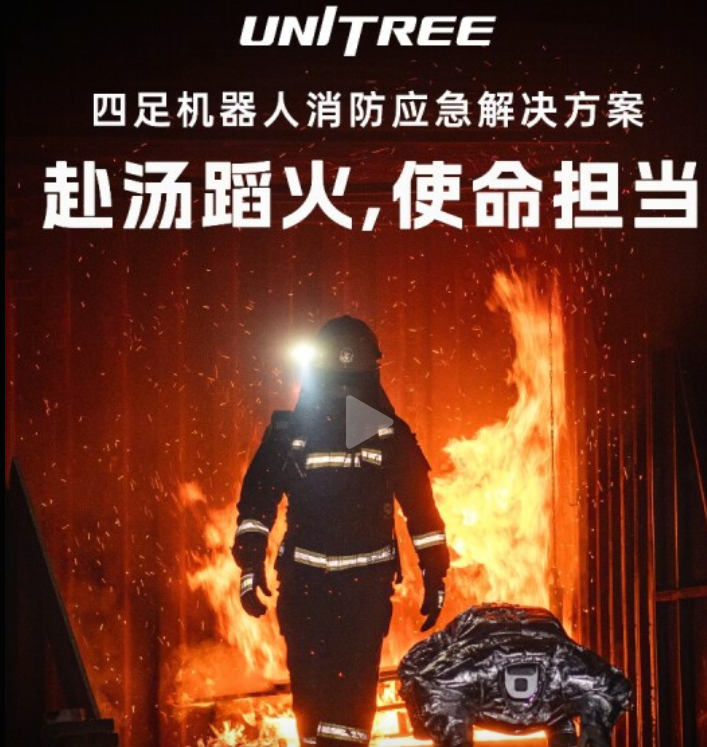
This is not Unitree’s first move into the sector. In April it showed a fire-recon robot dog built with Bawei Tong, fusing embodied intelligence with spatial intelligence. At the Yangtze River Delta emergency expo in May it brought a quadruped fire solution: a reconnaissance version that searches, shoots and identifies gas in rubble and complex terrain, and a water-cannon version that joins firefighting directly. At a Fujian training base, firefighters used a controller to plan autonomous patrol routes for a Unitree quadruped, testing its imaging and relay under random obstacles.
The B2 fire dog is rated IP68, runs at 5 metres per second, climbs 45-degree slopes and squeezes through gaps only 5 centimetres wider than its body. The fire variant carries a water cannon rated to 6 to 7 bar. Unitree is also working with Raycus Laser on a laser plus embodied-intelligence package and has signed a strategic deal with CRRC.
Local governments are moving. On 26 August an inspection team from Xuancheng’s emergency bureau discussed procurement, and Wuhan’s mobile fire detachment has already taken delivery of Go2 robot dogs and G1 robots.
From can walk and jump to can carry and rescue
For most people Unitree still means Spring Festival backflips and parkour. But in 2026 it is doing something more useful than showing off: making the robot actually work. A fire scene, with smoke, toxins, heat and collapse, is a harsher exam than a factory line. A dog that carries a water cannon through a burning building, climbs rubble and sends back data has to clear the same three bars as a humanoid that screws bolts on a line: protection rating, load capacity and motion control, all at industrial grade.
Climbing a 45-degree slope or slipping through a 5-centimetre gap is not for spectacle. It maps exactly to the firefighter’s problem of places too dangerous to enter. When a dog replaces a person in a toxic room to find survivors and locate the seat of the fire, what it saves is not property but lives.
From recon to firefighting, from rubble search to daily patrol, Unitree is assembling a full recon-decision-execution chain. If that chain holds, Unitree stops being a robot company and becomes an industry-solutions provider. The valuation logic shifts from selling hardware to selling capability plus service, and those sit in completely different leagues. Xuancheng, Wuhan, Tianjin and Chongqing are all buying. The path looks a lot like DJI’s march through drones. Unitree’s real moat is not the dancing. It is the saving of lives.
Editor’s note: This is an adapted translation of the original OFweek report. It has been trimmed and restructured for readability for an international business audience. The full original (in Chinese) is at https://robot.ofweek.com/2026-09/ART-8321204-8110-30701197.html.