UBTECH’s Walker S1 humanoid robot stood in the company’s Shenzhen headquarters on 13 October, narrating the scene around it in real time, while a Walker S2 unit placed material bins into marked positions with practiced precision. The demonstration, staged for a provincial industry delegation, is the public face of a company now pitching itself as an embodied-intelligence ecosystem platform rather than a robot maker.
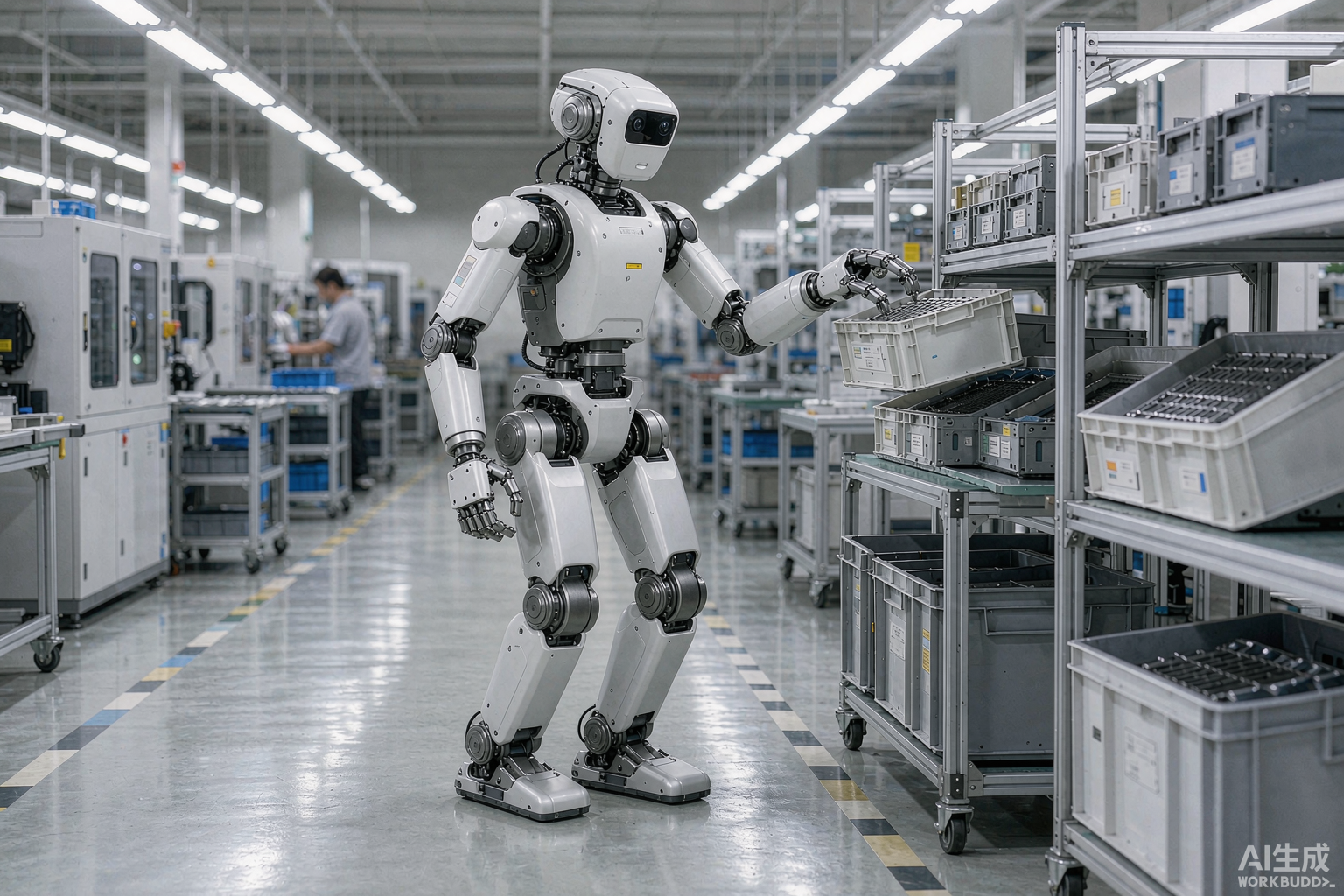
Vice-president Jiao Jichao, who leads the embodied-intelligence and humanoid research institute, frames the strategy as “three arrows released at once”: industrial, commercial and home-consumer scenarios advanced in parallel. The Walker S series targets factories, placing parts and handling materials. The Walker C1 handles guided tours and reception. The U1 family, built for companionship, renders more than 30 micro-expressions on a full-size face and reads emotion in real time.
From prototype to production line
The turning point came in September 2026, when UBTECH’s 10,000-unit humanoid super factory began operation, closing the loop from research to scaled mass production. Several new products start volume delivery in the second half of the year, covering all three scenarios.
The financials back the claim. In the first half of 2026 UBTECH booked revenue of RMB 1.27 billion, up 104.2 per cent year on year. Humanoid robot sales volume rose 268.3 per cent, and full-size embodied humanoids led the charge with revenue up 1,445 per cent and volume up 1,946.7 per cent. Since 2025, full-size embodied humanoids have been the company’s core revenue source.
Why Shenzhen matters
Jiao credits the Greater Bay Area supply chain for the speed. Send a sensor or battery drawing to a local supplier, he said, and a sample can be back the next day. Local logistics, 3C electronics and car manufacturing give robot development and scene validation a head start that is hard to replicate elsewhere.
Editor’s note: This is an adapted translation of the original Shenzhen News report. It has been trimmed and restructured for readability for an international business audience.