On 22 August, inside Beijing’s National Speed Skating Oval, known as the Ice Ribbon, the second World Humanoid Robot Games opened, and China Media Group cut its cameras to an actual tennis court.
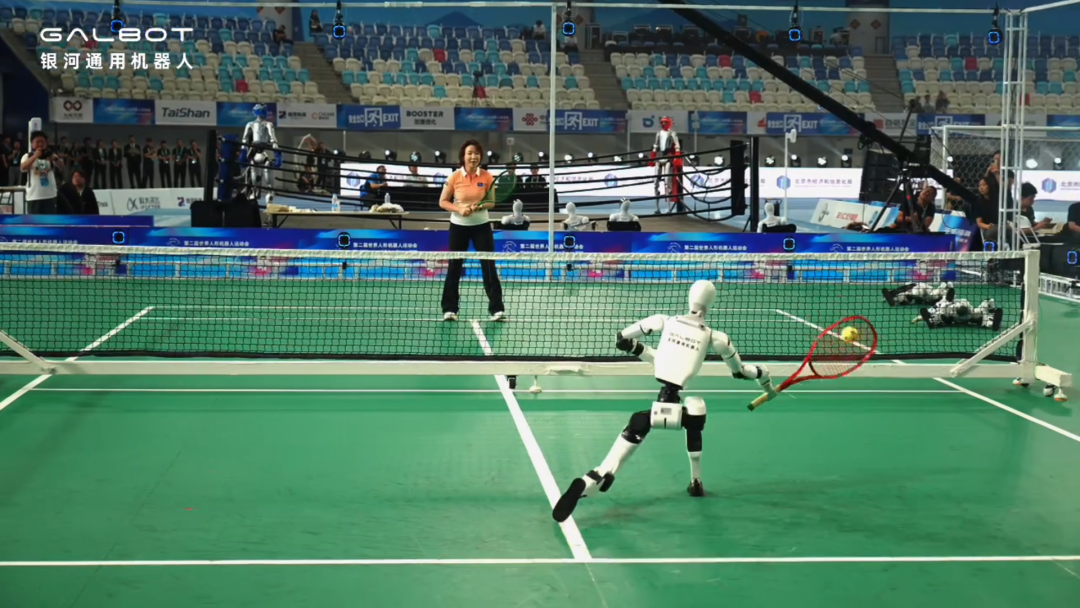
A humanoid robot stood on the baseline. A ball arrived at more than 50 kilometres per hour. Within milliseconds it read the landing point, moved its feet, turned its torso and swung. The ball clipped the net tape and dropped in.
Serve, forehand, backhand, baseline rallies, net volleys. It did not slip once.
In the warm-up doubles it paired with a human teammate, covering gaps and switching tactics. Midway through one fast exchange it made a diving save, hit the ground hard, pushed itself up and kept playing.
The machine that completed the world’s first fully autonomous tennis rally by a humanoid robot is made by Galbot.
Ten years ago AlphaGo proved that AI could think. Galbot set out to prove that AI can do. Closing the gap between thinking and doing took a full decade.
That is why we at LeiPhone read it as a landmark moment. It did not merely refresh a single benchmark. It put a humanoid robot on a live competitive court where thinking and acting happen at the same time.
Galbot gave the moment a name: the AstraTennis moment.
A generalist on court
The robot’s strokes look nothing like the machines of the past. The motion is human-like. The feet arrive first, the body drives the arm, upper and lower body fire together, and the swing is fluid with precise placement.
The more striking quality is generality. This is not a one-trick player. Serves, forehands and backhands are all in its repertoire, along with baseline movement, net volleys and control of ball speed and placement. It plays singles and doubles and adjusts tactics to the format.
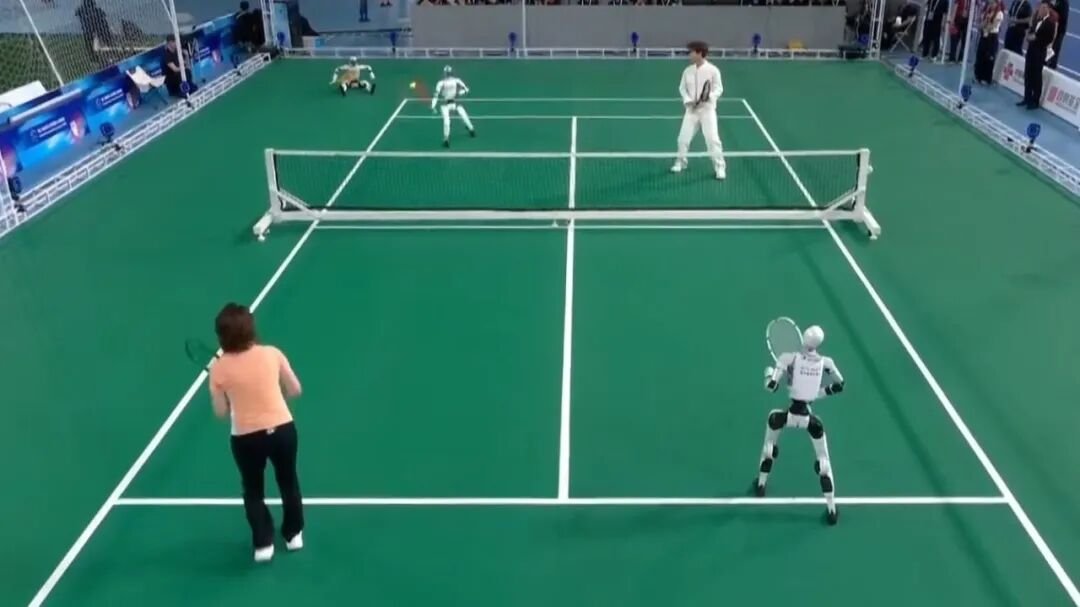
With a human partner it shows tactical awareness and makes on-the-spot decisions. When it falls in a high-speed exchange it gets straight back up.
Judging a player also means judging the opponent. Across the net stood Zheng Jie, a former Grand Slam doubles champion. Against that level, the robot had to complete every movement and still work out how to win the point.
One model for brain, cerebellum and bridge
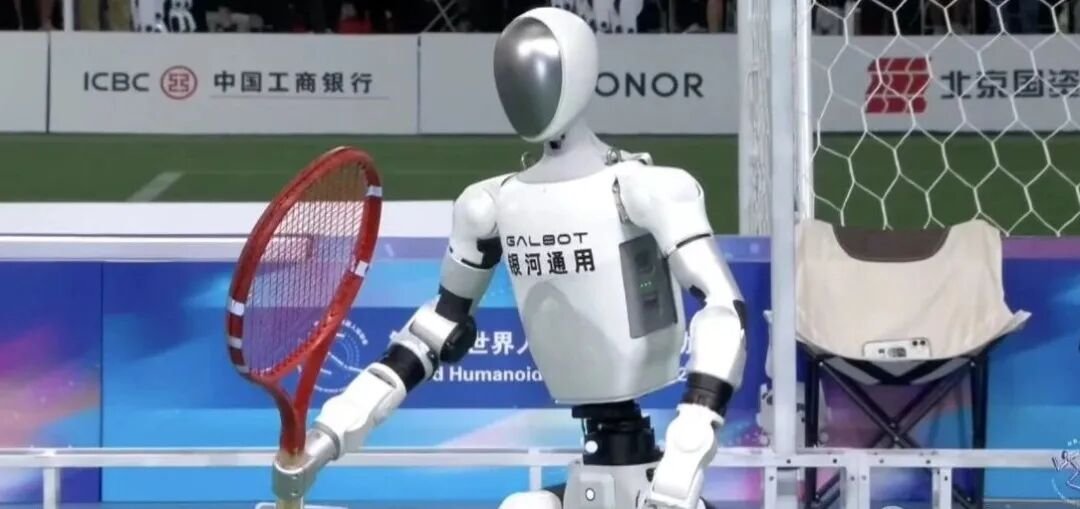
How do you make a robot think while it plays? Galbot’s answer is AstraBrain, an embodied foundation model.
Its defining feature is that it welds several jobs into a single model.
The brain handles understanding and decisions, reading the ball’s landing point, choosing the shot, organising tactics and coordinating with a doubles partner.
The cerebellum handles motion control, keeping the whole body balanced at speed, delivering explosive swings and producing human-like movement.
The pons translates the brain’s decisions into motion commands for the cerebellum.
In the past these three jobs sat in separate modules, each minding its own patch, and the interfaces between them were where things broke. AstraBrain makes them one system. That is the basis for its claim to be the world’s first end-to-end whole-body, whole-hand model integrating brain, cerebellum and neural control.
On court the value shows up at once. When a ball arrives, the brain decides in milliseconds whether it is deep or short and whether to attack or defend, while the cerebellum is already sliding left, crouching and drawing the racket back. At the instant of contact the brain updates its read. That return was not tight enough, so the next shot should press the line.
Only a single architecture can close that real-time loop of thinking while playing.
Readers of our AI coverage may recall that during CVPR 2026 in June we wrote about Galbot’s AstraBrain-WBC 0.5, which pushed zero-shot generalisation in the lab to 92.58 per cent and cut inference latency below 1.5 milliseconds. AstraTennis is the first outing for the same system in real competition.
A strong cerebellum is still only half a robot. Whether brain and cerebellum can work together under real pressure is the true coming-of-age test for embodied intelligence.
Galbot founder and CTO Wang He calls tennis the ultimate exam for a humanoid robot. Whoever can answer on a tennis court has shown they have solved both the cerebellum and the brain.
Learning from imperfect data
Good movement on court takes heavy practice. Humans rehearse repeatedly and copy professionals from video. Robots have traditionally learned actions through teleoperation.
In a game as fast as tennis, humans cannot react in time, so teleoperated data is useless. Recording a full real match with a motion-capture system is expensive to the point of being infeasible.
With the old road blocked, Galbot took another. AstraBrain Latent is described as the world’s first real-time whole-body planning and control algorithm for humanoid robots in tennis rallies. The name is deliberate. Latent means hidden or implicit, and the algorithm’s job is to pull the hidden rules of play out of messy, incomplete human motion data.
One counter-intuitive idea here deserves spelling out.
Everyone in robotics knows that the more professional the motion data, the better. Ideally you want a professional teleoperator’s complete motion, every frame textbook-perfect. Galbot’s team did the opposite. It skipped perfect data and collected scattered basic fragments, ordinary forehands, backhands, lateral slides and crossover steps, then used an algorithm to combine, correct and generalise them into a full set of tennis skills.
The logic is simple. Perfect data is too expensive and too hard to obtain. The imperfect data already holds the core priors of human motion, how weight shifts, how the arm swings, how the foot pushes off. The algorithm supplies the rest.
The idea is worth more than tennis. It means the barrier to robots learning motor skills can fall sharply. There is no need to wait for elite athletes to help with data collection, and no need for costly motion-capture rigs. Real skill can be distilled from data that is merely good enough.
To stop the robot’s motion drifting at high speed, the team added a mechanism called a latent action barrier, which draws a boundary in latent space so that movement stays inside a human-like band while the stance and swing path adjust to each incoming ball.
Random perturbations are injected during training, so the robot gradually learns to correct itself. By that stage it is playing a live ball and improvising.
A virtual tennis world
Tennis is hard enough that data alone is not enough. Galbot holds another card. It built its own virtual tennis world.
That world rests on Galaxy Star Square, Galbot’s in-house embodied intelligence dataset at the ten-billion scale.
Training runs in two steps. First comes massive rehearsal in simulation, where the robot plays, practises and reflects against virtual opponents of different levels. Once it is ready, only a small amount of calibration on the real machine is needed.
The most important step is multi-agent competition.
The conventional route has a robot imitate a human, one action at a time. Galbot lets the robot play itself. Two or more agents compete in simulation, trading shots and working out how to return them, then improving. Over time, abilities that were never explicitly taught emerge on their own.
This is skill emergence, the property the large-model era values most. Past a certain data volume, quantity turns into quality and the robot learns to generalise.
Crucially, skills trained in the virtual world transfer to a real court. That is the fundamental reason the AstraTennis moment could happen on a global livestream rather than stay inside a lab video.
A complete technical chain is now clear. AstraBrain thinks and moves. AstraBrain Latent distils skills from incomplete data. Galaxy Star Square supplies training scenes and opponents. Together they produced the robot that played tennis on court.
The fall
The image that stayed with us from the whole match was the fall.
In a high-speed exchange the robot failed to reach an extreme ball and crashed to the ground. No staff rushed in and nobody called a halt. It stood up quickly on its own and readied for the next ball.
That detail is more striking than any parameter. It shows this was not a lab demonstration. The robot’s motion control is strong enough to recover by itself from an accident in the real world.
Zoom out and the path Galbot has opened, with brain decisions, cerebellum execution and data emergence working as one, offers a reusable paradigm for the whole embodied intelligence industry.
In the past, every new humanoid action meant collecting new data and retraining. A general motion-control base means dance, inspection, rescue and housework can share one body operating system, with marginal cost falling as scale grows.
That capability is already running elsewhere. In smart pharmacies the robot picks a target from tens of thousands of products and hands it to a courier. On industrial lines the two arms of Galbot S1 lift 50-kilogramme loads. Tennis is simply the newest piece of the picture.
From the digital world to the physical one, from a stone on a Go board to a racket swing, AI took a full decade to step out of the screen and onto the floor of human life.
Editor’s note: This is an adapted translation of the original LeiPhone report. It has been trimmed and restructured for readability for an international business audience. The full original (in Chinese) is at https://www.leiphone.com/category/ai/DtuJryomWlykalLZ.html.