On 22 October, Bloomberg reported that Huawei Technologies has obtained a RMB 15 billion offshore syndicated loan, citing people familiar with the matter. The facility runs for seven years, is denominated in offshore renminbi, and was provided by six Chinese banks, including Bank of China, China Construction Bank and Industrial and Commercial Bank of China. Proceeds are for general corporate purposes. Huawei has not disclosed the interest rate or the detailed drawdown schedule.
The deal matters for its dating. It is the first offshore syndicated loan Huawei has taken since 2020, when it raised HK$11.8 billion, equivalent to about RMB 10.06 billion at the time. Before 2019 the company borrowed irregularly in international markets, assembling syndicates of European, American and Asian banks for facilities totalling several billion US dollars.
People cited by Bloomberg said Huawei held preliminary talks with several international banks before settling on a Chinese bank group. That detail is the interesting one. A company that once priced itself against global lenders has chosen a domestic-currency structure arranged entirely by institutions inside its home market.
The balance sheet behind the borrowing
Huawei’s 2026 interim report explains why a cash-rich company would arrange new credit. First-half revenue reached RMB 467.8 billion, up 9.6 per cent year on year. Net profit attributable to owners of the parent came in at RMB 23.4 billion, down 36.8 per cent.
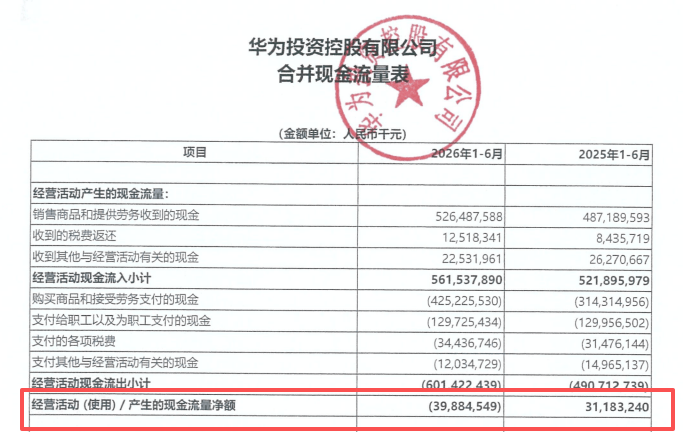
The gap between those two lines is spending. R&D expenses hit RMB 121.4 billion in the first six months, up 25.2 per cent, a rate well ahead of revenue growth. Inventories reached RMB 277.5 billion at the end of June, 42.3 per cent higher than at the end of 2025. With procurement and operating outlays rising, net operating cash flow flipped from an inflow of RMB 31.2 billion in the same period last year to an outflow of RMB 39.9 billion.
For a company of this size, a RMB 15 billion facility is not a rescue. It is working capital with a longer maturity than the operating cycle it is financing.
Where the growth actually is
According to Huawei’s 2025 annual report, China revenue reached RMB 616.2 billion last year, up 0.2 per cent. Europe, the Middle East and Africa brought in RMB 161.4 billion, up 8.8 per cent. Asia Pacific contributed RMB 50.1 billion, up 15.7 per cent, the fastest growth of any region.
The overseas push has continued through 2026. In February Huawei launched the Mate 80 Pro and related devices for international markets in Madrid. In July it held a global flagship launch in Kuala Lumpur for the Pura 90s series. Beyond handsets, Huawei Cloud extended model-as-a-service to nine countries in April, including Singapore, Thailand, Brazil and Saudi Arabia, offering local enterprises access to open models such as DeepSeek and Qwen.
On 18 September, Zhou Yuefeng, a Huawei director and chief executive of Huawei Cloud, set out the overseas commercial timetable for AI infrastructure. The Lingqu Ascend 950 computing cluster service is scheduled to go commercial overseas on 30 November. The enterprise agent platform Zhiguo AgentArts follows on 30 December.
Partnerships are moving in the same direction. On 19 September Huawei signed a cloud strategy agreement with Standard Bank Group, which operates across 21 African countries, covering application modernisation, data and AI, and a jointly built hybrid cloud platform.
What the loan tells an outside reader
Offshore renminbi borrowing from Chinese state banks is a well-worn structure for companies that need foreign-currency-linked funding without leaning on onshore quotas. It is also a structure that keeps pricing inside a relationship network rather than a public market.
The timing is what to watch. A company increasing inventory 42.3 per cent and running a RMB 39.9 billion operating cash outflow while funding data-centre clusters in nine countries needs duration. Seven years buys exactly that, and it buys it in the currency of the customers Huawei is now chasing.
Editor’s note: This is an adapted translation of the original Sohu Tech report. It has been trimmed and restructured for readability for an international business audience. The full original (in Chinese) is at https://www.sohu.com/a/1091744681_115479.