Anyone who has put a window-cleaning robot on glass has thought the same thing. No manufacturer dares print the words never falls, because on a high-rise facade the liability behind those words is not survivable.
What the product sells is not cleaning power. It is the promise that a risk has been transferred to a machine.
Window-cleaning robots are becoming one of the clearer variables in the home robotics market. IDC data puts second-quarter 2026 global shipments at about 847,000 units, up 59.8 per cent year on year, well ahead of the 21.5 per cent growth in the household cleaning robot market overall. AVC data shows the Chinese market growing from RMB 480 million in 2020 to RMB 1.7 billion in 2025, a compound annual growth rate of 28.6 per cent.
Capacity is expanding to match. Ecovacs’ Winbot line ran at a few thousand to twenty thousand units a month in its early years, and since volumes picked up in 2025 monthly capacity has moved from the 100,000 level into the 200,000 level. Global window-cleaning shipments reached about 2.373 million units in 2025, up 70.4 per cent, and the industry expects to pass 3 million units in 2026.
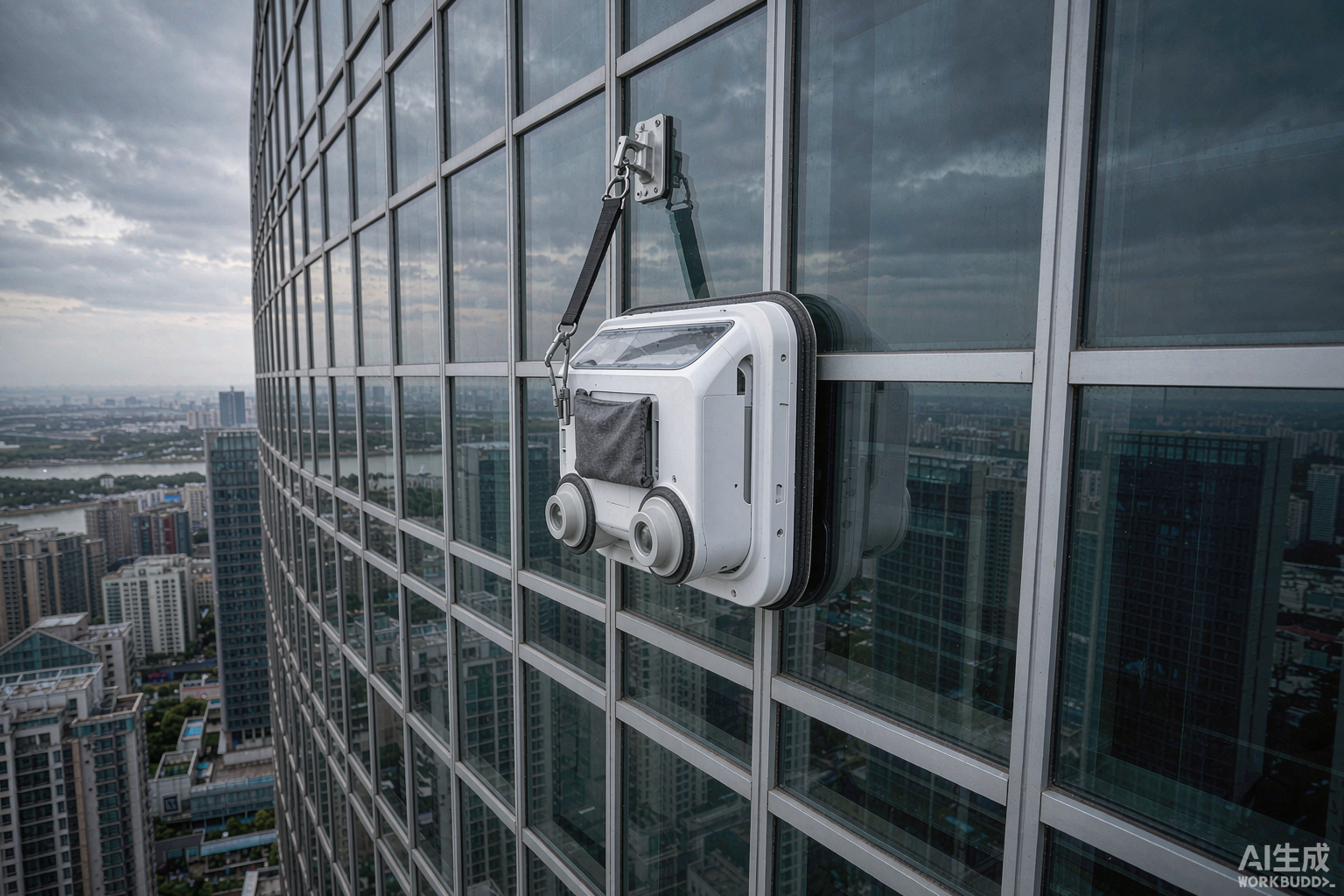
A small category with an unusually sharp failure mode
Cleaning windows is the household task least suited to doing by hand. It is infrequent but necessary, simple but dangerous. High-rise flats, large floor-to-ceiling glazing and sealed exterior panes have long been cleaning blind spots, and the only traditional options were leaning out or paying someone.
A robot vacuum solves a task you can do but do not want to. A window robot solves a task you cannot safely do yourself. The difference is in the consequence. Missing a corner with a vacuum is an experience problem. Misjudging a window edge with a cleaning robot is a safety problem.
Scale amplifies both sides. When monthly output jumps from twenty thousand to two hundred thousand, any component variability gets multiplied by a million units. Consumers want the machine to absorb the risk, and in practice they still tie a safety rope, check the glass condition and watch it run. Long-run tests by overseas review outlets find these products handle dust and routine maintenance and struggle with stubborn marks, with most scenarios still requiring a person to place, move and supervise the unit.
The complaints are familiar: corners left dirty, noise, and a form factor that only suits large flat panes. Basic experience has improved a lot in a few years, but edge blind spots, stubborn stains and the need for supervision remain common across brands.
For a machine working on the fourteenth floor, a millimetre of blind spot is a difference in how controllable the product feels.
Why the first edition sets a low bar
On 13 October, QB/T 8242-2026, the first industry standard for window-cleaning robots, was published for implementation on 1 December. The China Household Electrical Appliances Research Institute led the work, with Ecovacs participating as an OEM and Shanxi Jiashida, Beijing Hite and several testing bodies alongside.
The standard covers operational protection, cleaning performance, test methods, inspection rules, marking and instructions. It defines vertical flat glass, glass with sealed frames, glass with non-sealed frames and frameless glass, and fixes the meaning of safety unit, cleanliness level and cleaning cycle.
Its first job was nomenclature. Before 2026, brands used their own language for suction failure, abnormal operation, power loss, jamming and obstacle crossing. A standard translates brand language into a shared test method, which is what turns trust into a measurable number.
The thresholds are concrete: overall cleanliness of at least 70 per cent, edge and corner cleanliness of at least 65 per cent, and running durability of at least 200 hours.
They are also deliberately modest. Li Xiaohua, who leads the Winbot product line at Ecovacs, said the company’s internal test regime covers far more scenarios than the industry standard, and that applying all of it to a first edition would have left very few compliant products on the market.
That is a conscious trade. Under the current mechanism a published standard cannot be adjusted for two to three years, and a revision takes about a year from initiation to implementation, so this framework will run unchanged for three to four years. The first edition completes the step from zero to one on safety and cleaning performance and leaves performance leadership to company standards.
Where the real differences remain
The gap between compliant and good shows up in awkward windows. Standard test conditions use flat glass. Shaped windows, narrow windows and panes with obstacles are the dividing line. A compliant robot that jams, skips a patch or leaves streaks in a real home still needs a person, and the word compliant stops being useful.
This is the tension between industry and company standards, and it is also where the leaders separate from the pack. Ecovacs started development in 2011 and shipped its first Winbot in 2013. Its earlier robot vacuum business contributed the bumper and ball-joint detection at the front of the window unit and the cloth cleaning method, while the engineering work on vertical suction and edge detection fed back into the company’s sensor and path planning capability.
That base-technology transfer explains why Winbot iterates faster than the category, and it points to the next step: the perception upgrade and cleaning structure evolution that the vacuum line already went through will probably be repeated here. The roadmap runs from a base station that completes the whole cycle, to automatic cloth cleaning that reduces user intervention. The base station products that landed between late 2023 and 2024 combined power supply with the safety rope and added a built-in battery for low-power situations, which the company treats as the turning point.
Market position behind the standard
AVC data shows Ecovacs accounted for more than 60 per cent of Chinese window-cleaning robot sales in 2025, holding the largest share for five consecutive years, including 62.3 per cent in the first quarter of that year. In the first quarter of 2026 it held 96.5 per cent of the online premium segment above RMB 2,000.
IDC puts global shipments at about 1.195 million units in 2025 for a 50.30 per cent share, and 1.075 million units in the first half of 2026 for 57.60 per cent, ranking first worldwide.
The standard’s first task was fixing definitions for suction failure, jamming and obstacle crossing, terms every brand previously used differently. Safety suction depends on the fan, seals, air replenishment efficiency, structural rigidity and sensor coordination working together. The upper and lower bounds of fan replenishment, and the rebound consistency of sealing foam as it ages, are the kind of variables that decide whether a unit holds on a real pane. Competition in this category ends up in manufacturing, which is precisely what a published standard starts to formalise.
Editor’s note: This is an adapted translation of the original Leiphone report. It has been trimmed and restructured for readability for an international business audience. The full original (in Chinese) is at https://www.leiphone.com/category/smarthome/iDkOEQuhDC14QfOE.html.