China’s intellectual property office published a design patent on 9 October with an unusually plain product name: embodied intelligent robot. The holder was BYD. The grant itself had issued on 6 October, four days earlier, under registration number CN310247768S.
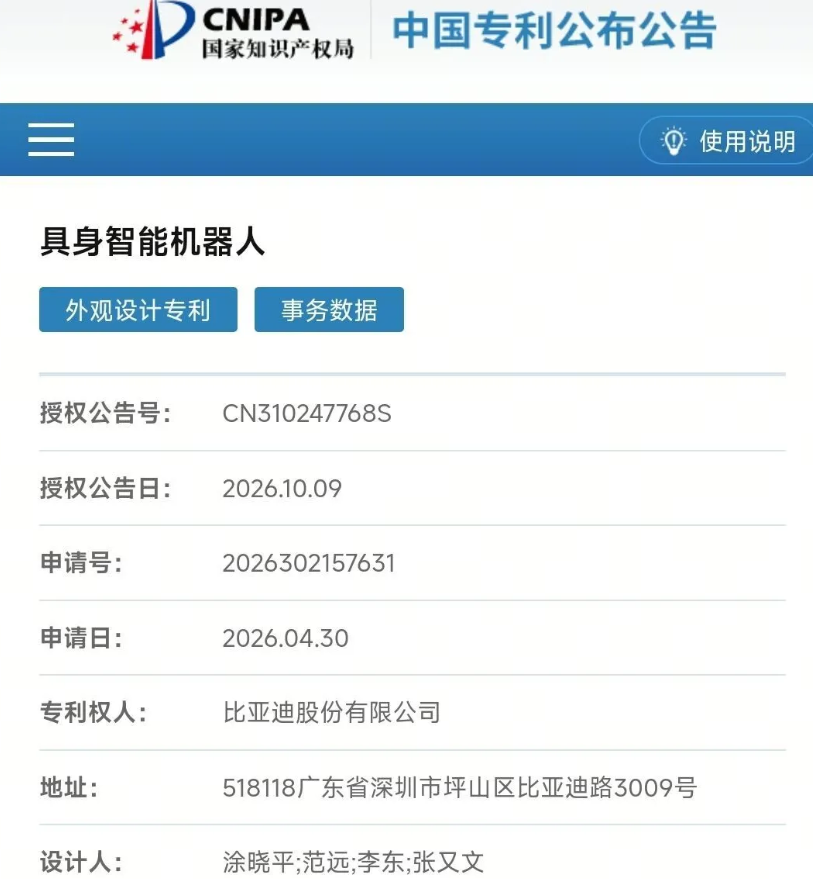
This is the first time the carmaker’s own humanoid has been shown in official filings. The drawings are eight in total, covering front, rear, top, bottom and perspective views.
What the drawings show
The body is a two-tone black and white shell. The head is a single continuous curved surface with no protruding display and no anthropomorphic eyes or mouth. Joints are visible throughout the torso, arms and legs, with black spherical or hinged components at the shoulders, elbows, hips and knees, wrapped in white casing. The aesthetic is industrial engineering rather than companion robot.
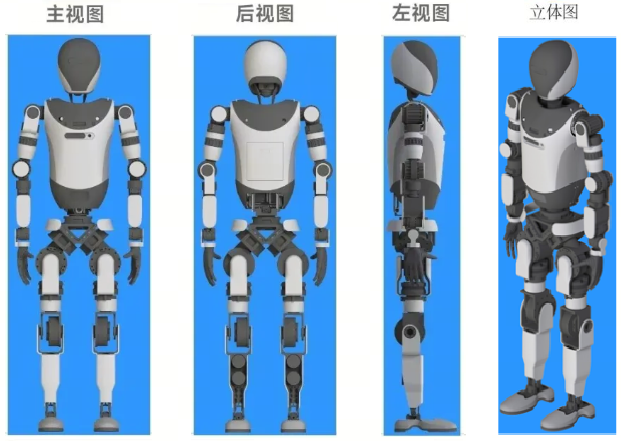
The stated use is deliberately narrow: a robot with walking, balancing and interaction functions, for service, education or industrial settings.
The silhouette matches a teaser BYD executive vice-president He Zhiqi posted on 28 July, captioned with the line that the company’s assistant had become a robot. The filing was lodged on 30 April and granted on 6 October, a five-and-a-half-month turnaround that is fast for any jurisdiction.
The specification sheet is the interesting part
BYD has already disclosed most of the numbers. The robot stands 1.61 m and weighs 58.5 kg, with 31 degrees of freedom. Its dexterous hands hold repeat positioning accuracy of plus or minus 1 mm, enough to grasp objects, hold gestures and point at things while explaining them.
Core components are 80 per cent self-developed. Parts commonality across the bill of materials exceeds 60 per cent. The robot reuses servo motors from FinDreams Powertrain, Blade battery cells and battery management, and the 360-degree surround-view algorithms developed by BYD’s driver-assistance team. It runs BYD RobotOS 1.0 with end-to-end control latency under 50 ms.
The cost target, disclosed separately, is under RMB 200,000 per unit.
It is not a paper robot
BYD put the machine in front of the public in August at a Di Space showroom in Zhengzhou, where it now works as a greeter on a regular schedule. The company has said the launch sequence runs from an August reveal to showroom duty first, with wider deployment later.
Reading the filing correctly
A design patent protects what a product looks like. It says nothing about what the product can do. Publication therefore amounts to an identity photograph, not a capability claim.
What it does establish is intent and speed. A carmaker with 80 per cent component self-sufficiency, its own motors, cells and vision stack, and a 60 per cent commonality target can move a humanoid from sketch to granted design rights in five and a half months. The RMB 200,000 cost target is the number that matters for deployment. It is roughly a fifth of what comparable research platforms cost two years ago, and it lands the machine in the price band where a car dealership, a showroom or a factory gate can justify one.
Editor’s note: This is an adapted translation of the original OFweek report. It has been trimmed and restructured for readability for an international business audience. The full original (in Chinese) is at https://robot.ofweek.com/2026-10/ART-8321206-8110-30706243.html.