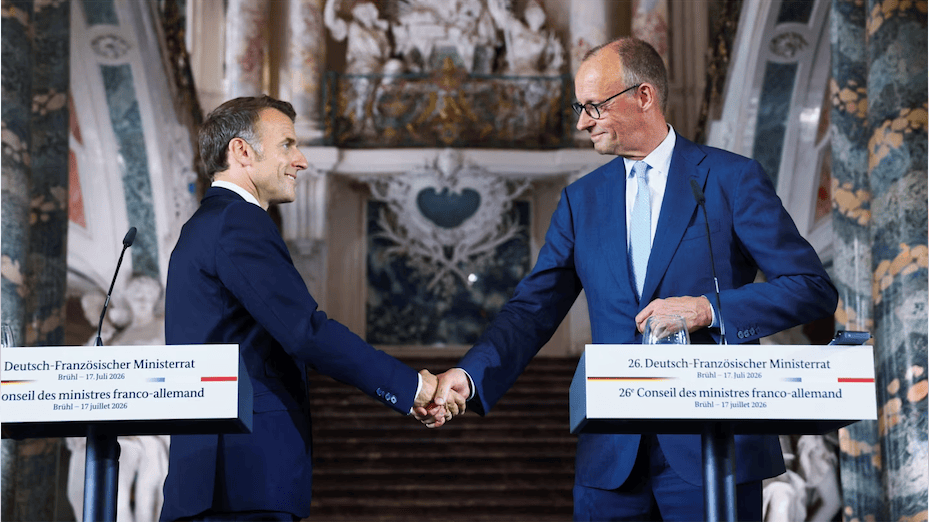
On 19 October the Financial Times ran a commentary that did not bother with diplomatic language. It argued that the car-industry agreement just struck between Paris and Berlin, which stretches the life of the internal combustion engine and shields the legacy car industry, risks pushing the European car industry towards self-destruction.
Why neither government can let go
The numbers explain the paralysis. German car manufacturing generates close to 4 per cent of GDP. Cars and components account for roughly 17 per cent of the country’s goods exports. In 2025 the sector directly employed 732,000 people. It is not one industry among many, it is the load-bearing wall of German exports, employment and industrial output.
France is smaller but no less exposed. The car supply chain is only 1.1 per cent of GDP, yet its industrial segment produces about 11 per cent of manufacturing value added and directly supports 329,000 jobs. Between 2010 and 2023, employment across the French car chain fell 33 per cent.
Both governments can read the same forecast. Germany’s VDA expects the car industry to shed a cumulative 225,000 jobs by 2035 against 2019 levels.
They did try electric. The clock did not agree.
Volkswagen, Porsche, BMW and Mercedes all committed large sums to electrification. What they could not match was the cadence of the Chinese industry. German product planning assumes a lifecycle of seven to eight years. Chinese new-energy models refresh configurations and upgrade technology inside a year, sometimes inside six months. By the time one German generation reaches mid-cycle, several Chinese start-ups have already lived and died.
That cadence is brutal on buyers. Chinese owners joke about being the test mice. It does, however, accumulate engineering knowledge at a speed the German system cannot reproduce, and it drags regulation along behind it.
The common Chinese phrase is overtaking on the curve. That metaphor is wrong. The Chinese industry never leaves the track. The German industry pits every lap, checks the tyres, and rejoins.
The electric bill has already arrived
Porsche is the clearest exhibit. Taycan deliveries fell 40.2 per cent in 2025 to 13,578 units. Group operating profit collapsed from EUR 5.637 billion to EUR 413 million, and the operating return on sales fell from 14.1 per cent to 1.1 per cent.
Berlin still holds genuine advantages in engines, transmissions and mechanical engineering, accumulated over a century. Electrification inverts that advantage. Mercedes had high-profile battery fires. Porsche’s move into electric cars diluted the brand’s positioning rather than extending it.
The French problem is political, not technical
Changing the drivetrain looks simple from Beijing. In France it reads as removing the livelihood of every car worker. French unions are strong enough that any decision reducing headcount produces social instability.
German unions are not passive either. They hold half the seats on Volkswagen’s supervisory board, and in 2024 they negotiated a guarantee against compulsory redundancies for operational reasons through the end of 2030.
Countries with smaller car industries carry far less of this weight. Norway and the Netherlands moved early. Britain, once a car-making power, sold most of its brands and now faces much less resistance to electrification.
The market is already voting
European battery-electric registrations rose 70.3 per cent year on year in September. Consumers are switching faster than the policy calendar in Paris and Berlin. Two governments are spending political capital to buy the combustion engine a few more years, in a market that is already walking away from it.
Editor’s note: This is an adapted translation of the original Sohu Auto report. It has been trimmed and restructured for readability for an international business audience. The full original (in Chinese) is at https://www.sohu.com/a/1089905892_140060.